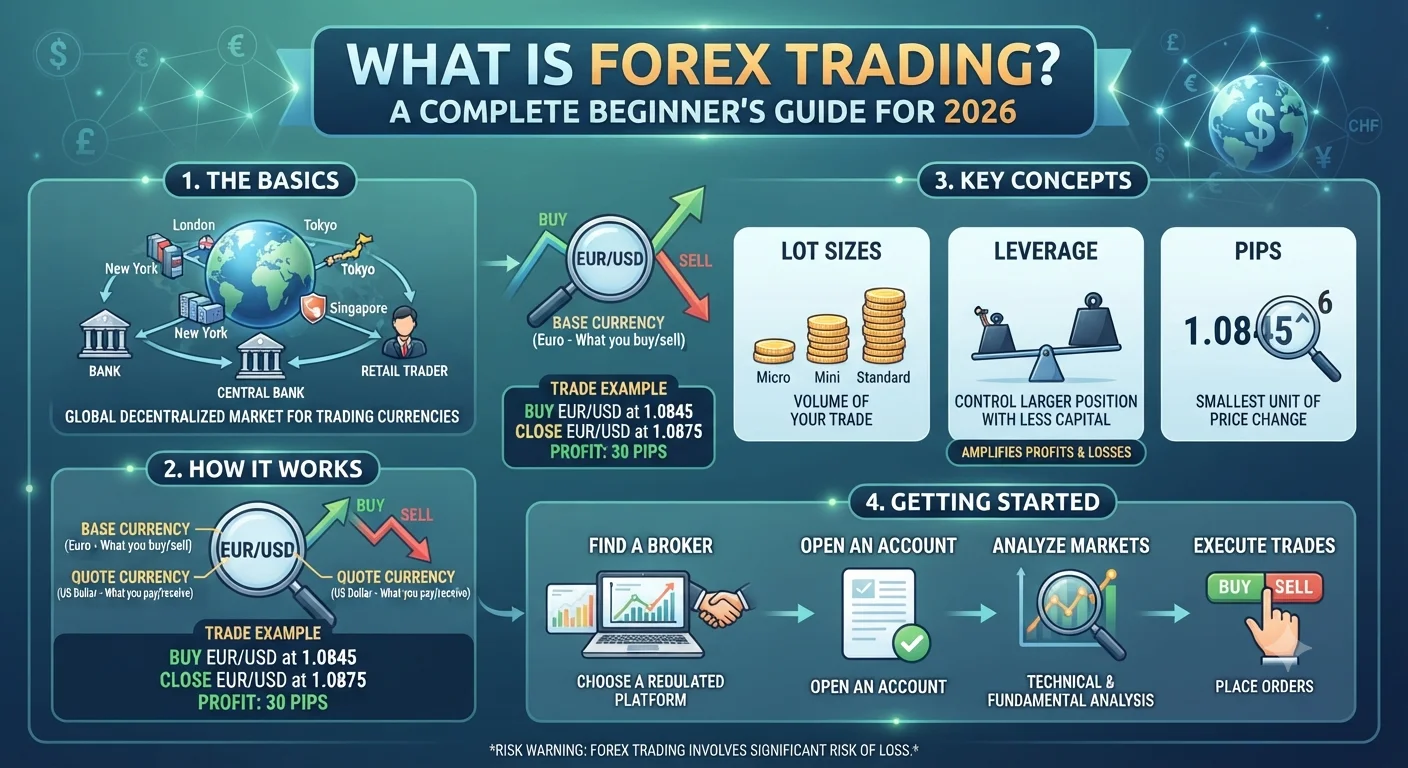
Quick Answer: What Is Forex Trading?
Forex trading, short for foreign exchange trading, is the process of buying one currency while simultaneously selling another. It is the largest financial market in the world, with the Bank for International Settlements (BIS) reporting a daily trading volume of approximately $7.5 trillion as of 2022. Currencies are always traded in pairs, such as EUR/USD or GBP/JPY, and traders profit from changes in exchange rates between those pairs.
Introduction
- Quick Answer: What Is Forex Trading?
- Introduction
- How the Global Forex Market Works
- Who Participates in the Forex Market?
- Major Currency Pairs Explained
- The Role of Central Banks in Forex Markets
- Key Forex Terminology Every Beginner Must Know
- What Are Pips, Lots, and Leverage?
- What Is a Bid-Ask Spread in Forex?
- How to Start Forex Trading as a Beginner in 2026
- Step 1: Educate Yourself Before You Trade
- Step 2: Choose a Regulated Forex Broker
- Step 3: Open and Practice on a Demo Account
- Step 4: Develop a Trading Plan
- Step 5: Start Small With Real Money
- Risks of Forex Trading: What Every Trader Must Understand
- Key Takeaways
- Frequently Asked Questions
Every time a business in Germany pays a supplier in the United States, every time a tourist exchanges euros for Japanese yen at an airport, and every time a central bank intervenes to stabilize its national currency, a forex transaction takes place. Most of us participate in the foreign exchange market without ever realizing it.
For traders and investors, however, the forex market represents something far more deliberate: a 24-hour, five-day-a-week marketplace where currencies are bought and sold with the goal of generating profit. Understanding what forex trading is, how the market works, and what separates successful traders from those who lose money is the essential first step for anyone considering entering this space.
This guide explains everything you need to know as a beginner in 2026, from market structure and terminology to practical steps for getting started.
How the Global Forex Market Works
The foreign exchange market is not located in a single building or governed by a single exchange. Unlike the New York Stock Exchange, which has a centralized trading floor, the forex market is a decentralized, over-the-counter (OTC) market. This means transactions occur directly between parties through a global network of banks, financial institutions, brokers, and electronic trading platforms.
According to the Bank for International Settlements Triennial Central Bank Survey, the forex market processes approximately $7.5 trillion in daily transactions, making it roughly 25 times larger than the global stock market. This extraordinary size creates deep liquidity, meaning traders can buy and sell large amounts of currency with minimal price disruption.
The market operates across four major trading sessions, each tied to a financial capital of the world: Sydney, Tokyo, London, and New York. These sessions overlap at certain hours, creating windows of especially high trading activity and price movement. The London session, which runs from approximately 8:00 AM to 5:00 PM GMT, is the most active, accounting for roughly 38 percent of all daily forex transactions according to the BIS.
Who Participates in the Forex Market?
The forex market is structured in layers, and understanding who the participants are helps explain how currency prices are set.
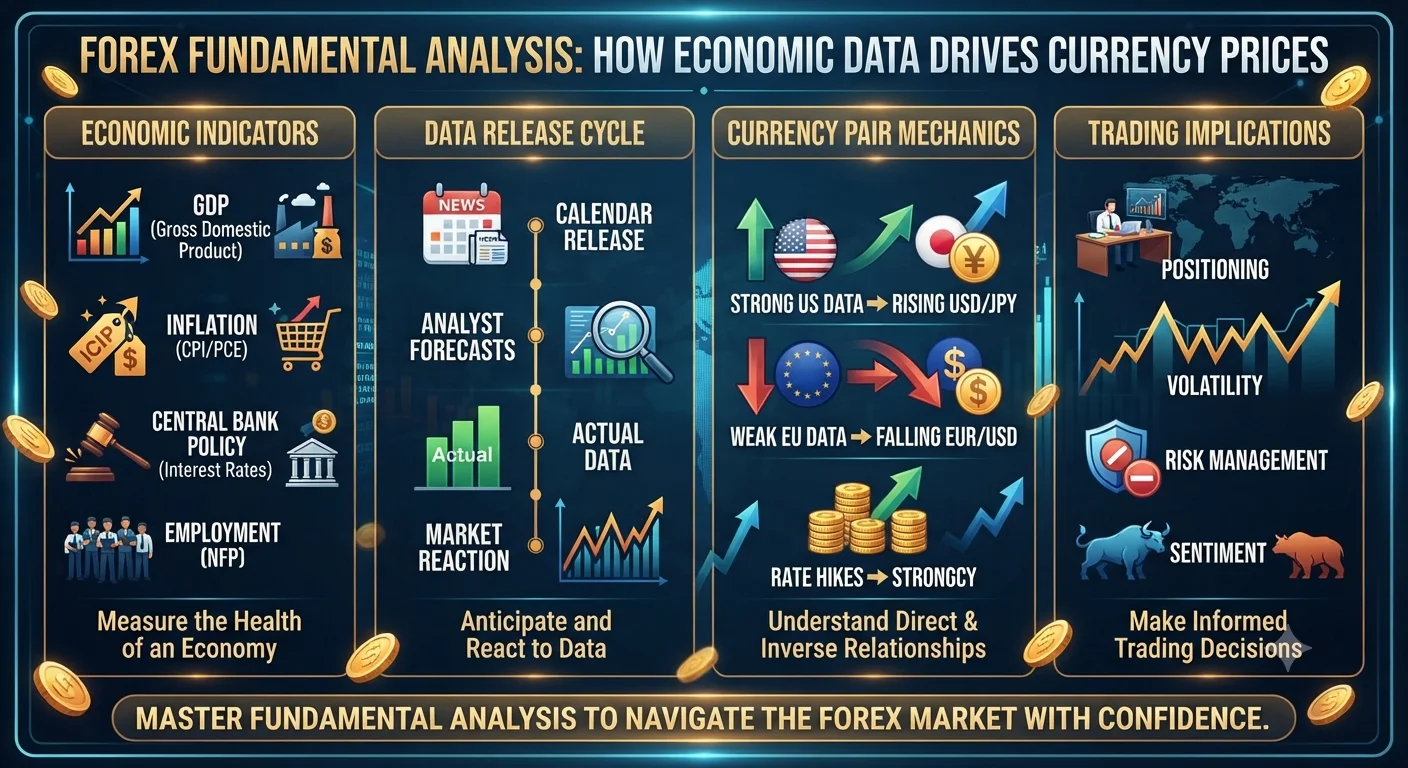
At the top of the hierarchy sit central banks, including the Federal Reserve (the Fed) in the United States, the European Central Bank (ECB), the Bank of Japan (BOJ), and the Bank of England (BOE). Central banks influence currency values through interest rate policy, quantitative easing programs, and direct market interventions. When the Fed raises interest rates, for example, the US dollar (USD) typically strengthens because higher rates attract foreign capital seeking better returns.
Below central banks are the major commercial and investment banks, including institutions like JPMorgan Chase, Deutsche Bank, Citibank, and UBS. These banks conduct enormous volumes of currency transactions on behalf of corporations, governments, and their own trading operations. This interbank market determines the benchmark exchange rates that filter down to retail traders.
Corporations make up another significant layer. A multinational company like Apple, which earns revenue in dozens of currencies, must regularly convert those currencies back into US dollars. These hedging and conversion activities represent a substantial portion of daily forex volume.
At the retail level sit individual traders like you, accessing the market through regulated brokers who provide trading platforms, leverage, and market access. While retail traders represent a small fraction of total market volume, the accessibility of online trading has grown this segment significantly over the past two decades.
Major Currency Pairs Explained
Currencies in forex are always quoted in pairs because buying one currency means selling another simultaneously. Each pair has a base currency (the first) and a quote currency (the second). The exchange rate tells you how much of the quote currency is needed to buy one unit of the base currency.
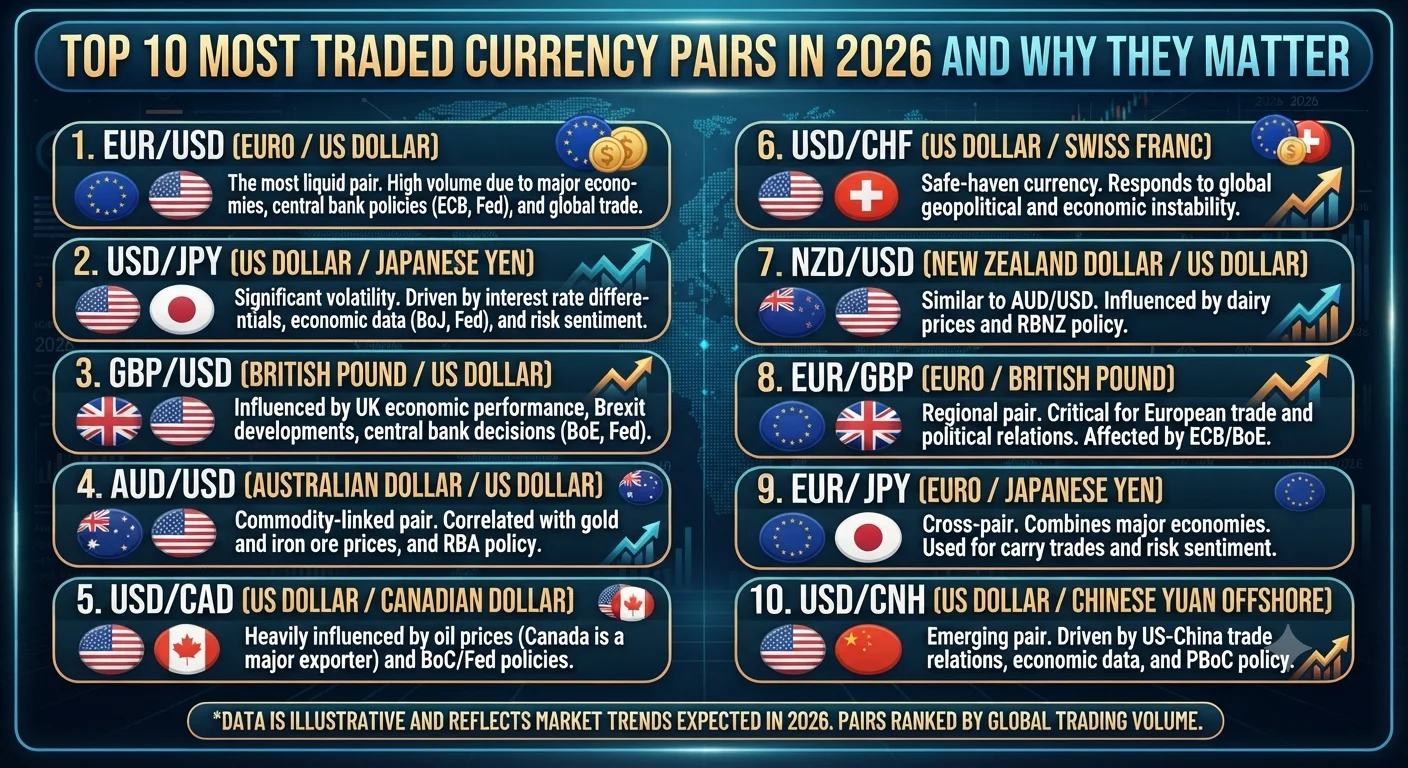
The most traded currency pairs, known as the major pairs, all include the US dollar on one side and consistently account for the largest share of daily trading volume:
| Currency Pair | Nickname | Countries Involved |
|---|---|---|
| EUR/USD | The Euro | Eurozone vs United States |
| USD/JPY | The Gopher | United States vs Japan |
| GBP/USD | Cable | United Kingdom vs United States |
| USD/CHF | The Swissie | United States vs Switzerland |
| AUD/USD | The Aussie | Australia vs United States |
| NZD/USD | The Kiwi | New Zealand vs United States |
| USD/CAD | The Loonie | United States vs Canada |
The EUR/USD pair is the single most traded currency pair in the world, representing approximately 22 percent of total daily forex turnover according to BIS data. Its high liquidity means tight spreads and ample trading opportunities for traders at all skill levels.
The Role of Central Banks in Forex Markets
Central banks are the most powerful force in the foreign exchange market. Their primary tool for influencing currencies is monetary policy, specifically the setting of benchmark interest rates.
When a central bank raises interest rates, it makes holding that currency more attractive to international investors seeking higher yields. This increased demand strengthens the currency. Conversely, when a central bank cuts rates, the currency typically weakens as capital flows toward higher-yielding alternatives.
Beyond interest rates, central banks also conduct quantitative easing (QE), which involves purchasing government bonds and other assets to inject money into the financial system. QE programs tend to weaken a currency because they increase the money supply. The Federal Reserve's QE programs following the 2008 financial crisis and again in 2020 had measurable effects on the USD's relative value against other major currencies.
Central banks also sometimes intervene directly in the forex market, buying or selling their own currency to prevent excessive volatility or maintain a target exchange rate range. The Bank of Japan, for example, has historically intervened to prevent excessive strengthening of the yen, which damages Japan's export-dependent economy.
Key Forex Terminology Every Beginner Must Know
Before placing your first trade, you must understand the core vocabulary of the forex market. These terms appear in every trading platform, every analysis article, and every broker agreement you will encounter.
What Are Pips, Lots, and Leverage?
A pip (percentage in point) is the smallest standardized price movement in a currency pair. For most major pairs, one pip equals a movement of 0.0001 in the exchange rate. For example, if EUR/USD moves from 1.0850 to 1.0851, that is a one-pip movement. For pairs involving the Japanese yen (USD/JPY, EUR/JPY), a pip equals 0.01 because yen pairs are quoted to only two decimal places.
Understanding pips is essential because all profit and loss calculations in forex are denominated in pips before being converted to your account currency.
A lot defines the size of a forex trade. The standard measurement units are:
- Standard Lot: 100,000 units of the base currency
- Mini Lot: 10,000 units of the base currency
- Micro Lot: 1,000 units of the base currency
- Nano Lot: 100 units of the base currency (offered by some brokers)
For a standard lot of EUR/USD, each one-pip movement is worth approximately $10. For a micro lot, each pip is worth approximately $0.10. Lot size selection directly determines both your potential profit and your risk per trade.
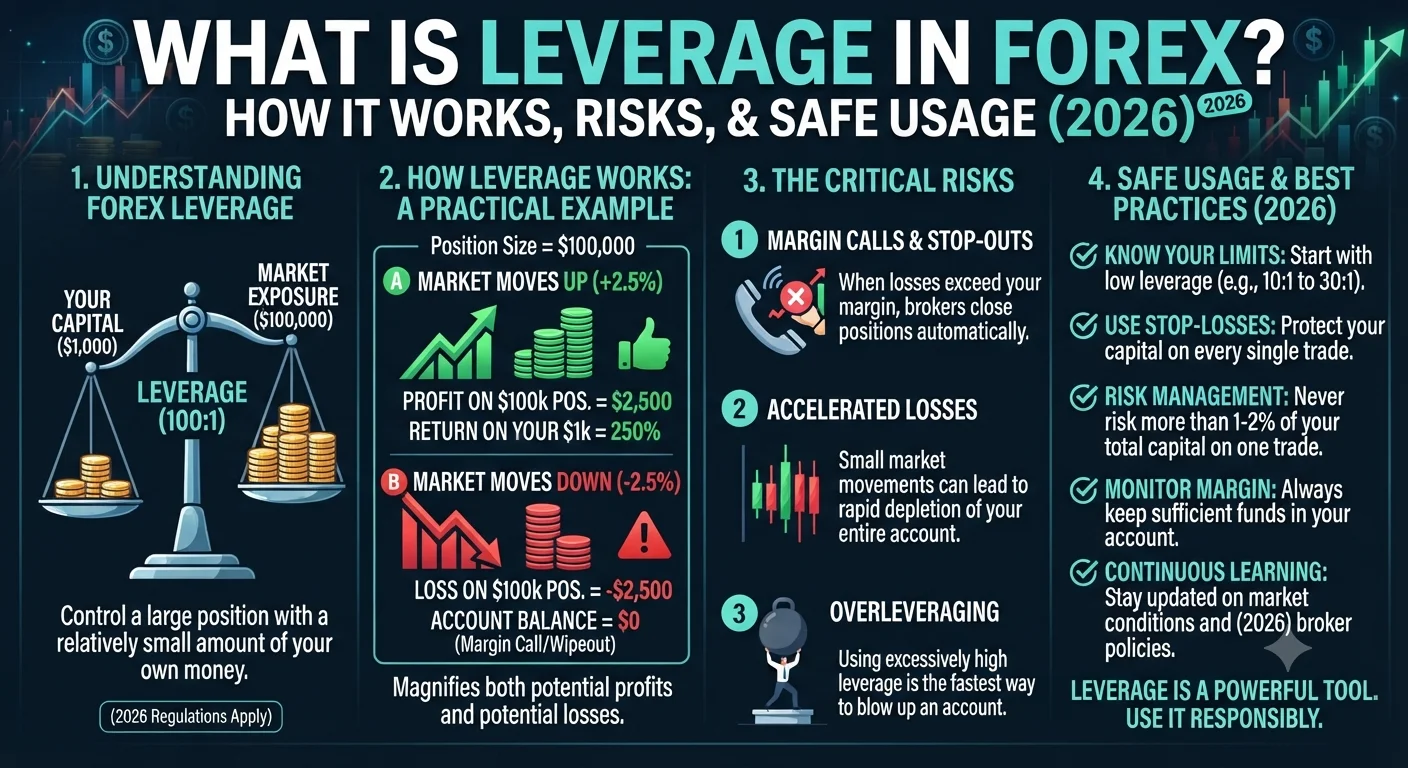
Leverage is one of the most important and most misunderstood concepts in forex trading. It allows traders to control a position much larger than their actual account balance. A leverage ratio of 1:100, for example, means that for every $1 in your account, you can control $100 in the market.
Leverage amplifies both gains and losses equally. While it allows small accounts to participate meaningfully in the market, it also means that a relatively small adverse price movement can wipe out your entire trading capital. Regulatory bodies in the European Union limit retail leverage to 1:30 for major pairs. In the United States, the Commodity Futures Trading Commission (CFTC) limits retail forex leverage to 1:50. Some offshore jurisdictions offer much higher leverage, but these come with substantially greater risk.
What Is a Bid-Ask Spread in Forex?
Every currency pair is quoted with two prices: the bid (the price at which you can sell the base currency) and the ask (the price at which you can buy the base currency). The difference between these two prices is the spread, and it represents the primary cost of every forex transaction.
Recommended Articles
 FOREX TRADING BASICS
 FOREX TRADING BASICS
 FOREX TRADING BASICS
 FOREX TRADING BASICS
For example, if EUR/USD is quoted as 1.08500 / 1.08510, the spread is 1.0 pip. Your position begins at a small loss equal to the spread, which means the market must move in your favor by at least the spread amount before you become profitable.
Spreads vary based on the currency pair, time of day, and market conditions. Major pairs like EUR/USD typically carry the tightest spreads, often 0.5 to 1.5 pips with competitive brokers. Exotic pairs involving emerging market currencies can carry spreads of 10 pips or more. During major news events, spreads can widen dramatically as liquidity temporarily reduces.
How to Start Forex Trading as a Beginner in 2026
Starting forex trading requires a structured approach. Jumping into live markets without education, practice, and proper setup is one of the most common reasons new traders lose money quickly.
Step 1: Educate Yourself Before You Trade
The forex market rewards preparation. Before funding any account, invest significant time learning market structure, reading price charts, understanding economic indicators, and studying trading strategies. The information is freely available through educational resources, central bank publications, and regulated brokers' learning centers.
Step 2: Choose a Regulated Forex Broker
This is arguably the most critical decision a new trader makes. A regulated broker operates under the oversight of a recognized financial authority, which means your funds are held in segregated accounts, the broker follows capital adequacy requirements, and you have recourse if problems arise.
Key regulatory authorities to look for include:
- Financial Conduct Authority (FCA) in the United Kingdom
- Commodity Futures Trading Commission (CFTC) and National Futures Association (NFA) in the United States
- Australian Securities and Investments Commission (ASIC) in Australia
- Cyprus Securities and Exchange Commission (CySEC) in the European Union
- Financial Services Authority (FSA) in Japan
When evaluating brokers, consider the minimum deposit requirement, available trading platforms (MetaTrader 4, MetaTrader 5, cTrader), spread and commission structure, customer support quality, and educational resources.
Step 3: Open and Practice on a Demo Account
Every legitimate broker offers a demo account that simulates real market conditions using virtual money. A demo account gives you the opportunity to learn how to use the trading platform, test strategies without financial risk, and develop the emotional discipline that live trading demands.
Most professionals recommend spending a minimum of three to six months on a demo account before trading with real money. This timeline allows you to evaluate your strategy across different market conditions, including trending markets, ranging markets, and high-volatility news events.
Step 4: Develop a Trading Plan
A trading plan is a written document that defines your strategy, risk tolerance, trading hours, currency pairs, position sizing rules, and performance review process. Trading without a plan is equivalent to driving in an unfamiliar city without a map.
Your plan should answer:
- What currency pairs will you trade and why?
- What time frame will you analyze and trade?
- What is your entry signal?
- Where will your stop-loss be placed on every trade?
- What is your risk per trade as a percentage of your total capital?
- What are your daily and weekly maximum loss limits?
Step 5: Start Small With Real Money
When you move to a live account, start with the smallest possible lot sizes. Many traders begin with micro lots, which limit the financial impact of early mistakes while still providing the psychological experience of real trading. As your consistency and confidence grow, you can gradually increase your position sizes.
Risks of Forex Trading: What Every Trader Must Understand
Forex trading carries substantial financial risk, and no educational guide would be complete without an honest discussion of those risks.
According to data published by various European regulators under MiFID II disclosure requirements, between 60 and 80 percent of retail CFD and forex trading accounts lose money. This is not because the market is rigged but because most retail traders enter without adequate education, risk management discipline, or realistic expectations.
The primary risks in forex trading include:
Leverage risk is the most significant amplifier of losses. A 1:100 leverage ratio means a 1 percent adverse move against your position wipes out 100 percent of the margin you committed to that trade. Many traders who blow their accounts do so not because the market moved far against them but because they used excessive leverage.
Market risk exists because currency prices are influenced by an enormous range of factors, including central bank decisions, economic data releases, geopolitical events, and large institutional order flow. Even well-researched positions can be reversed by unexpected news.
Psychological risk is perhaps the least discussed but most impactful risk for retail traders. Fear, greed, overconfidence, and revenge trading lead to poor decisions that technical skill alone cannot overcome. Developing emotional discipline requires consistent self-awareness and a rules-based approach to every trading decision.
Counterparty risk arises if you are trading with an unregulated or poorly regulated broker. Always verify a broker's regulatory status before depositing funds.
Key Takeaways
- Forex trading is the process of buying and selling currencies in the world's largest financial market, with $7.5 trillion in daily volume according to the Bank for International Settlements.
- The market operates 24 hours a day, five days a week, across four major trading sessions centered in Sydney, Tokyo, London, and New York.
- Central banks, commercial banks, corporations, and retail traders all participate, with central bank policy being the most powerful driver of long-term currency trends.
- Essential concepts include currency pairs, pips, lots, leverage, and bid-ask spreads.
- New traders should begin with education and a demo account before committing real capital.
- Risk management, not trading strategy alone, is the primary determinant of long-term success or failure in forex.
Frequently Asked Questions
What is forex trading in simple terms? Forex trading is the buying and selling of currencies with the goal of profiting from changes in their exchange rates. When you believe the euro will rise against the US dollar, you buy EUR/USD. If the price rises, you sell at a higher rate and keep the difference as profit.
How much money do I need to start forex trading? Many brokers allow you to open a live account with as little as $50 to $100. However, starting with a very small account significantly limits your ability to manage risk properly. Most professional educators recommend beginning with at least $500 to $1,000 to allow for sensible position sizing with micro or mini lots.
Is forex trading legal? Yes, forex trading is legal in most countries around the world when conducted through a properly regulated broker. The legal status and regulatory framework vary by country. In the United States, retail forex trading is regulated by the CFTC and NFA. In the United Kingdom, the FCA oversees forex brokers. Always verify that your broker holds the appropriate license for your country of residence.
How does forex trading make money? Traders make money in forex by correctly predicting which direction a currency pair's price will move. If you buy EUR/USD at 1.0850 and the price rises to 1.0900, you have gained 50 pips. The monetary value of that gain depends on your lot size. Conversely, if the price falls to 1.0800, you lose 50 pips.
What is the best currency pair for beginners? The EUR/USD is widely recommended for beginners because it offers the highest liquidity, tightest spreads, and the most available analysis and educational content. Its price behavior tends to be more predictable during major economic releases, making it a suitable starting point for learning technical and fundamental analysis.
Can forex trading make you rich? Forex trading can generate meaningful income, but the idea of becoming rich quickly is a misconception that leads many beginners to take excessive risks and lose their capital. Successful forex trading requires time, education, consistent discipline, and realistic expectations. Many professional traders aim for consistent monthly returns in the range of 3 to 10 percent with proper risk management, not overnight wealth.
What is the safest way to trade forex? The safest approach to forex trading combines working with a regulated broker, using low leverage, risking no more than one to two percent of your account on any single trade, using stop-loss orders on every position, and continuing to educate yourself over time. No approach eliminates risk entirely, but these practices significantly reduce the probability of catastrophic losses.
RISK DISCLAIMER: Forex trading involves substantial risk of loss and is not appropriate for all investors. The high degree of leverage available in forex trading can work against you as well as for you. Before deciding to trade, you should carefully consider your investment objectives, level of experience, and risk appetite. This article is for educational purposes only and does not constitute financial advice.