Quick Answer: What Is the Stock Market?
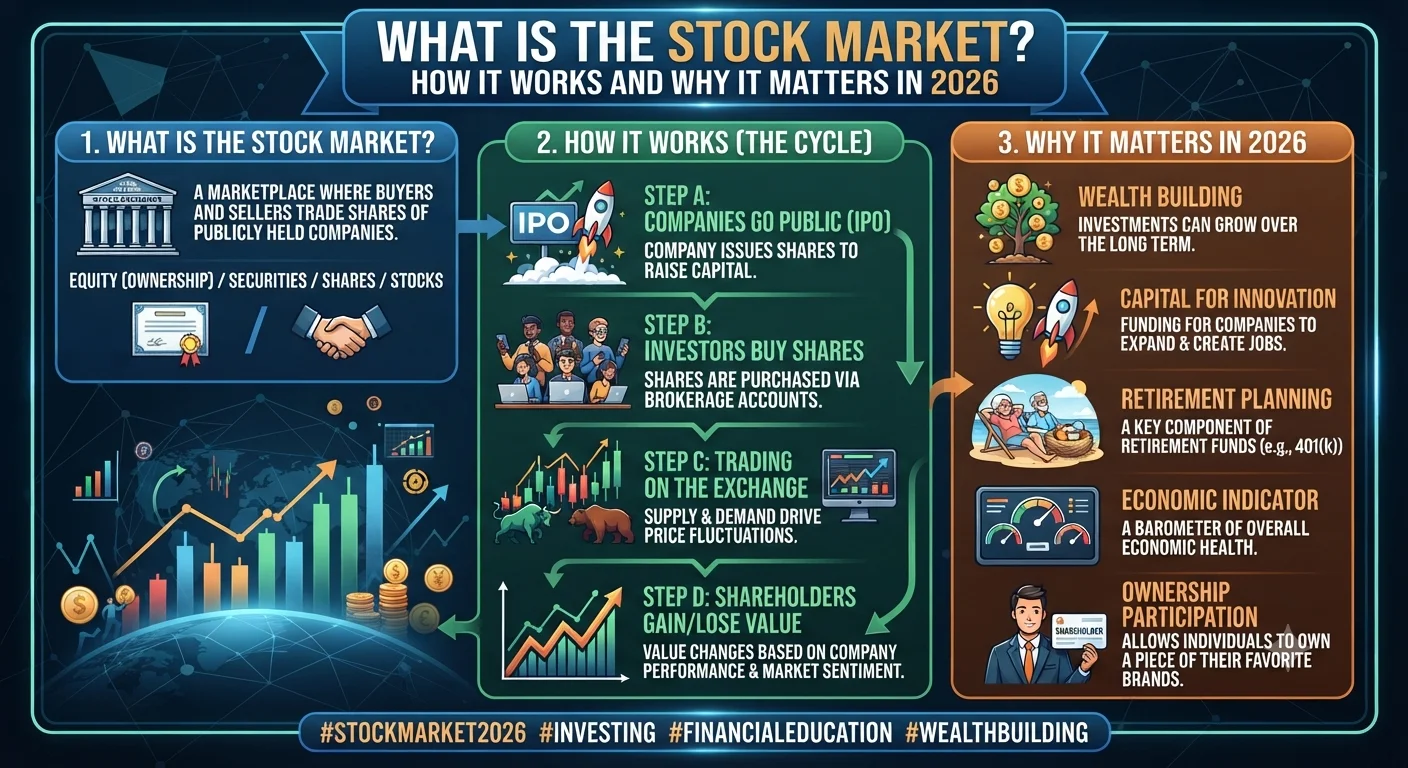
The stock market is a regulated marketplace where shares of publicly listed companies are bought and sold by investors. When you buy a share of stock, you purchase a small ownership stake in that company and become entitled to a proportional share of its future profits and assets. The price of each share fluctuates continuously based on supply and demand, which itself is driven by company performance, economic conditions, and investor sentiment.
Introduction
- Quick Answer: What Is the Stock Market?
- Introduction
- Defining the Stock Market: Entities, Exchanges, and Participants
- How Are Stocks Created? The IPO Process Explained
- What Drives Stock Prices Up and Down?
- Earnings Reports and Company Fundamentals
- Macroeconomic Indicators
- Investor Sentiment and Market Psychology
- Major Stock Exchanges Around the World
- How Individual Investors Can Participate in 2026
- Key Takeaways
- Frequently Asked Questions
On any given trading day, the New York Stock Exchange and the NASDAQ together process tens of millions of individual transactions. The collective decisions of individual investors, pension funds, sovereign wealth funds, hedge funds, algorithmic trading systems, and corporate treasury departments all converge in this marketplace, producing the continuous price movements displayed on financial news tickers around the world.
The stock market is not a casino, though it is sometimes treated as one. It is the primary mechanism through which profitable businesses raise capital for growth and through which ordinary individuals can build long-term wealth by participating in that growth. Companies including Apple, Microsoft, Amazon, and Tesla have collectively added trillions of dollars in shareholder value over the past two decades, and anyone who owned shares in those companies participated in that value creation.
Understanding how the stock market works is fundamental knowledge for anyone seeking to build financial security in 2026. Whether you plan to invest passively through index funds or actively through stock selection, knowing the underlying mechanics of how shares are issued, priced, traded, and regulated gives you a significant advantage over investors who simply follow tips and headlines.
Defining the Stock Market: Entities, Exchanges, and Participants
The term "stock market" is actually a collective description of multiple interconnected exchanges, trading venues, and regulatory frameworks that together allow shares in public companies to be bought and sold.
A stock represents a unit of ownership in a corporation. When a company issues stock, it divides itself into millions or billions of equal shares and sells those shares to investors in exchange for capital. Each share carries specific rights defined by the company's charter, typically including the right to vote on major corporate decisions and the right to receive dividends if the company distributes profits.
A stock exchange is the organized marketplace where these shares are listed and traded. Exchanges provide three essential services: they create a centralized location where buyers and sellers can find each other, they establish and enforce trading rules that protect participants, and they provide transparent, real-time price information that reflects genuine market conditions.
The major participants in the stock market include:
Retail investors are individuals investing their own money, either directly through brokerage accounts or indirectly through mutual funds, ETFs, and retirement accounts. Retail investors collectively represent a significant portion of market trading volume, particularly in recent years as commission-free trading has dramatically lowered barriers to participation.
Institutional investors are organizations that manage large pools of capital: mutual funds, pension funds, insurance companies, endowments, and sovereign wealth funds. Institutions account for the majority of daily trading volume on major exchanges. Their large orders can move markets significantly, particularly in smaller, less liquid stocks.
Hedge funds are private investment partnerships that use sophisticated strategies including short selling, leverage, and derivatives to generate returns. Unlike mutual funds, hedge funds are generally available only to accredited investors and institutional clients.
Market makers are firms that provide liquidity by continuously quoting both buy and sell prices for specific securities. They profit from the spread between their bid and ask prices and play a critical role in ensuring that any investor can buy or sell shares at any time without experiencing severe price impact.
Algorithmic and high-frequency trading firms use computer programs to execute enormous numbers of trades at speeds impossible for human traders. These firms provide a significant portion of daily market liquidity in exchange for capturing tiny, microsecond-scale price discrepancies.
How Are Stocks Created? The IPO Process Explained
Before a company's shares can be bought and sold on a public exchange, the company must go through a formal process known as an Initial Public Offering, or IPO. This is the mechanism by which a privately held company sells shares to the public for the first time.
The IPO process typically unfolds in several stages. First, the company hires investment banks (known as underwriters) to evaluate the business, determine a fair valuation, and manage the sale process. The leading underwriters for major IPOs are firms like Goldman Sachs, Morgan Stanley, and JPMorgan Chase.
The company then files a registration statement with the relevant regulatory authority: the Securities and Exchange Commission (SEC) in the United States, the Financial Conduct Authority (FCA) in the United Kingdom, or equivalent bodies in other jurisdictions. This filing, called a prospectus, contains detailed financial information about the company's business model, historical financials, competitive position, and risk factors. The prospectus is publicly available and is the primary document investors should study before participating in an IPO.
After regulatory review and approval, the underwriters conduct a "roadshow," presenting the company to major institutional investors to gauge demand and build an order book. Based on this demand, the underwriters set the IPO price. On the IPO date, shares are allocated to institutional investors and begin trading publicly on the exchange.
After the IPO, shares trade on the secondary market, meaning investors buy and sell existing shares from each other rather than from the company itself. The company receives no proceeds from secondary market transactions. It raised its capital during the IPO; subsequent trading simply determines the current market price of its shares.
Direct Listings and Special Purpose Acquisition Companies (SPACs) are alternative pathways to public markets that have gained attention in recent years, though the traditional IPO remains the dominant mechanism for major companies.
What Drives Stock Prices Up and Down?
Stock prices are determined by supply and demand, but the forces that drive that supply and demand are numerous and complex. Understanding these drivers gives investors context for why markets behave as they do.
Earnings Reports and Company Fundamentals
The most direct driver of an individual company's stock price is its financial performance, primarily measured through quarterly earnings reports. Every public company is required to report its financial results regularly, and these reports are scrutinized intensely by analysts and investors.
The key metrics investors watch include:
Revenue (also called net sales) measures the total income generated by the company's business activities. Revenue growth signals that the company is expanding its market reach or selling more products and services.
Earnings Per Share (EPS) divides the company's net profit by the number of outstanding shares. EPS is the most widely followed profitability metric in stock market analysis. Companies that report EPS above analyst consensus expectations typically see their stock price rise, while those that miss expectations often see sharp declines even if they report positive profits.
Revenue Guidance refers to the company's own forecast for future revenue. In many cases, guidance for the next quarter or full year affects the stock price more significantly than the current quarter's results, because financial markets are forward-looking instruments that price in expected future performance, not just historical data.
Profit Margin measures what percentage of revenue becomes profit. Expanding margins suggest improving operational efficiency; contracting margins may signal cost pressures or competitive threats.
Macroeconomic Indicators
Individual company fundamentals do not exist in a vacuum. The broader economic environment shapes the conditions within which every business operates, and macroeconomic data releases directly influence investor expectations for corporate earnings and economic growth.
Gross Domestic Product (GDP) measures the total output of an economy. Strong GDP growth generally signals healthy consumer spending, robust business activity, and favorable conditions for corporate revenue growth, all of which support higher stock valuations. Conversely, contracting GDP (recession) typically pressures corporate earnings and drives stock prices lower.
Inflation data, particularly the Consumer Price Index (CPI) and the Personal Consumption Expenditures (PCE) index, influences stock prices significantly because it shapes central bank policy. High inflation typically leads to higher interest rates, which increase the cost of corporate borrowing, compress profit margins, and reduce the present value of future earnings in investor valuation models.
Interest rate decisions by central banks are among the most powerful forces in equity markets. When the Federal Reserve raises the federal funds rate, it increases borrowing costs throughout the economy, slows economic growth, and makes bonds more competitive relative to stocks as an investment, often prompting capital to shift from equities to fixed income. Rate cuts generally have the opposite effect, stimulating economic activity and making stocks more attractive relative to lower-yielding bonds.
Employment data, particularly the monthly Non-Farm Payrolls report in the United States, provides a real-time snapshot of economic health. Strong employment supports consumer spending, which drives revenue for consumer-facing businesses. Unemployment rising above expected levels signals potential economic weakness.
Investor Sentiment and Market Psychology
Beyond the measurable fundamentals, stock prices are profoundly shaped by the collective psychology of market participants. Behavioral economist Robert Shiller, who shared the Nobel Memorial Prize in Economic Sciences in 2013, has extensively documented the role of "narrative economics" in driving market cycles far beyond what fundamental analysis alone would predict.
During bull markets, widespread optimism leads investors to pay increasingly high valuations for stocks, pushing price-to-earnings ratios well above historical averages as participants extrapolate recent performance indefinitely into the future. During bear markets and crises, fear causes investors to sell fundamentally sound companies at prices that imply deep and permanent impairment, creating the opportunity for disciplined value investors to buy quality assets at discounted prices.
The Fear and Greed Index, published by CNN Business, quantifies current market sentiment by measuring seven indicators including stock price momentum, market volatility, and the relationship between safe-haven and risky assets. While not a precise market timing tool, it provides useful context about whether markets are currently driven by excessive optimism or excessive fear.
Major Stock Exchanges Around the World
Understanding the landscape of global equity markets helps investors appreciate both the opportunities and the structural differences across different markets.
| Exchange | Location | Market Capitalization | Key Indices |
|---|---|---|---|
| New York Stock Exchange (NYSE) | New York, USA | Over $25 trillion | Dow Jones Industrial Average, NYSE Composite |
| NASDAQ | New York, USA | Over $20 trillion | NASDAQ Composite, NASDAQ 100 |
| Shanghai Stock Exchange (SSE) | Shanghai, China | Over $7 trillion | SSE Composite |
| Euronext | Amsterdam/Paris/Brussels | Over $6 trillion | CAC 40, AEX |
| London Stock Exchange (LSE) | London, UK | Over $3.5 trillion | FTSE 100, FTSE 250 |
| Tokyo Stock Exchange (TSE) | Tokyo, Japan | Over $6 trillion | Nikkei 225, TOPIX |
| Hong Kong Stock Exchange (HKEX) | Hong Kong | Over $4 trillion | Hang Seng Index |
| National Stock Exchange (NSE) | Mumbai, India | Over $3 trillion | Nifty 50 |
The NYSE and NASDAQ together represent the world's largest and most liquid equity markets. The NYSE, founded in 1792, is the oldest major US exchange and tends to list large, established companies. NASDAQ, founded in 1971, is known for its technology-heavy listing profile and fully electronic trading system. Unlike the NYSE, which still maintains a physical trading floor in lower Manhattan, NASDAQ has always been a purely electronic marketplace.
How Individual Investors Can Participate in 2026
The barriers to stock market participation have fallen dramatically over the past decade. Commission-free trading, fractional shares, and mobile-first brokerage platforms have made it possible for anyone with a smartphone and a modest amount of capital to begin investing in publicly traded companies.
Opening a brokerage account is the first step. A brokerage is a regulated financial intermediary that provides access to exchanges on your behalf. When selecting a broker, prioritize regulatory compliance (look for SEC and FINRA registration in the US, or FCA authorization in the UK), the availability of commission-free trading, user-friendly platform design, and the quality of educational resources.
Fractional shares have been a transformative development for small investors. Previously, buying a single share of a company like Amazon or Berkshire Hathaway class A required thousands or hundreds of thousands of dollars. With fractional shares, offered by most major retail brokers, you can invest as little as $1 in any publicly traded company regardless of its share price.
Tax-advantaged accounts are the most efficient vehicle for long-term stock market participation. In the United States, investing through a Roth IRA or 401(k) allows your investment growth to compound without annual tax drag, a significant advantage over decades of investing. In the United Kingdom, the Stocks and Shares ISA provides the equivalent tax-free growth environment.
Dollar-cost averaging into low-cost index funds tracking broad market indices remains the approach recommended by the vast majority of evidence-based financial educators for most individual investors. The practical steps are straightforward: open a tax-advantaged brokerage account, set up an automatic monthly investment into a low-cost total market or S&P 500 index fund, and maintain the contributions consistently regardless of market conditions.
Key Takeaways
- The stock market is a regulated marketplace where ownership shares in publicly listed companies are bought and sold, with prices continuously reflecting the collective judgment of millions of investors.
- Companies access the stock market through an IPO process, raising capital by selling shares to the public for the first time. After the IPO, shares trade between investors on secondary markets.
- Stock prices are driven by company earnings and fundamentals, macroeconomic indicators including GDP, inflation, and interest rates, and the collective psychology of market participants.
- Major exchanges including the NYSE, NASDAQ, LSE, and TSE provide organized, regulated venues where trading occurs with transparent pricing and regulatory oversight.
- Individual investors in 2026 can participate with very small amounts of capital through commission-free brokers, fractional shares, and tax-advantaged account structures.
- Long-term investment in diversified, low-cost index funds remains the approach most consistently supported by academic research and the advice of leading investors for most individuals.
Frequently Asked Questions
How does the stock market make money for investors? Investors make money from stocks through two channels. The first is capital appreciation: when you sell shares at a higher price than you paid, the difference is your profit. The second is dividend income: many established companies distribute a portion of their profits to shareholders as regular dividend payments. Total return investing captures both sources of return simultaneously.
Is the stock market safe for beginners? The stock market involves genuine financial risk, and individual stocks can and do lose significant value. However, for investors with a long time horizon who invest in broadly diversified portfolios of quality companies or index funds, and who maintain their positions through temporary downturns rather than panic-selling, the historical evidence strongly supports the stock market as a reliable long-term wealth-building vehicle. The key protective factors are diversification, time horizon, and emotional discipline.
What is the difference between the stock market and the forex market? The stock market is where ownership shares in individual companies are traded. The forex market is where national currencies are bought and sold against each other. Stocks generally represent long-term ownership in productive businesses. Currency trading is primarily driven by short-term macroeconomic factors and interest rate differentials. The forex market is significantly larger by daily trading volume ($7.5 trillion per day vs approximately $500 billion to $600 billion per day for global equities), operates 24 hours a day, and involves different analytical approaches, risk characteristics, and regulatory frameworks.
What is a stock market index? A stock market index is a calculated measure representing the aggregate performance of a selected group of stocks. The S&P 500, for example, tracks the 500 largest publicly listed US companies by market capitalization, weighted by their market cap, so that larger companies have more influence on the index's movements. Index performance is used as a benchmark for evaluating investment strategies. When people say "the market went up 1 percent today," they are typically referring to the performance of a major index like the S&P 500 or the Dow Jones Industrial Average.
How much money do I need to start investing in stocks? With fractional shares now widely available through major retail brokers in most countries, you can begin investing in stocks with as little as $1. However, a more practical starting point that allows for meaningful diversification across multiple investments is $500 to $1,000. For most beginners, a single investment in a total market or S&P 500 index fund provides immediate diversification across hundreds of companies without requiring multiple separate purchases.
What causes a stock market crash? Stock market crashes are triggered by a combination of factors: an initial shock or catalyst (which might be a financial crisis, pandemic, geopolitical event, or sudden shift in monetary policy), followed by a cascade of selling driven by fear, margin calls forcing leveraged investors to liquidate positions, and algorithmic trading systems responding to predefined thresholds. Crashes frequently occur when markets have been trading at elevated valuations for extended periods, meaning the underlying vulnerability exists long before the triggering event. Historical crashes including 1929, 1987, 2000 to 2002, 2008 to 2009, and the March 2020 COVID crash all followed this general pattern.
RISK DISCLAIMER: Investing in the stock market involves risk, including the potential loss of the entire amount invested. This article is for educational purposes only and does not constitute investment advice. Please consult a qualified financial advisor before making investment decisions.