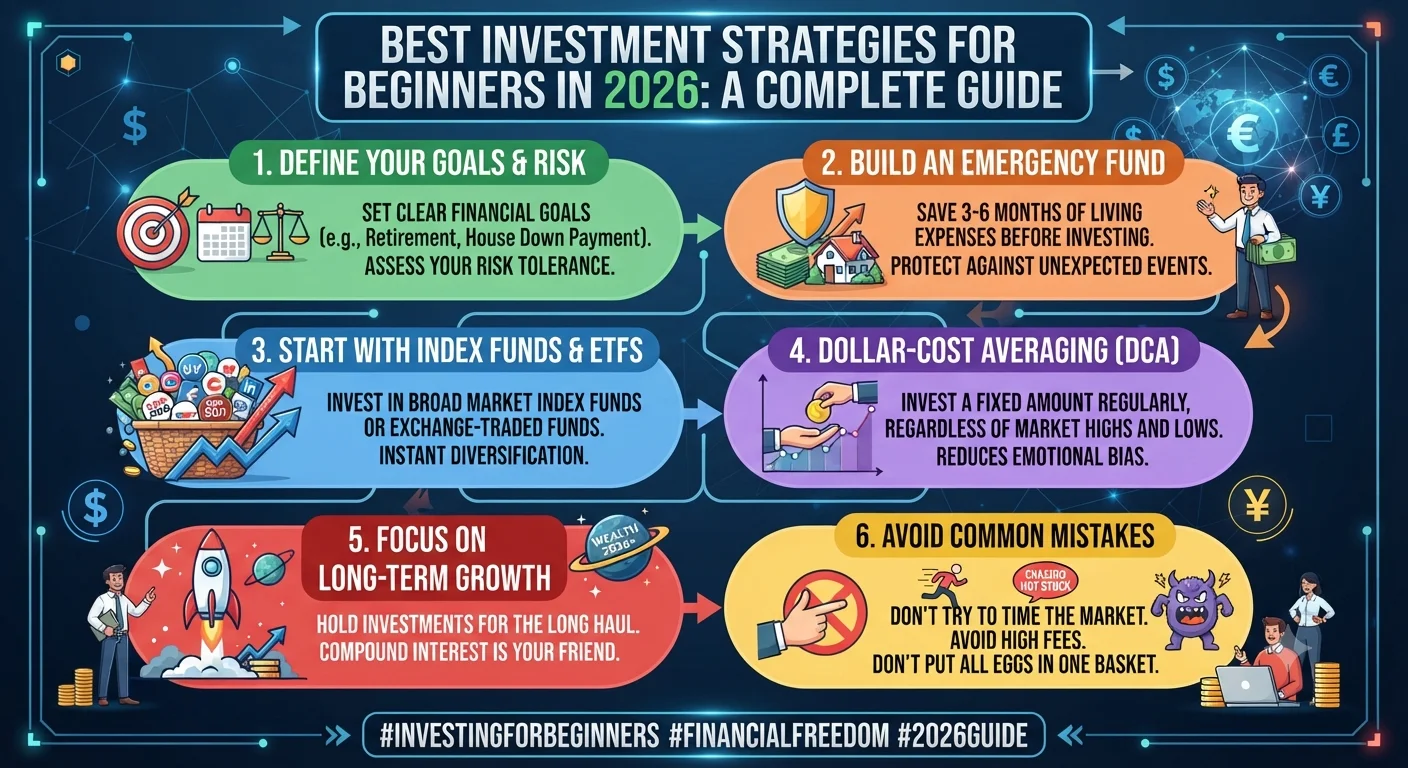
Quick Answer: What Are the Best Investment Strategies for Beginners?
The best investment strategies for beginners in 2026 are index fund investing, dollar-cost averaging, and dividend investing. These approaches are backed by decades of academic research and real-world performance data. They require no advanced financial knowledge, carry manageable risk, and allow beginners to participate in long-term wealth building without the need to pick individual stocks or time the market.
Introduction
- Quick Answer: What Are the Best Investment Strategies for Beginners?
- Introduction
- What Is an Investment Strategy and Why Does It Matter?
- The 7 Best Investment Strategies for Beginners in 2026
- 1. Index Fund Investing: The Warren Buffett Approach
- 2. Dollar-Cost Averaging: Investing Without Timing the Market
- 3. Value Investing: Buying Undervalued Assets
- 4. Growth Investing: Investing in Tomorrow's Leaders
- 5. Dividend Investing: Building Income From Stocks
- 6. Bond Laddering: Conservative Wealth Building
- 7. Portfolio Diversification: The Foundation of All Risk Management
- How to Choose the Right Investment Strategy for Your Financial Goals
- Common Investment Mistakes Beginners Make in 2026
- Key Takeaways
- Frequently Asked Questions
Every generation of investors faces a version of the same fundamental question: what should I do with my money? In 2026, that question has become both easier and harder to answer. Easier, because the tools and information available to everyday investors have never been more accessible. Harder, because the sheer volume of options, platforms, and financial products can feel overwhelming to anyone starting from scratch.
The reality, supported by decades of data from institutions like Vanguard, BlackRock, and the academic research of economists such as Eugene Fama and John Bogle, is that the most effective investment strategies for most people are surprisingly simple. They do not require predicting the market, constantly monitoring prices, or taking on excessive risk.
This guide explains the seven most proven investment strategies for beginners, how each one works, and how to choose the approach that best fits your financial goals and personal circumstances in 2026.
What Is an Investment Strategy and Why Does It Matter?
An investment strategy is a structured plan that guides how you allocate your money across different assets in pursuit of specific financial goals. Without a strategy, most investors make decisions based on emotion, news headlines, or the advice of friends, all of which tend to produce poor long-term outcomes.
Research published by Dalbar, a financial research firm, consistently shows that the average retail investor significantly underperforms the overall stock market over time. Their 2023 Quantitative Analysis of Investor Behavior found that over a 30-year period, the average equity fund investor earned roughly 6.3 percent annually, compared to the S&P 500's average annual return of approximately 10.7 percent. The primary reason for this gap is behavioral: investors buy when markets are high out of excitement and sell when markets fall out of fear.
A clearly defined investment strategy removes the emotional component from decision-making. It tells you what to buy, when to buy it, how much to invest, and what conditions would cause you to adjust your approach. This discipline is what separates investors who build genuine wealth over time from those who perpetually feel behind.
The 7 Best Investment Strategies for Beginners in 2026
1. Index Fund Investing: The Warren Buffett Approach
Index fund investing is the practice of buying a fund that tracks a broad market index, such as the S&P 500, rather than attempting to select individual winning stocks. When you invest in an S&P 500 index fund, you instantly own a proportional share of 500 of the largest publicly traded companies in the United States.
Warren Buffett, widely regarded as the most successful investor in modern history, has publicly and repeatedly stated that index funds are the best choice for most retail investors. In his 2013 letter to Berkshire Hathaway shareholders, he described his instructions for the trustee of his estate after his death: put 90 percent of the cash in a very low-cost S&P 500 index fund and 10 percent in short-term government bonds.
The academic foundation for this approach comes from the Efficient Market Hypothesis, developed by economist Eugene Fama at the University of Chicago, which argues that it is extraordinarily difficult to consistently outperform the market because stock prices already reflect all publicly available information.
The data supports this view. According to the S&P Dow Jones Indices SPIVA Report, over any given 15-year period, approximately 88 to 92 percent of actively managed US large-cap funds underperform their benchmark index after fees.
Key advantages of index fund investing:
- Instant diversification across hundreds or thousands of companies
- Very low fees, typically 0.03 to 0.20 percent per year with major providers like Vanguard and Fidelity
- No need to research individual stocks
- Historically strong long-term returns
- Available through most retirement accounts (401k, IRA, ISA)
2. Dollar-Cost Averaging: Investing Without Timing the Market
Dollar-cost averaging (DCA) is the practice of investing a fixed amount of money at regular intervals, regardless of what the market is doing. Instead of trying to invest a lump sum at the "right" moment, you invest, for example, $200 every month, consistently and automatically.
This strategy eliminates one of the most destructive behaviors in investing: trying to time the market. Research from Fidelity Investments found that investors who attempted to time the market during the 2008 financial crisis and missed just the five best trading days of 2009 earned dramatically lower returns over the following decade compared to those who simply stayed invested.
When prices are high, your fixed investment buys fewer shares. When prices are low, your fixed investment buys more shares. Over time, this averaging effect tends to reduce the average cost per share compared to making a single large purchase, particularly in volatile markets.
Dollar-cost averaging works especially well for beginners because it creates a sustainable, automated investment habit that removes the need for constant decision-making. Setting up a recurring monthly contribution to a low-cost index fund and leaving it to compound over time is a strategy that requires almost no ongoing effort and has produced strong results for millions of investors.
3. Value Investing: Buying Undervalued Assets
Value investing is the strategy of identifying companies whose stock prices appear to be trading below their true intrinsic value, purchasing those shares, and holding them until the market recognizes their worth and the price rises accordingly.
This approach was developed by economist Benjamin Graham, whose 1949 book "The Intelligent Investor" remains the foundational text of value investing. Warren Buffett was a student of Graham and adapted his methodology into one of the most successful investment records in history.
Value investors use financial metrics to identify undervalued companies. The most important include:
Price-to-Earnings (P/E) Ratio: Compares a company's stock price to its annual earnings per share. A lower P/E relative to industry peers or the company's historical average may indicate undervaluation.
Price-to-Book (P/B) Ratio: Compares market price to the net asset value of the company. A P/B below 1.0 historically suggested a company trading below its liquidation value.
Free Cash Flow: The actual cash a business generates after accounting for capital expenditures. Companies with strong, growing free cash flow tend to be financially healthy and capable of rewarding shareholders.
Value investing requires patience. Undervalued stocks can remain undervalued for extended periods, and the approach demands the discipline to hold positions through periods when the market disagrees with your assessment. For beginners, a simpler entry point is investing in value-focused ETFs rather than selecting individual value stocks.
4. Growth Investing: Investing in Tomorrow's Leaders
Growth investing focuses on companies expected to grow their revenues and earnings at an above-average rate compared to the overall market, even if their current valuations appear expensive by traditional measures.
Companies like Amazon, Apple, Tesla, and Nvidia were quintessential growth stocks during their expansion phases. Investors who identified and held these companies during their high-growth periods generated extraordinary returns.
The trade-off is significant risk. Growth stocks trade at high valuations based on anticipated future performance. If a company fails to deliver the expected growth, its stock price can fall sharply. During the 2022 market correction, many high-growth technology stocks fell 50 to 80 percent from their peak values as rising interest rates compressed their future earnings valuations.
For beginners, growth investing is best approached through diversified growth ETFs rather than concentrated bets on individual companies. This limits the damage of any single company disappointing and still allows participation in the growth of innovative industries.
5. Dividend Investing: Building Income From Stocks
Dividend investing focuses on purchasing shares of companies that regularly distribute a portion of their profits to shareholders in the form of dividends. Investors build portfolios of dividend-paying stocks to generate a predictable income stream that grows over time.
The most sought-after category of dividend stocks is the Dividend Aristocrats, a group of S&P 500 companies that have increased their dividend payment every year for at least 25 consecutive years. These companies, which include Johnson and Johnson, Procter and Gamble, and Coca-Cola, have demonstrated the financial stability and shareholder commitment necessary to sustain and grow dividends through multiple economic cycles, including recessions.
The compounding effect of reinvesting dividends over time is one of the most powerful wealth-building mechanisms available to individual investors. According to Hartley Withers research data, dividends reinvested over a 40-year period in the S&P 500 contributed approximately 40 percent of total returns compared to price appreciation alone.
6. Bond Laddering: Conservative Wealth Building
Bond laddering is a fixed-income strategy that involves purchasing bonds with staggered maturity dates, creating a predictable schedule of income and capital return while managing interest rate risk.
In a bond ladder with five rungs, an investor might purchase bonds maturing in one, two, three, four, and five years. As each bond matures, the proceeds are reinvested into a new five-year bond. This approach prevents the investor from being locked into low rates for extended periods while still benefiting from the generally higher yields available on longer-dated bonds.
For beginners, bond laddering is most accessible through bond ETFs or US Treasury direct purchase programs like TreasuryDirect.gov, which allows individuals to purchase government bonds directly without a broker.
This strategy is particularly suitable for more conservative investors, those nearing retirement, or anyone seeking a stable income component within a broader diversified portfolio.
7. Portfolio Diversification: The Foundation of All Risk Management
Diversification is not a standalone strategy so much as a foundational principle that applies to every investment approach. It is the practice of spreading investments across different asset classes, geographies, sectors, and instruments so that poor performance in any single area does not disproportionately harm the overall portfolio.
The theoretical basis for diversification was formalized by economist Harry Markowitz in his 1952 paper "Portfolio Selection," which introduced Modern Portfolio Theory and earned him the Nobel Memorial Prize in Economic Sciences in 1990. Markowitz demonstrated mathematically that combining assets with low or negative correlations to each other reduces overall portfolio volatility without necessarily reducing expected returns.
A well-diversified portfolio in 2026 might include:
| Asset Class | Example Instruments | Typical Role |
|---|---|---|
| Domestic Equities | S&P 500 index fund | Growth engine |
| International Equities | MSCI World ex-US ETF | Geographic diversification |
| Bonds | US Treasury bonds, corporate bonds | Stability and income |
| Real Estate | REITs | Inflation hedge and income |
| Commodities | Gold ETF | Crisis hedge |
| Cash Equivalents | Money market fund | Liquidity buffer |
The exact allocation depends on your age, risk tolerance, income, and time horizon, which we address in the following section.
How to Choose the Right Investment Strategy for Your Financial Goals
No single investment strategy is optimal for every person. Choosing the right approach requires honest assessment of four key factors.
Time horizon is perhaps the most important. If you are investing for a retirement that is 30 years away, you can afford to ride out market downturns and should lean toward higher-equity, growth-oriented strategies. If you need access to your money within five years, capital preservation becomes more important and conservative strategies involving bonds and cash equivalents make more sense.
Risk tolerance is your psychological and financial ability to withstand losses. An investment portfolio that falls 30 percent during a market correction will eventually recover, but only if you stay invested. Investors who panic-sell during downturns lock in losses permanently. Be honest about whether you could watch your account value drop significantly without making emotional decisions.
Income and savings rate determines how much you can invest consistently. Strategies that depend on regular contributions, like dollar-cost averaging, require a reliable monthly surplus after expenses. Before investing aggressively, ensure you have an emergency fund covering three to six months of living expenses, because having to liquidate investments during a down market to cover an unexpected expense can be financially devastating.
Financial goals should be specific, measurable, and time-bound. "I want to retire at 60 with $1 million in invested assets" is a goal that guides strategy selection far more effectively than "I want to build wealth someday."
Common Investment Mistakes Beginners Make in 2026
Understanding what not to do is as valuable as understanding what to do. The most costly beginner mistakes include:
Trying to time the market is one of the most reliably wealth-destroying behaviors for retail investors. Research consistently shows that missing just the 10 best trading days in any given decade cuts long-term returns dramatically, and those best days frequently occur during periods of maximum fear when most people are selling.
Investing without an emergency fund means that an unexpected car repair, medical bill, or job loss forces you to liquidate investments, potentially at a significant loss, precisely when markets are most depressed.
Chasing recent performance leads investors to buy assets after they have already risen sharply, essentially paying premium prices for past results that rarely continue indefinitely. The mutual funds with the best three-year records rarely maintain their advantage in the following three years.
Ignoring fees is a slow-motion wealth destroyer. An expense ratio of 1 percent per year versus 0.10 percent on a $100,000 portfolio over 30 years can cost hundreds of thousands of dollars in foregone compound growth.
Over-diversifying into complexity without understanding what you own is a common modern mistake. Owning 15 different ETFs that all track similar indices provides no additional diversification benefit and simply adds confusion.
Key Takeaways
- Index fund investing in broad market indices like the S&P 500 outperforms the majority of actively managed funds over long periods, according to S&P Dow Jones Indices SPIVA data.
- Dollar-cost averaging removes the need to time the market and creates a disciplined, automated investment habit that compounds over time.
- Value, growth, and dividend strategies each have distinct risk-return profiles and suit different investor personalities and goals.
- Diversification across asset classes, geographies, and sectors reduces portfolio volatility without necessarily reducing expected returns.
- The biggest enemies of investment success are emotion-driven decisions, excessive fees, and unrealistic expectations.
Frequently Asked Questions
What is the best investment strategy for a complete beginner? The best starting point for a complete beginner is a simple, low-cost index fund paired with a dollar-cost averaging approach. Investing a fixed amount monthly into a broad stock market index fund, such as one tracking the S&P 500 or total world market, requires minimal knowledge to implement, carries very low fees, and has produced strong long-term results historically.
How much should a beginner invest? The best amount is whatever you can invest consistently without affecting your ability to cover essential expenses or maintain an emergency fund. Starting with even $50 to $100 per month and increasing contributions as your income grows is far more effective than waiting until you have a large lump sum. The most important factor is starting as early as possible to maximize the compounding period.
Are investment strategies different in 2026 than they were before? The core principles of sound investing, diversification, consistency, long-term thinking, and fee minimization remain unchanged. What has evolved is the accessibility of investment tools, with fractional shares allowing investment in high-priced stocks with very small amounts, and the growing importance of considering inflation-resistant assets as central banks navigate a higher-rate environment.
Is it better to invest in stocks or bonds as a beginner? For most beginners with a long time horizon, a predominantly stock-based portfolio tends to produce better long-term results because equities historically outperform bonds over periods of 10 years or more. However, a small allocation to bonds reduces volatility and can prevent panic-selling during downturns by cushioning the portfolio's overall drawdown. A common starting allocation for a young investor is 80 to 90 percent equities and 10 to 20 percent bonds.
What is the difference between saving and investing? Saving involves putting money into low-risk, highly liquid accounts like savings accounts or money market funds. The goal is capital preservation and access. Investing involves placing money in assets that carry more risk but offer the potential for higher returns over time. Both are necessary: save your emergency fund and short-term needs, invest for long-term goals.
Can I lose all my money in an index fund? Losing all your money in a diversified index fund is theoretically possible only if every company in the index went bankrupt simultaneously, an event that would represent a total collapse of the economy far beyond any historically recorded scenario. While index funds can and do fall significantly during recessions, they have always recovered over sufficient time periods. Diversification means no single company's failure can eliminate your entire investment.
RISK DISCLAIMER: All investments carry risk. The strategies discussed in this article are for educational purposes only and do not constitute personalized financial advice. Investment performance varies based on market conditions, individual circumstances, and implementation. Please consult a qualified financial advisor before making investment decisions.