How Does the Foreign Exchange Market Work?
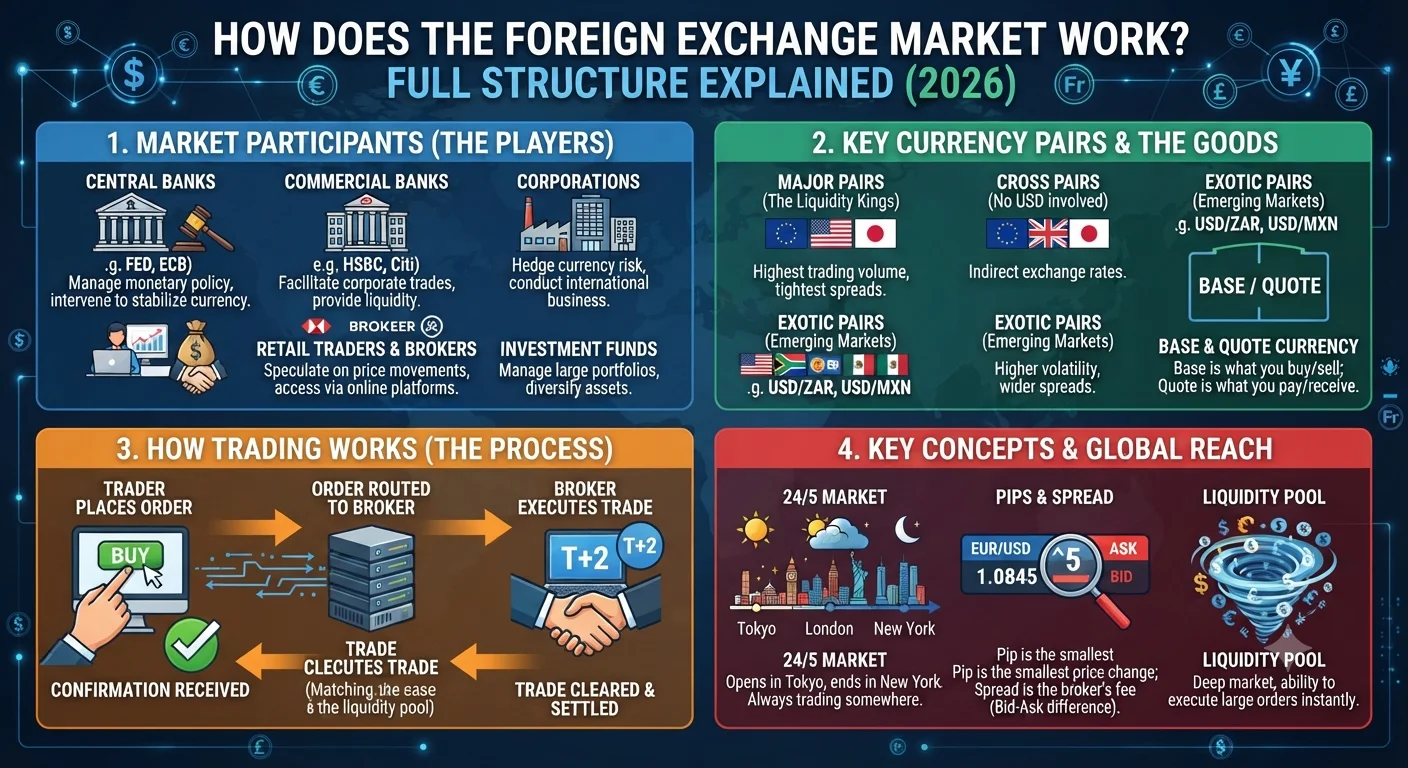
The foreign exchange market works as a decentralized, over-the-counter network where banks, institutions, and retail traders buy and sell currencies 24 hours a day. Currency prices are set by supply and demand. When demand for a currency rises due to stronger economic data, higher interest rates, or increased investor confidence, its value appreciates against other currencies. The process repeats continuously across four overlapping global trading sessions.
Introduction
- How Does the Foreign Exchange Market Work?
- Introduction
- What Is the Foreign Exchange Market?
- The Hierarchical Structure of the Forex Market
- Tier 1: The Interbank Market
- Tier 2: Electronic Communication Networks and Prime Brokers
- Tier 3: Retail Brokers and Retail Traders
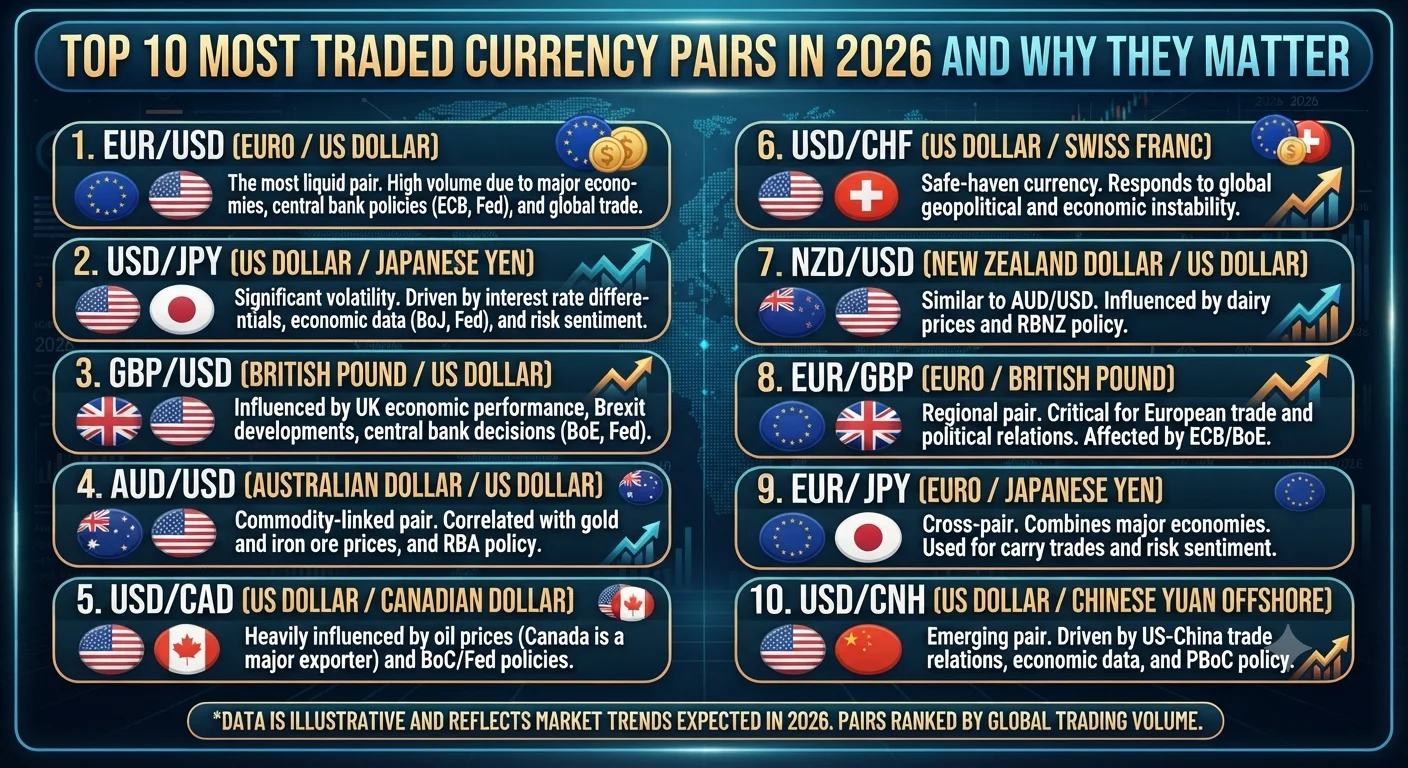
- How Are Currency Exchange Rates Determined?
- Supply and Demand in the Forex Market
- The Role of Interest Rates and Inflation
- Geopolitical Events and Market Sentiment
- When Is the Forex Market Open? Trading Sessions Explained
- The Four Major Trading Sessions
- Best Times to Trade Forex in 2026
- How Forex Prices Are Quoted and Traded
- Key Takeaways
- Frequently Asked Questions
Somewhere right now, a Japanese manufacturer is converting US dollars earned from American exports back into yen to pay its domestic suppliers. A European hedge fund is selling British pounds and buying Swiss francs to hedge against political uncertainty. A central bank is quietly purchasing its own currency to prevent excessive depreciation. And a retail trader sitting at a laptop in Karachi is placing a 10-pip scalp trade on USD/JPY.
All of these activities happen simultaneously within the same vast, interconnected ecosystem: the foreign exchange market.
To trade currencies successfully, or even to simply understand why the dollar strengthens after a Federal Reserve rate hike or why the pound fell sharply after Brexit, you need to understand how the forex market is structured, who controls it, and what forces cause prices to move. This article provides that complete picture.
What Is the Foreign Exchange Market?
The foreign exchange market, commonly known as the forex market or FX market, is the global marketplace where national currencies are bought, sold, and exchanged. Unlike stock exchanges such as the New York Stock Exchange or the London Stock Exchange, the forex market has no central physical location. It operates entirely through a global network of banks, financial institutions, electronic trading platforms, and brokers.
According to the Bank for International Settlements (BIS) Triennial Central Bank Survey, the forex market is the largest financial market in the world by trading volume, processing approximately $7.5 trillion in transactions every single day. To put this in perspective, the New York Stock Exchange, one of the world's largest equity markets, processes approximately $20 to $25 billion in daily trading volume. The forex market is roughly 300 times larger.
This extraordinary size creates a market that is, for all practical purposes, impossible to manipulate by any single entity, even the largest investment banks. Prices are determined by the collective activity of millions of participants acting simultaneously across the globe.
The Hierarchical Structure of the Forex Market
The forex market is not flat. It operates in a distinct hierarchy, where price formation begins at the highest institutional level and filters down to retail traders. Understanding this structure helps explain why the prices retail traders see on their brokers' platforms differ slightly from those transacted between the world's largest banks.
Tier 1: The Interbank Market
The interbank market sits at the top of the forex hierarchy. It is a network where the world's largest commercial banks trade currencies directly with each other, both on behalf of their clients and for their own proprietary accounts.
The major participants in the interbank market include Deutsche Bank, Citibank, JPMorgan Chase, UBS, HSBC, Barclays, and Bank of America. These institutions transact in enormous volumes, often in the hundreds of millions or billions of dollars per trade. The exchange rates they negotiate with each other form the basis for the benchmark rates used throughout the rest of the market.
Two electronic systems dominate interbank currency trading: Reuters Matching and Electronic Broking Services (EBS). These platforms allow major banks to post bids and offers and execute trades electronically, replacing much of the phone-based trading that characterized the market in earlier decades.
Access to the interbank market requires significant capital, typically in the range of tens of millions of dollars, making it inaccessible to retail traders directly. However, the prices established here ultimately flow down through the market hierarchy to affect every participant.
Tier 2: Electronic Communication Networks and Prime Brokers
The second tier consists of Electronic Communication Networks (ECNs) and prime brokerage services that aggregate liquidity from multiple interbank sources and make it available to a broader range of participants, including hedge funds, asset managers, smaller banks, and sophisticated trading firms.
ECN platforms connect buyers and sellers directly, displaying competing bids and offers from multiple liquidity providers. This competition among providers narrows spreads and improves pricing for participants at this tier. Well-known ECN platforms include Currenex, Integral, and FXall.
Prime brokers, typically the investment banking arms of major financial institutions, extend interbank market access to institutional clients by acting as a central counterparty. A hedge fund with a prime brokerage relationship can effectively trade at near-interbank spreads despite not meeting the capital requirements for direct interbank access.
Tier 3: Retail Brokers and Retail Traders
The third and final tier is where most individual traders participate. Retail forex brokers source their liquidity from the tiers above, either through direct arrangements with banks and prime brokers, or by aggregating price feeds from multiple ECNs. They then offer their clients the ability to trade currencies through platforms like MetaTrader 4, MetaTrader 5, or their own proprietary software.
Retail brokers operate under two primary business models:
Market Maker Brokers take the opposite side of their clients' trades internally, creating their own market rather than routing orders directly to liquidity providers. This creates a potential conflict of interest, though regulated market makers are subject to capital requirements and best execution obligations designed to protect clients.
STP (Straight Through Processing) and ECN Brokers route client orders directly to their liquidity providers without taking the opposite side. These brokers typically charge a commission per trade rather than widening the spread, and their pricing more closely reflects true interbank rates.
How Are Currency Exchange Rates Determined?
Exchange rates are prices, and like all prices in a market economy, they are determined by the interaction of supply and demand. When more participants want to buy a currency than sell it, its price rises. When more participants want to sell, its price falls. The mechanisms that drive those supply and demand shifts, however, are complex and multifaceted.
Supply and Demand in the Forex Market
The most direct drivers of currency supply and demand are international trade flows and capital flows.
Trade flows arise from the need to exchange currencies when conducting cross-border commerce. If Germany exports automobiles to the United States, American importers must convert US dollars into euros to pay German manufacturers. This creates demand for euros and supply of dollars, which, all else being equal, pushes the euro higher against the dollar. Countries that run persistent trade surpluses (exporting more than they import) tend to see sustained demand for their currency from this channel.
Capital flows are often larger and faster-moving than trade flows. When investors in one country purchase stocks, bonds, real estate, or business assets in another country, they must first convert their domestic currency. If US interest rates are significantly higher than European rates, international investors may sell euros and buy dollars to invest in higher-yielding US Treasury bonds, strengthening the dollar. These capital flow dynamics explain why central bank interest rate decisions are among the most powerful individual events in the forex market.
The Role of Interest Rates and Inflation
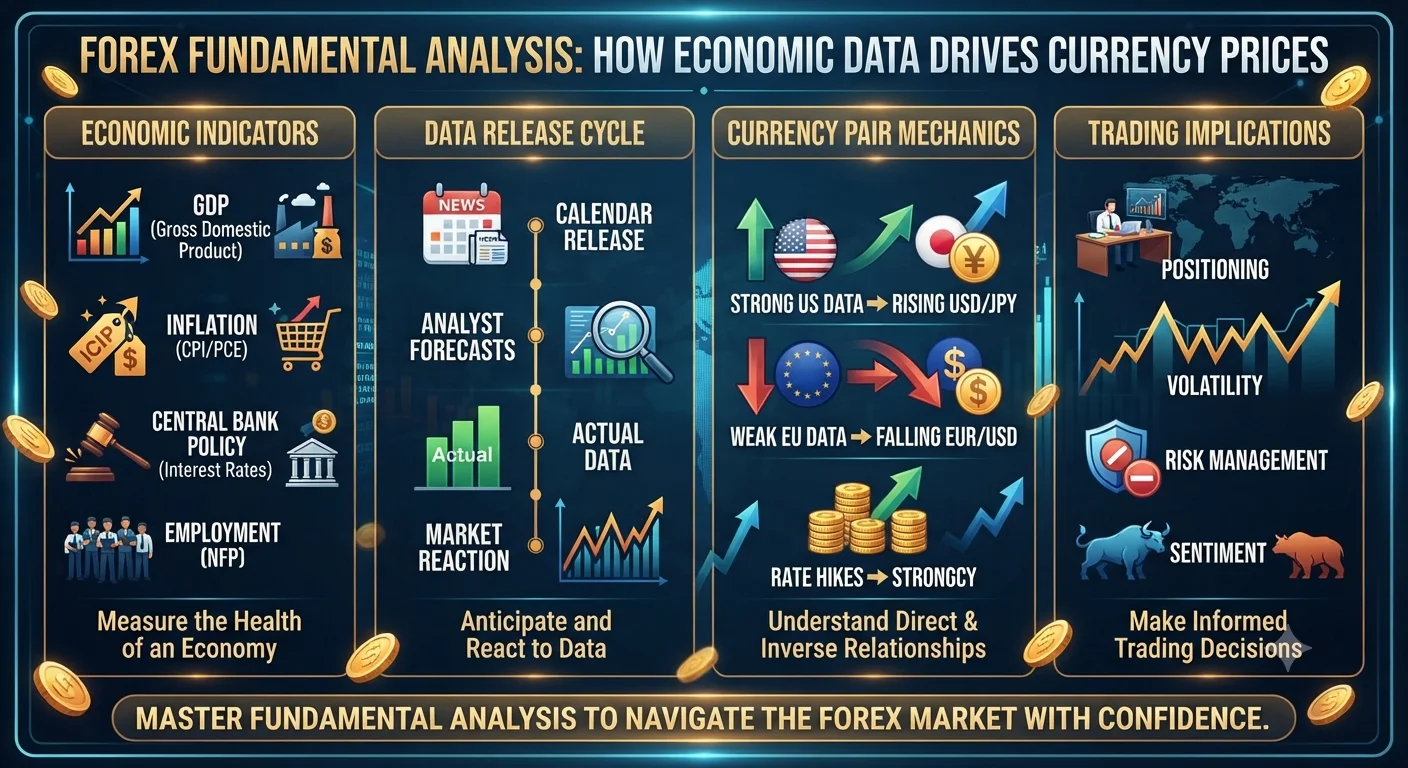
Interest rates set by central banks are the single most influential long-term driver of currency values. The relationship is straightforward: higher interest rates attract foreign capital seeking better returns, increasing demand for the currency and pushing its value higher. Lower interest rates have the opposite effect.
The real interest rate, which adjusts the nominal interest rate for inflation, is particularly important. A country with a 5 percent interest rate and 6 percent inflation has a negative real rate of minus 1 percent, which is actually unattractive to investors despite the seemingly high nominal rate. Conversely, a country with a 3 percent interest rate and 1 percent inflation offers a positive real rate of 2 percent, which may attract significant capital.
Inflation itself also directly affects a currency's purchasing power. According to the theory of Purchasing Power Parity (PPP), which was formalized by economists including Gustav Cassel in the early 20th century, exchange rates should in the long run adjust to reflect the relative inflation rates between two countries. A country with persistently higher inflation will see its currency depreciate over time because each unit of currency buys progressively less.
Recommended Articles
 FOREX TRADING BASICS
 FOREX TRADING BASICS
 FOREX TRADING BASICS
 FOREX TRADING BASICS
Geopolitical Events and Market Sentiment
Beyond the measurable economic fundamentals, currency markets are profoundly influenced by geopolitical events and shifts in investor sentiment. Elections, wars, trade disputes, and political crises can trigger rapid, large-scale capital movements that overwhelm the underlying economic fundamentals.
The British pound's dramatic fall on the day of the Brexit referendum result in June 2016, when it fell as much as 10 percent against the US dollar in a single day, illustrates how political events can produce forex movements that dwarf normal economic cycle-driven fluctuations. Similarly, the Russian ruble's collapse following Western sanctions in 2022 demonstrated how geopolitical events can have catastrophic effects on currency values in extreme scenarios.
Safe-haven currencies, particularly the US dollar, the Swiss franc, and the Japanese yen, tend to strengthen during periods of global uncertainty as investors flee riskier assets for perceived stability. This behavior is documented extensively in academic research and is a reliable pattern that experienced traders incorporate into their market analysis.
When Is the Forex Market Open? Trading Sessions Explained
One of the most unique characteristics of the forex market is that it operates 24 hours a day, five days a week, from the market open in Sydney, Australia on Monday morning local time to the market close in New York on Friday afternoon local time. This continuous operation is possible because as one major financial center closes, another opens in a different time zone, maintaining an unbroken chain of market activity.
The Four Major Trading Sessions
The Sydney Session opens the forex week each Monday morning (local Sydney time, Sunday evening in most Western time zones). It is the smallest of the four major sessions, with lower liquidity and generally more subdued price action. The Australian dollar (AUD), New Zealand dollar (NZD), and Japanese yen (JPY) are most active during this session.
The Tokyo (Asian) Session follows Sydney and represents the largest concentration of Asian financial activity. The Bank of Japan is the dominant institutional force during this session, and pairs involving the yen, the Singapore dollar, and the Chinese yuan are most active. Volume in this session is substantial but lower than the European and American sessions.
The London Session is the largest and most liquid trading session in the forex market, accounting for approximately 38 percent of daily global trading volume according to BIS data. London's dominance reflects its status as the world's premier financial center for currency trading. The major European currency pairs, EUR/USD, GBP/USD, and EUR/GBP, are most active during this session. The London session opens at 8:00 AM GMT and closes at 5:00 PM GMT.
The New York Session overlaps significantly with the London session in its early hours, creating the most liquid and volatile window of the trading day. The New York-London overlap, from approximately 1:00 PM to 5:00 PM GMT, sees the highest concentration of trading volume globally. Major US economic data releases, including Non-Farm Payrolls, CPI, and FOMC meeting statements, occur during the New York session and frequently trigger the largest intraday price movements.
Best Times to Trade Forex in 2026
| Session | GMT Hours | Peak Activity | Best Pairs |
|---|---|---|---|
| Sydney | 10:00 PM to 7:00 AM | Early hours | AUD/USD, NZD/USD |
| Tokyo | 12:00 AM to 9:00 AM | 2:00 AM to 4:00 AM | USD/JPY, AUD/JPY |
| London | 8:00 AM to 5:00 PM | 8:00 AM to 12:00 PM | EUR/USD, GBP/USD |
| New York | 1:00 PM to 10:00 PM | 1:00 PM to 5:00 PM | EUR/USD, USD/CAD |
| London/New York Overlap | 1:00 PM to 5:00 PM | Entire overlap | All major pairs |
The London-New York overlap produces the ideal combination of liquidity, tight spreads, and significant price movement, making it generally the best window for retail traders seeking active market conditions. Conversely, trading during the quiet periods between the New York close and the Sydney open (approximately 10:00 PM to 12:00 AM GMT) tends to offer poor liquidity, wider spreads, and choppy, unpredictable price action.
How Forex Prices Are Quoted and Traded
Every currency pair displays two prices simultaneously: the bid and the ask. The bid is the price at which the market (or your broker) will buy the base currency from you, and the ask is the price at which it will sell the base currency to you. The difference between these two prices is the spread.
When you enter a long trade (buying the base currency expecting it to rise), you buy at the ask price. When you close that trade, you sell at the bid price. This means you effectively pay the spread twice on every round-trip trade, which accumulates into a significant cost over many trades, particularly for short-term traders.
The forex market also allows traders to profit in either direction. Going long means buying a currency pair expecting the base currency to appreciate. Going short means selling a currency pair expecting the base currency to depreciate. This bidirectional flexibility is one of the key differences between forex and many other asset markets, where profiting from declining prices requires more complex instruments.
Key Takeaways
- The forex market is a decentralized, over-the-counter network processing approximately $7.5 trillion daily, making it the largest financial market in the world according to the Bank for International Settlements.
- The market operates in a hierarchy from the interbank market at the top, through ECNs and prime brokers, down to retail brokers and individual traders.
- Exchange rates are determined by supply and demand, driven by trade flows, capital flows, interest rate differentials, inflation, and geopolitical events.
- Central bank monetary policy, particularly interest rate decisions, is the most powerful long-term driver of currency values.
- The market operates across four major sessions: Sydney, Tokyo, London, and New York, with the London-New York overlap producing the highest liquidity and trading activity.
- Safe-haven currencies like the USD, CHF, and JPY strengthen during periods of global uncertainty as investors seek stability.
Frequently Asked Questions
Is the forex market controlled by any single entity? No. The forex market is too large and decentralized to be controlled by any single participant, including the world's largest banks or central banks. While central banks can influence their own currency's value significantly through policy decisions and direct intervention, they cannot dictate exchange rates indefinitely against sustained market pressure, as numerous historical examples including the European Exchange Rate Mechanism crisis of 1992 have demonstrated.
Why do exchange rates change every second? Exchange rates change constantly because the forex market aggregates the buy and sell orders of millions of participants simultaneously, around the clock. Every new piece of economic data, every shift in investor sentiment, and every large institutional order instantly affects the balance of supply and demand, producing continuous price fluctuations.
What is the interbank rate and can retail traders access it? The interbank rate is the exchange rate at which major banks trade currencies with each other. Retail traders cannot access interbank rates directly because the minimum transaction sizes are typically in the millions or tens of millions of dollars. Retail brokers provide pricing based on interbank rates, adding a spread or commission to generate revenue.
How do currency exchange rates affect ordinary people? Currency exchange rates affect everyday life in numerous ways that most people rarely consider. They influence the cost of imported goods, international travel, remittances sent abroad, and the competitiveness of domestic businesses that export products. A stronger domestic currency makes imports cheaper but can harm exporters. A weaker currency makes exports more competitive but increases the cost of imported goods and foreign travel.
What is the difference between spot, forward, and futures forex trading? Spot forex refers to the immediate exchange of currencies at the current market rate, with settlement typically occurring within two business days. This is the market that retail traders primarily access through brokers. Forward contracts lock in an exchange rate for a future date and are primarily used by corporations for hedging purposes. Forex futures are standardized contracts traded on regulated exchanges like the Chicago Mercantile Exchange.
Why is the US dollar involved in so many currency pairs? The US dollar is the world's primary reserve currency, a status formalized under the Bretton Woods Agreement of 1944 and maintained since then through the depth of US financial markets, the size of the US economy, and global confidence in US institutions. Most international commodity trade, including oil, gold, and agricultural goods, is priced in dollars. This means most countries need dollars for international transactions, creating persistent global demand for the currency.
RISK DISCLAIMER: Forex trading involves substantial risk of loss and is not suitable for all investors. The educational content in this article does not constitute financial advice. Please consult a qualified financial advisor before trading currencies.