Quick Answer: What Is Leverage in Forex?
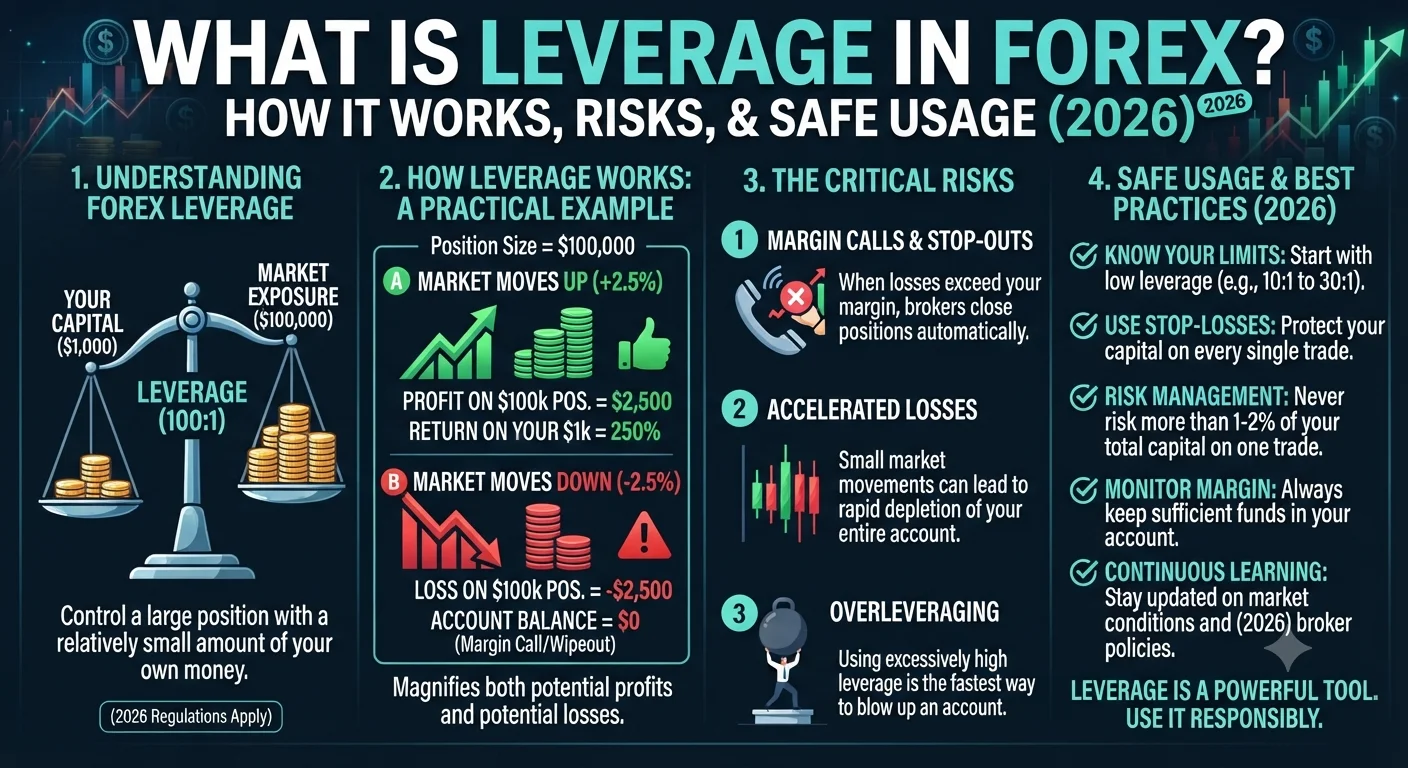
Leverage in forex trading is a mechanism that allows a trader to control a position much larger than their actual account balance. With 1:100 leverage, a trader with $1,000 in their account can control a position worth $100,000 in the market. Leverage amplifies both potential profits and potential losses by the same multiple. A 1 percent favorable price move on a 1:100 leveraged position produces a 100 percent return on the capital committed. A 1 percent adverse move produces a 100 percent loss of that same capital. It is the most powerful and most dangerous tool in retail forex trading.
Introduction
- Quick Answer: What Is Leverage in Forex?
- Introduction
- Defining Leverage in Forex Trading
- How Leverage Works: A Step-by-Step Example
- Common Leverage Ratios: Understanding the Scale
- What Is Margin in Forex and How Is It Related to Leverage?
- What Is a Margin Call and How to Avoid One
- Regulatory Leverage Limits by Region
- How to Use Leverage Responsibly in 2026
- Key Takeaways
- Frequently Asked Questions
No single feature of the forex market generates more excitement among new traders and more damage to their accounts than leverage. The ability to control large positions with small amounts of capital is the core marketing proposition of retail forex brokers, and it attracts traders who see the potential for outsized returns without fully internalizing what that same multiplier does to losses.
The Bank for International Settlements has documented that retail forex traders consistently take on leverage significantly in excess of what experienced risk management professionals would consider prudent. The results are predictable. Data from regulated brokers in the European Union, published annually under MiFID II retail client outcome disclosure requirements, consistently shows that the vast majority of retail trading accounts lose money, with excessive leverage identified as a primary contributor.
This does not mean leverage is inherently dangerous or that it should be avoided entirely. Professional traders and institutions use leverage routinely and effectively. The difference is that they use it within clearly defined risk management frameworks that limit the capital exposed to any single trade. Understanding how leverage actually works, how margin requirements are calculated, what triggers a margin call, and what leverage level is genuinely appropriate for a developing trader is essential knowledge that transforms leverage from a wealth destroyer into a manageable tool.
Defining Leverage in Forex Trading
Leverage in forex is expressed as a ratio. A 1:50 leverage ratio means that for every $1 of your own capital committed to a trade, the broker provides $49 of additional capital, allowing you to control $50 of market position. A 1:100 ratio means your $1 controls $100. A 1:500 ratio means your $1 controls $500.
The practical effect is that leverage allows traders with modest account sizes to participate meaningfully in a market where standard contract sizes (one standard lot of most major pairs equals $100,000 in the base currency) would otherwise be inaccessible. Without leverage, a trader would need $100,000 simply to trade one standard lot of EUR/USD. With 1:100 leverage, the same position requires only $1,000 in margin.
This accessibility has democratized forex trading, making it available to hundreds of millions of retail participants worldwide who would not otherwise have access to currency markets. But accessibility without understanding is dangerous, and leverage is the variable that most directly determines whether a trader's career is measured in years or in weeks.
It is important to note that leverage in retail forex is typically implicit rather than explicit. When you open a trading account and select your leverage ratio, you are agreeing to a margin requirement framework rather than literally borrowing money in the traditional sense. Most retail forex brokers operate on a principal basis, meaning they are your counterparty rather than a lender in the legal sense. The leverage ratio determines how much of your own capital must be committed as margin to open and maintain positions.
How Leverage Works: A Step-by-Step Example
A concrete numerical example makes the mechanics of leverage immediately clear.
Suppose you have a $2,000 trading account and your broker offers 1:100 leverage. You analyze EUR/USD and decide to buy one mini lot (10,000 units of the base currency) at 1.0850.
Without leverage, one mini lot of EUR/USD would require $10,850 in capital, which is more than your entire account. With 1:100 leverage, the margin required to open this position is $10,850 divided by 100, which equals $108.50. This is the capital held by your broker as collateral while the trade is open.
- How to Read Forex Charts: Candlestick Patterns for Beginners (2026)
- How Does the Foreign Exchange Market Work? Full Structure Explained (2026)
- What Is Forex Trading? A Complete Beginners Guide for 2026
Scenario A: EUR/USD rises 50 pips to 1.0900. On a mini lot, each pip is worth approximately $1. Your profit is $50. On the $108.50 margin committed, this represents a return of approximately 46 percent from a 50-pip move, which in absolute dollar terms represents only a 0.46 percent move in the exchange rate. This is the amplifying effect of leverage working in your favor.
Scenario B: EUR/USD falls 50 pips to 1.0800. Your loss is $50 on the trade, again representing a 46 percent loss on the margin committed from a 0.46 percent adverse move in the exchange rate.
Scenario C: EUR/USD falls 200 pips to 1.0650. Your loss is $200, which represents approximately 185 percent of the margin committed and 10 percent of your total account balance. This is still manageable if you had placed a stop-loss before the trade reached this level, but it illustrates how quickly losses accumulate against the margin requirement without proper risk control.
The key insight is that leverage does not change the pip value of currency movements or the size of market fluctuations. It changes how much of your own capital is exposed to those movements. The market moves the same 50 pips regardless of your leverage ratio. Leverage determines how much that 50-pip move costs or earns you relative to the capital you deposited.
Common Leverage Ratios: Understanding the Scale
Leverage ratios available to retail traders vary significantly by jurisdiction and broker type. Understanding the practical implications of different ratios helps you choose an appropriate starting point.
| Leverage Ratio | Margin Required per $10,000 Position | 1% Adverse Move Loss | Account Impact on $1,000 Account |
|---|---|---|---|
| 1:5 | $2,000 | $100 | 10% of account |
| 1:10 | $1,000 | $100 | 10% of account |
| 1:30 | $333 | $100 | 10% of account |
| 1:50 | $200 | $100 | 10% of account |
| 1:100 | $100 | $100 | 10% of account |
| 1:500 | $20 | $100 | 10% of account |
An important observation from this table: the percentage loss on your total account from a 1 percent adverse price movement is the same regardless of the leverage ratio, because the pip value of the position does not change. What changes is the margin required to open the position. Higher leverage requires less margin, which means a trader with a $1,000 account can open more positions simultaneously, increasing aggregate exposure and risk.
This is the true danger of high leverage for retail traders: not the leverage ratio itself but the temptation it creates to open multiple large positions simultaneously, creating a total exposure that can devastate the account on a single adverse market day.
What Is Margin in Forex and How Is It Related to Leverage?
Margin and leverage are two sides of the same coin. Leverage is expressed as the ratio of position control to capital required. Margin is expressed as the percentage of a position's value that must be held as collateral.
The relationship is: Margin Percentage = 1 / Leverage Ratio
At 1:100 leverage, the margin requirement is 1 percent. At 1:50 leverage, the margin requirement is 2 percent. At 1:30 leverage (the EU regulatory maximum for major pairs), the margin requirement is 3.33 percent.
When you open a position, your broker reserves the required margin from your account balance. This reserved margin is called used margin. The remaining balance available to open new positions is called free margin or usable margin. The ratio of your total account equity to your used margin is called the margin level, typically expressed as a percentage.
Understanding these terms is critical for avoiding margin calls and stop-outs.
Account Equity is your account balance plus or minus the floating profit or loss on any open positions. As your open positions move against you, your equity falls even though your account balance (the settled cash figure) remains unchanged.
Used Margin is the total margin reserved across all open positions.
Free Margin is Account Equity minus Used Margin. If your free margin falls to zero, you cannot open any additional positions.
Margin Level is calculated as (Account Equity / Used Margin) x 100. A margin level of 100 percent means your equity exactly equals your used margin. Brokers typically trigger a margin call at a margin level between 50 and 100 percent, and a stop-out (forced closure of positions) at a margin level between 20 and 50 percent, depending on their specific policy.
What Is a Margin Call and How to Avoid One
A margin call occurs when your account equity falls to a level where the broker warns you that you must either deposit additional funds or close positions to bring your margin level back above the required threshold. If you do not respond, the broker's automated system issues a stop-out, which forcibly closes your losing positions starting with the largest, until the margin level recovers.
The margin call is not a malicious action by the broker. It is a risk management mechanism that protects both parties: the broker from having a client owe more than their account balance, and the client from losses that exceed their deposited funds.
However, in practice, a margin call almost always represents a severe failure of risk management that has allowed losses to compound far beyond what should have been permitted by a properly placed stop-loss system. A trader who reaches a margin call has typically either been trading without stop-losses, moved their stop-losses when price approached them, been holding positions through a rapid, unexpected adverse move without adequate protection, or opened far too many positions simultaneously relative to their account size.
Recommended Articles
 FOREX TRADING BASICS
 FOREX TRADING BASICS
 FOREX TRADING BASICS
 FOREX TRADING BASICS
The most effective way to avoid margin calls is never to allow your used margin to represent more than a small fraction of your total account equity. A practical guideline is to keep used margin below 10 percent of your account balance at any time. At this level, even a severe adverse move against all open positions simultaneously would need to be extraordinary in scale before approaching a margin call situation.
Monitoring your margin level in real time is straightforward on all major trading platforms. MetaTrader 4 and MT5 display account equity, used margin, free margin, and margin level continuously in the terminal window at the bottom of the platform. Checking these figures before opening any new position should be standard practice.
Regulatory Leverage Limits by Region
Recognizing the damage that excessive leverage causes to retail traders, financial regulators in multiple jurisdictions have imposed mandatory leverage caps that brokers operating within their regulatory framework must observe.
European Union: Under the European Securities and Markets Authority (ESMA) framework, implemented in 2018 and maintained through subsequent reviews, retail client leverage is capped at 1:30 for major currency pairs, 1:20 for non-major currency pairs and gold, 1:10 for commodities other than gold, 1:5 for individual equities and other reference values, and 1:2 for cryptocurrency CFDs.
United Kingdom: The Financial Conduct Authority implemented equivalent leverage restrictions following Brexit. UK retail forex traders face the same 1:30 maximum for major pairs under FCA rules, with the same tiered structure for other instruments.
United States: The Commodity Futures Trading Commission and National Futures Association limit retail forex leverage to 1:50 for major currency pairs and 1:20 for all other currency pairs, making US regulations somewhat more permissive than EU rules for major pairs but stricter for minors and exotics.
Australia: ASIC implemented retail leverage restrictions broadly aligned with the ESMA framework in 2021, capping major pair leverage at 1:30 for retail clients.
Offshore Jurisdictions: Brokers regulated by authorities in jurisdictions such as Vanuatu, Belize, the Seychelles, and certain Caribbean nations frequently offer leverage of 1:500 or higher. These brokers are not subject to the investor protection requirements of tier-one regulators. While some operate legitimately, trading with offshore-regulated brokers carries substantially higher counterparty risk and fewer legal protections.
The existence of leverage caps in regulated markets reflects a considered policy judgment by financial regulators, informed by extensive data on retail trading outcomes, that high leverage is a primary driver of retail client losses. For a developing trader, voluntarily choosing to trade within these regulated leverage parameters, even if your broker offers higher leverage, is a meaningful risk management decision.
How to Use Leverage Responsibly in 2026
The professional approach to leverage is not to maximize the ratio your broker offers but to use the minimum leverage necessary to achieve properly sized positions given your account balance and risk parameters.
For a trader with a $2,000 account who wants to risk 1 percent per trade ($20) with a 20-pip stop-loss, and whose pip value on a mini lot is $1, the correct position size is one mini lot ($20 / 20 pips x $1 per pip = 1 mini lot). To open a one mini lot position in EUR/USD, the margin required at 1:30 leverage is approximately $36. This means the effective leverage being used is approximately 1:30, the regulatory minimum, which is also the appropriate level for this trade size relative to account balance.
Many experienced traders deliberately operate at effective leverage ratios well below the regulatory maximum, typically between 1:5 and 1:20 for individual trades, as a result of their position sizing discipline. The maximum leverage your broker offers is a ceiling, not a recommendation.
A practical framework for responsible leverage use involves four commitments. First, calculate correct position size using the risk management formula before every trade rather than selecting leverage or lot size intuitively. Second, never allow total used margin to exceed 10 percent of account equity across all open positions simultaneously. Third, always use stop-loss orders on every position, sized to fit the market structure of each specific trade rather than arbitrarily. Fourth, choose a regulated broker operating under tier-one regulatory oversight with mandatory leverage caps and negative balance protection.
Key Takeaways
- Leverage allows traders to control positions larger than their account balance by committing a fraction of the position value as margin, amplifying both potential profits and potential losses by the same multiple.
- The danger of high leverage for retail traders is not the ratio itself but the temptation to open multiple large positions simultaneously, creating aggregate exposure that can devastate an account in a single session.
- Margin, used margin, free margin, and margin level are interconnected metrics that every active trader must monitor continuously to avoid margin calls and stop-outs.
- Regulatory bodies in the EU, UK, US, and Australia have imposed leverage caps on retail traders specifically because data consistently shows excessive leverage as a primary driver of retail account losses.
- Responsible leverage use means calculating the position size required by your risk management rules and using whatever leverage ratio is necessary to achieve that position size, rather than maximizing leverage to open the largest possible position.
- A practical starting guideline is to keep total used margin below 10 percent of account equity at all times and to trade at effective leverage ratios between 1:5 and 1:20 per individual position.
Frequently Asked Questions
Is higher leverage always better in forex? No. Higher leverage increases the capital efficiency of your positions but also accelerates the speed at which losses consume your account. For a trader with sound risk management and properly sized positions, higher leverage simply reduces the margin required per trade. For a trader without disciplined position sizing, higher leverage dramatically increases the probability and speed of account depletion. Most professional risk managers recommend using the minimum leverage necessary to execute your intended position size, not the maximum your broker offers.
What happens if my losses exceed my account balance? In the absence of negative balance protection, a trader could theoretically owe money to their broker beyond their deposited funds. This situation can arise during extreme market events such as flash crashes or sudden large gaps caused by unexpected news. Under EU, UK, and Australian regulations, brokers are required to offer negative balance protection to retail clients, meaning your losses cannot exceed your deposited funds. US regulations achieve a similar result through different mechanisms. Traders using offshore-regulated brokers without negative balance protection face genuine risk of owing funds beyond their account balance.
What leverage should a complete beginner use? Beginners are consistently best served by the lowest available leverage, ideally 1:10 or lower, during their learning period. This is not because low leverage produces better analytical results but because it provides a longer runway to develop skills before errors in position sizing or stop-loss management become account-ending events. As risk management discipline becomes consistent and automatic, the position sizes dictated by the 1 percent rule at the trader's actual account size determine the effective leverage used, making the maximum available ratio less relevant.
Can I change my leverage ratio after opening an account? Yes. Most brokers allow you to adjust your account leverage ratio through your account settings or client portal. Changing the leverage ratio affects the margin required for new positions opened after the change. It does not affect margin calculations for positions already open. You can typically switch between available leverage options freely, subject to any regulatory restrictions applicable to your jurisdiction.
What is a leverage ratio of 1:400 in practice? A leverage ratio of 1:400 means that $1 of your capital controls $400 of market position. The margin required to open a $100,000 standard lot position would be $250. While this sounds efficient, it means that a 0.25 percent adverse move against a standard lot position ($250) wipes out the entire margin commitment. A 1 percent adverse move, which occurs routinely in forex markets, would produce a $1,000 loss on a $250 margin position. Leverage ratios above 1:100 are generally incompatible with sound risk management for retail traders and are prohibited in most tier-one regulated markets for exactly this reason.
Does leverage affect the spread I pay on each trade? No. The spread is determined by the difference between the bid and ask price quoted by your broker or liquidity provider and is unrelated to your leverage ratio. A one-pip spread on EUR/USD costs the same in pips regardless of whether you are trading at 1:10 or 1:200 leverage. What leverage does affect is the dollar value of that spread cost relative to the margin you committed to open the position.
RISK DISCLAIMER: Leverage in forex trading significantly increases both the potential for profit and the potential for loss. This article is for educational purposes only and does not constitute financial advice. Trading with leverage can result in losses exceeding your initial deposit. Please ensure you fully understand the risks before trading.