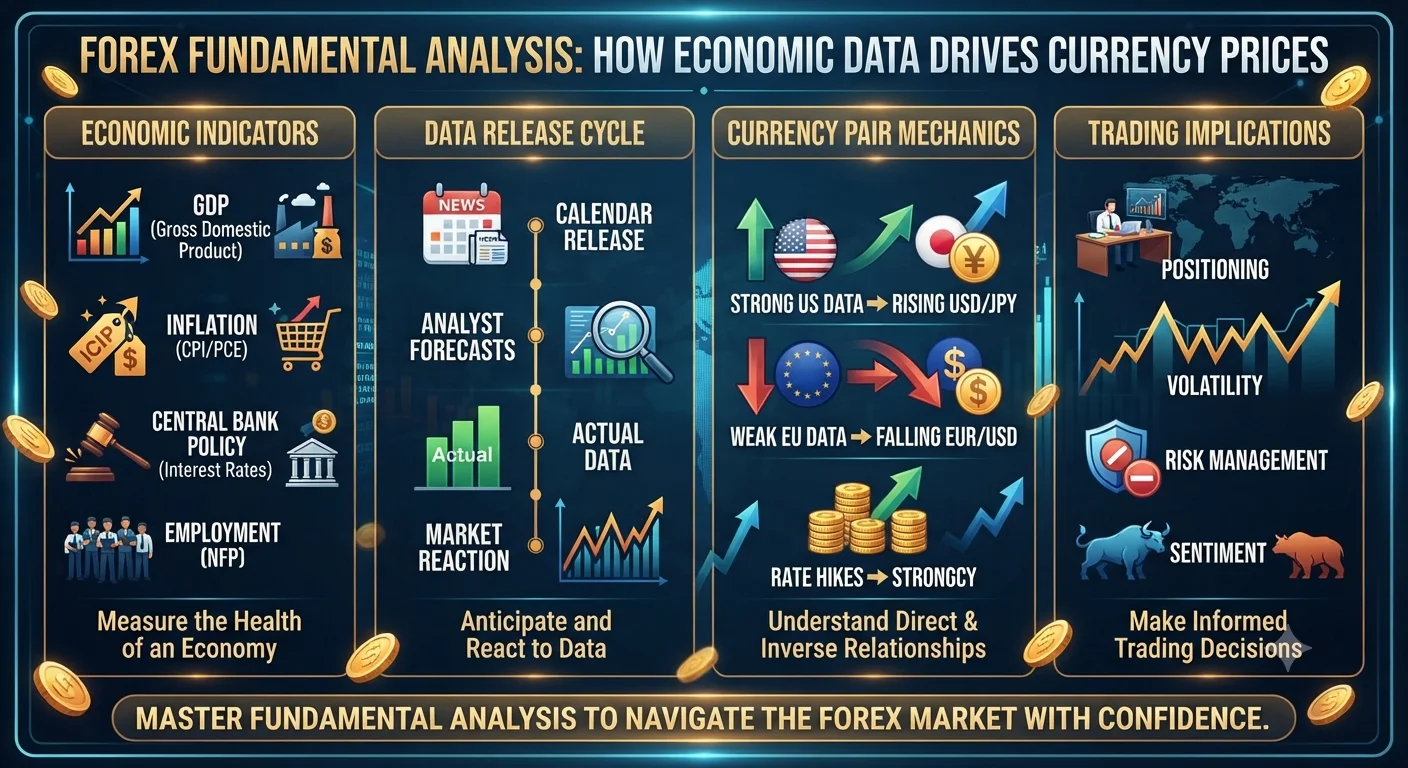
Quick Answer: What Is Fundamental Analysis in Forex?
Fundamental analysis in forex is the evaluation of economic, political, and monetary factors that influence the long-term value of one currency relative to another. Rather than studying price charts, fundamental analysts examine interest rate differentials between central banks, relative economic growth rates, inflation dynamics, trade balances, and geopolitical conditions to determine which currency in a pair should appreciate or depreciate over time. It is the framework used by institutional investors, central banks, and macro hedge funds to form long-term currency views.
Introduction
- Quick Answer: What Is Fundamental Analysis in Forex?
- Introduction
- The Interest Rate Effect: Central Banks and Currency Value
- The Federal Reserve: How Fed Policy Moves the USD
- The European Central Bank: ECB Policy and EUR Direction
- The Bank of Japan: Yield Curve Control and the Carry Trade
- Other Key Central Banks: BOE, RBA, BOC, and SNB
- Inflation Data and Currency Purchasing Power
- GDP Reports: Measuring National Economic Health
- Political Risk and Currency Markets: Geopolitics in 2026
- How to Combine Fundamental and Technical Analysis
- Key Takeaways
- Frequently Asked Questions
In the short term, currency prices can move for many reasons: a large institutional order, a rumor, a technical stop-loss cascade, or pure speculative momentum. In the long term, currency prices converge toward levels determined by economic fundamentals. This is not a theoretical claim. It is one of the most consistently documented relationships in the academic literature on international economics.
The foundational principle is that currencies are claims on national economies. A currency backed by a growing economy with low inflation, high interest rates, and stable institutions should appreciate over time relative to a currency backed by a stagnant economy with high inflation, low rates, and political instability. The purchasing power of money flows toward where it earns the best real return, and exchange rates adjust to reflect those flows.
Understanding forex fundamental analysis means understanding the specific mechanisms through which economic conditions translate into currency price movements. This article covers the most important fundamental drivers, how to analyze each major central bank and its currency, and how to integrate fundamental analysis with technical tools to produce higher-quality trading decisions in 2026.
The Interest Rate Effect: Central Banks and Currency Value
Interest rates set by central banks are the most powerful and most directly measurable long-term driver of exchange rates. The mechanism is the carry: investors naturally move capital toward the currency that offers the highest return for an equivalent risk level. When one country's central bank raises interest rates while another holds rates steady or cuts them, capital flows toward the higher-yielding currency, increasing demand and strengthening its exchange rate.
This relationship is captured theoretically by the Interest Rate Parity condition, which holds that the interest rate differential between two countries should equal the expected change in their exchange rate. In practice, markets frequently deviate from strict interest rate parity, creating the trading opportunities that currency investors seek.
The practical implication for traders is that following the relative monetary policy direction of the two central banks in a currency pair is the most reliable compass for the pair's long-term direction. A central bank that is raising rates (hawkish) while its counterpart is cutting (dovish) creates a widening interest rate differential that acts as a sustained tailwind for the hawkish country's currency.
The Federal Reserve: How Fed Policy Moves the USD
The Federal Reserve is the world's most influential central bank, and its monetary policy decisions move not just the US dollar but effectively every major currency pair and global asset class. The Fed's dual mandate, established by the Federal Reserve Act, is to promote maximum employment and stable prices (targeting approximately 2 percent annual inflation as measured by the PCE deflator).
The primary tool the Federal Reserve uses to pursue this mandate is the federal funds rate, which is the target interest rate at which banks lend to each other overnight. Eight times per year, the Federal Open Market Committee (FOMC) meets to assess economic conditions and set the federal funds rate target. The FOMC statement, the updated Summary of Economic Projections (also called the "dot plot"), and the Fed Chair's press conference following each meeting are among the most closely watched events in global financial markets.
The pattern of Fed policy impacts on the US dollar is well-documented in both academic research and market practice. When the Fed signals or delivers rate increases, dollar strength tends to follow as capital flows toward higher US yields. When the Fed pivots toward rate cuts, dollar weakness tends to emerge as yield differentials compress. The magnitude of market reaction often depends less on the rate decision itself than on how the Fed's communication shifts the market's expectation for the future path of rates.
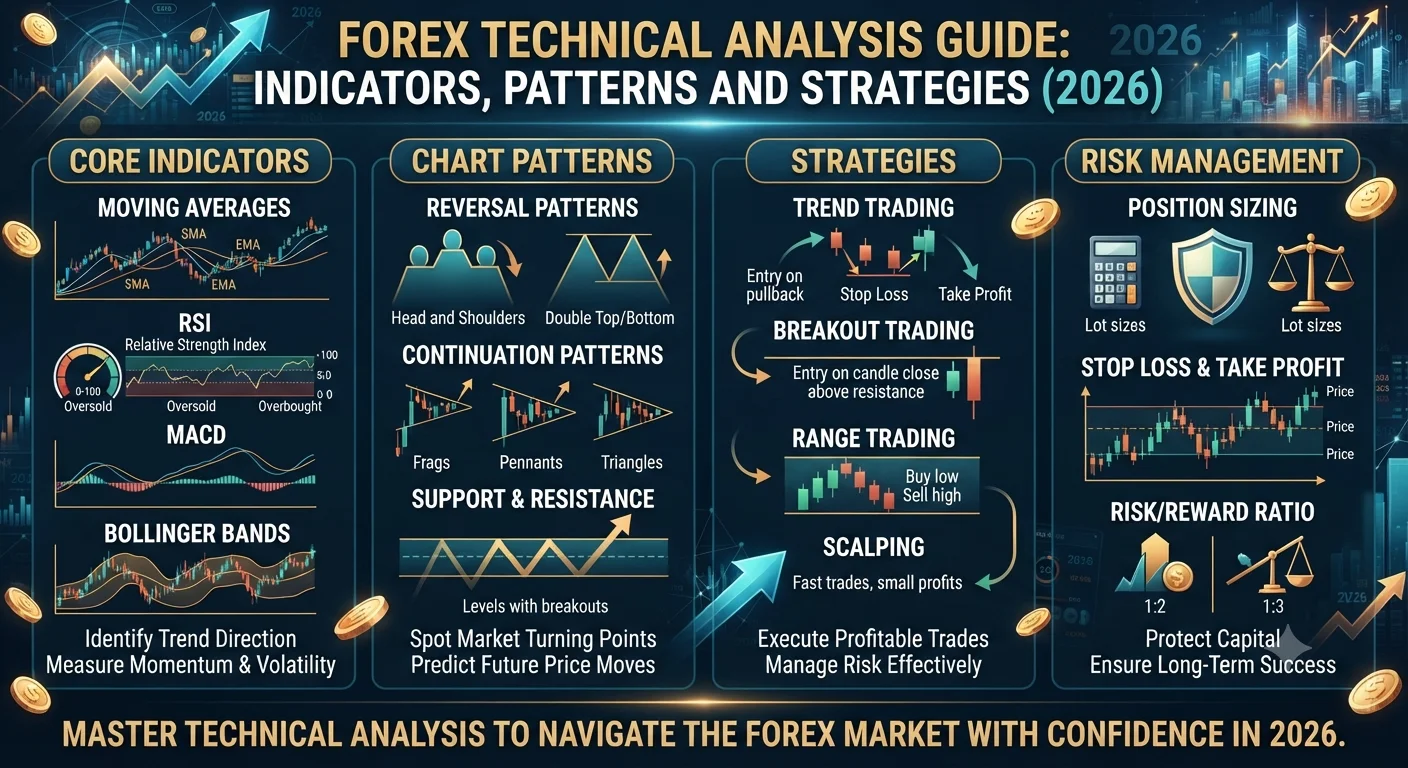
- Forex Technical Analysis Guide: Indicators, Patterns and Strategies (2026)
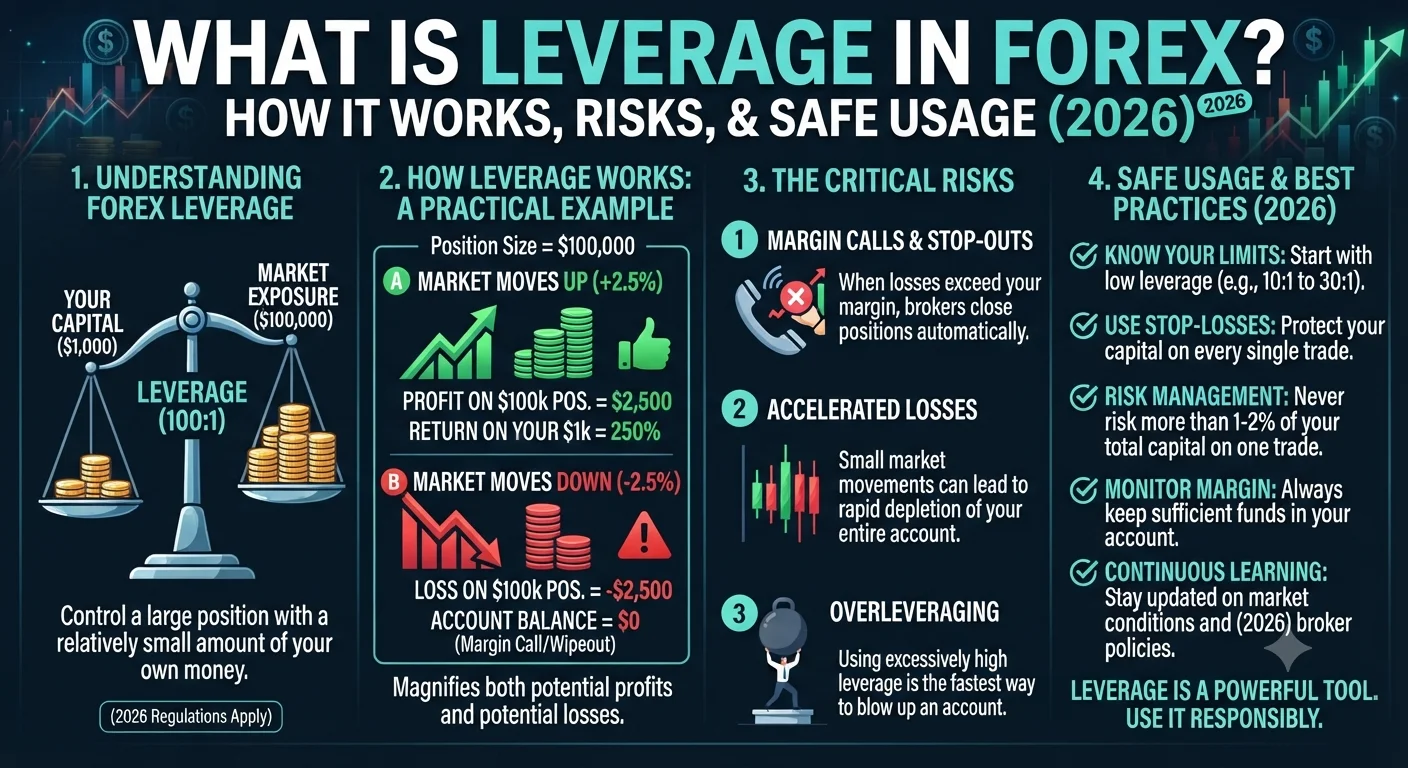
- What Is Leverage in Forex? How It Works, Risks, and Safe Usage (2026)
- How to Read Forex Charts: Candlestick Patterns for Beginners (2026)
The dot plot, which shows each FOMC member's projection for the federal funds rate at year-end for the next several years, is particularly valuable for understanding the Fed's trajectory. A shift in the median dot projection upward signals a more hawkish committee; a shift downward signals a more dovish one, and both shifts produce immediate dollar reactions.
The European Central Bank: ECB Policy and EUR Direction
The European Central Bank (ECB) sets monetary policy for the 20 member countries of the Eurozone and is the primary fundamental driver of the euro's value. The ECB's mandate, defined by the Treaty on the Functioning of the European Union, is price stability, defined as maintaining inflation below but close to 2 percent over the medium term. Unlike the Federal Reserve, the ECB has no explicit employment mandate, though it considers labor market conditions as part of its broader economic assessment.
ECB policy decisions are announced following Governing Council meetings, which occur approximately every six weeks. The ECB president's press conference following each decision is scrutinized for forward guidance language. Phrases indicating concern about above-target inflation and potential rate increases are hawkish signals for the euro. Language about growth risks and openness to accommodation are dovish signals that typically weigh on EUR.
The inherent complexity of the ECB's position relative to the Fed reflects the structural challenge of setting a single monetary policy for 20 economies with different growth rates, fiscal positions, and inflation dynamics. Germany's economic performance, as the Eurozone's largest economy, disproportionately shapes ECB policy, which can create tensions with smaller member states facing different economic conditions.
The Bank of Japan: Yield Curve Control and the Carry Trade
The Bank of Japan (BOJ) occupies a unique position among major central banks due to its decades-long experiment with unconventional monetary policy. Having battled deflation and economic stagnation since the 1990s, the BOJ maintained near-zero or negative interest rates and a policy called Yield Curve Control (YCC) for an extended period, targeting the 10-year Japanese government bond yield at approximately zero percent.
The BOJ's ultra-loose policy stance made the yen the world's premier funding currency for the carry trade: investors borrowed cheaply in yen and invested the proceeds in higher-yielding currencies and assets, selling yen in the process and keeping the currency under persistent downward pressure. The gradual normalization of BOJ policy that began in 2022 and accelerated through 2024 to 2026 produced significant yen volatility as the basis for the carry trade was progressively undermined.
BOJ policy announcements are among the most binary events in forex: when the BOJ surprises markets by adjusting its policy framework, the resulting yen movements can be enormous and swift. The historic yen strengthening episode in 2022 to 2023 and subsequent volatility made USD/JPY one of the most consequential and most watched currency pairs in the global market.
Other Key Central Banks: BOE, RBA, BOC, and SNB
Beyond the three most systemically important central banks, several others produce regular significant trading opportunities:
The Bank of England (BOE) sets monetary policy for the United Kingdom and is the primary driver of GBP. The BOE's Monetary Policy Committee meets eight times per year and publishes quarterly Monetary Policy Reports providing detailed economic forecasts and policy rationale.
The Reserve Bank of Australia (RBA) governs the Australian dollar, which is particularly sensitive to commodity prices (especially iron ore and coal) and economic conditions in China, Australia's largest trading partner. The RBA meets 11 times per year.
The Bank of Canada (BOC) governs the Canadian dollar, which has a strong sensitivity to crude oil prices given Canada's status as a major oil exporter. The BOC meets eight times annually.
The Swiss National Bank (SNB) governs the Swiss franc, a traditional safe-haven currency that strengthens during periods of global uncertainty. The SNB meets only quarterly, making its meetings particularly high-impact events for CHF pairs.
Inflation Data and Currency Purchasing Power
Inflation erodes the purchasing power of a currency over time. A country with persistently higher inflation than its trading partners will see its currency depreciate in the long run as each unit of the currency buys progressively fewer goods and services internationally. This relationship is formalized in the theory of Purchasing Power Parity (PPP), originally developed by Swedish economist Gustav Cassel and later refined by researchers including Paul Samuelson and Bela Balassa.
For forex traders, the most important inflation data points are those that influence central bank behavior. The Consumer Price Index (CPI) and the Personal Consumption Expenditures (PCE) price index are the two measures most closely followed by the Federal Reserve. The Eurozone's Harmonised Index of Consumer Prices (HICP) drives ECB analysis. The UK's CPI is the BOE's primary measure.
When inflation rises above a central bank's target and appears persistent rather than temporary, markets begin pricing in rate increases to control it, which strengthens the currency. When inflation falls below target or concerns arise about deflation, expectations of rate cuts emerge, which weakens the currency.
The relationship between inflation and currency value is not always simple. A country experiencing high inflation driven by supply-side factors (energy price shocks, supply chain disruptions) may see its currency weaken even as nominal interest rates rise, if the real interest rate (nominal rate minus inflation) remains negative or low relative to trading partners. This nuance is why experienced fundamental analysts look at real interest rate differentials rather than just nominal rates when assessing relative currency attractiveness.
Recommended Articles
 FOREX TRADING BASICS
 FOREX TRADING BASICS
 FOREX TRADING BASICS
 FOREX TRADING BASICS
GDP Reports: Measuring National Economic Health
Gross Domestic Product growth data provides the broadest single measure of an economy's health and trajectory. Strong GDP growth supports currency strength through multiple channels: it validates high interest rates as sustainable, attracts foreign investment seeking exposure to a growing economy, and generates trade flows that create currency demand.
The sequence of GDP releases is important for traders to understand. In the United States, the Bureau of Economic Analysis releases GDP data in three iterations: the advance estimate (approximately 30 days after quarter end), the second estimate (approximately 60 days after), and the third estimate (approximately 90 days after). Markets react most strongly to the advance estimate because it is the first reading. Subsequent revisions typically receive less market attention unless they are unusually large.
GDP growth that significantly exceeds or falls below consensus expectations produces the most powerful market reactions. A strong GDP beat that convincingly demonstrates economic momentum gives the central bank confidence to maintain or increase interest rates, supporting the currency. A GDP miss that raises recession concerns typically prompts speculation about rate cuts, weakening the currency.
Traders also watch the composition of GDP growth. Growth driven by strong private consumption and business investment is more sustainable and more bullish for the currency than growth driven primarily by government spending or inventory building. Similarly, growth accompanied by rising wages and employment is qualitatively stronger than GDP expansion driven solely by productivity-neutral factors.
Political Risk and Currency Markets: Geopolitics in 2026
Political stability, institutional quality, and geopolitical relationships are fundamental inputs into currency valuation that operate on longer time horizons than economic data but can produce sudden, dramatic market movements when they shift unexpectedly.
Countries with strong, independent legal and regulatory institutions, transparent governments, and stable political systems attract international investment and trade on better terms than countries where political risk is elevated. This institutional quality premium is reflected in currency valuations over time, explaining why currencies like the Swiss franc, the Singapore dollar, and the Japanese yen maintain safe-haven status even during periods when their economic fundamentals are not superior to alternatives.
Geopolitical events that affect currency markets in 2026 include:
Trade policy shifts: Tariffs, trade agreements, and import restrictions directly affect the trade flows that drive currency demand. Countries that are net exporters of goods in high global demand see sustained currency support from trade flows. Sudden tariff escalations between major trading partners can rapidly alter these dynamics.
Sanctions and financial restrictions: Financial sanctions imposed by major Western economies on specific countries effectively remove those countries' currencies from large portions of the global financial system, producing severe currency depreciation as exemplified by the Russian ruble experience in 2022.
Elections and policy uncertainty: Currency markets typically price in uncertainty ahead of elections that could produce significant policy shifts. A central bank whose independence might be threatened by an incoming government, or a country facing a choice between fiscal austerity and expansion, will see its currency affected by shifting election probabilities.
Armed conflict: Military conflicts near economically significant regions or involving countries with systemically important currencies produce immediate safe-haven flows into the USD, CHF, and JPY as investors reduce risk across the board.
How to Combine Fundamental and Technical Analysis
The most effective forex trading approach in 2026 integrates both analytical frameworks in a structured sequence:
Step 1: Establish the fundamental bias. Using the tools covered in this article, determine which currency in a pair should appreciate over the medium term based on relative interest rate trajectories, economic growth differentials, and current monetary policy stances. This gives you your directional bias: should you be looking to buy or sell this pair over the coming weeks and months?
Step 2: Identify key fundamental events. Review the economic calendar for upcoming high-impact releases relevant to your currency pair: central bank meetings, inflation reports, GDP data, and employment figures. Note the consensus expectations and the previous reading.
Step 3: Apply technical analysis for entry timing. Once your fundamental bias is established, use technical analysis (as covered in the technical analysis guide) to identify the optimal entry point within the context of your fundamental view. Wait for price to reach a significant technical support or resistance level that is consistent with your entry direction. Look for a confirming candlestick pattern or indicator signal at that level before executing.
Step 4: Size and manage the position. Apply your risk management framework: calculate the correct position size for your stop-loss placement, verify that the risk-to-reward ratio meets your minimum threshold, and set your take-profit at the next significant technical level.
Step 5: Monitor fundamental developments. While the trade is open, track whether the fundamental thesis that motivated it remains intact. A change in the relative monetary policy outlook that contradicts your original thesis is a valid reason to close or reduce the position, even if technical levels have not been breached.
Key Takeaways
- Fundamental analysis evaluates economic, monetary, and political factors to determine the long-term relative value of currencies, providing the directional framework within which technical analysis identifies entry and exit points.
- Interest rate differentials between central banks are the most powerful and most directly measurable long-term driver of exchange rates, with capital flowing toward the higher-yielding currency in a pair.
- The Federal Reserve, European Central Bank, and Bank of Japan are the three most systemically important central banks in forex markets, with their relative policy stances directly driving the direction of the world's most traded currency pairs.
- Inflation dynamics determine both the purchasing power trajectory of currencies over time and the central bank policy response that drives shorter-term exchange rate movements.
- GDP growth data, political stability, and geopolitical developments are secondary but significant fundamental drivers that can overwhelm monetary policy differentials during extreme events.
- The most robust trading framework combines fundamental analysis to establish directional bias with technical analysis to optimize entry timing, stop-loss placement, and profit target selection.
Frequently Asked Questions
Is fundamental analysis or technical analysis better for forex trading? Neither is universally superior. They serve different purposes in the analytical process. Fundamental analysis is stronger at determining the correct directional bias for medium-term to long-term positions. Technical analysis is stronger at identifying precise entry and exit levels with defined risk parameters. Most professional forex traders and institutional analysts use both: fundamental analysis for direction and technical analysis for execution. The combination produces more robust trading decisions than either approach alone.
How do I follow central bank communications effectively? The most reliable approach is to follow central banks directly through their official publications. The Federal Reserve releases its FOMC statements, meeting minutes, and Chair press conference transcripts on federalreserve.gov. The ECB publishes equivalent materials on ecb.europa.eu. The Bank of Japan publishes on boj.or.jp. For real-time market interpretation of central bank language, financial news services including Bloomberg and Reuters provide immediate analysis, though developing your own reading of central bank communications is a valuable long-term skill.
What is the difference between hawkish and dovish monetary policy? Hawkish monetary policy refers to a central bank stance that prioritizes controlling inflation, typically through higher interest rates and tighter financial conditions. A hawkish central bank is inclined toward raising rates or maintaining them at restrictive levels. Dovish monetary policy prioritizes economic growth and employment, typically through lower interest rates and looser financial conditions. A dovish central bank is inclined toward cutting rates or maintaining accommodative policy. These terms describe positions on a spectrum, and the same central bank shifts between hawkish and dovish orientations as economic conditions change.
How much does geopolitical risk affect currency markets day to day? In the absence of sudden geopolitical events, day-to-day currency movements are driven primarily by economic data and central bank communications rather than geopolitical factors. Geopolitical risk influences currency markets most powerfully through two channels: as a background discount embedded in currencies of countries facing persistent political uncertainty, and as an acute shock factor when unexpected events (elections with surprising outcomes, military escalations, sanctions announcements) force rapid repricing of political risk premiums. The distinction between background and acute geopolitical risk is important for understanding when to elevate its weight in your analysis.
Can I trade forex based solely on fundamental analysis? Yes, but it requires a different approach than short-term chart-based trading. Pure fundamental traders typically hold positions for weeks, months, or longer, based on macro views about the direction of economic and monetary policy cycles. This approach requires acceptance of significant short-term volatility against your position while the fundamental thesis plays out, as well as robust position sizing that allows you to maintain positions through the temporary adverse moves that invariably occur even when the long-term thesis proves correct. Many macro hedge funds operate primarily in this way.
RISK DISCLAIMER: Fundamental analysis is a framework for evaluating currency value drivers and does not guarantee profitable trading outcomes. Economic conditions and central bank policies can change rapidly and unpredictably. This article is for educational purposes only and does not constitute financial advice.