Quick Answer: What Is Bitcoin?
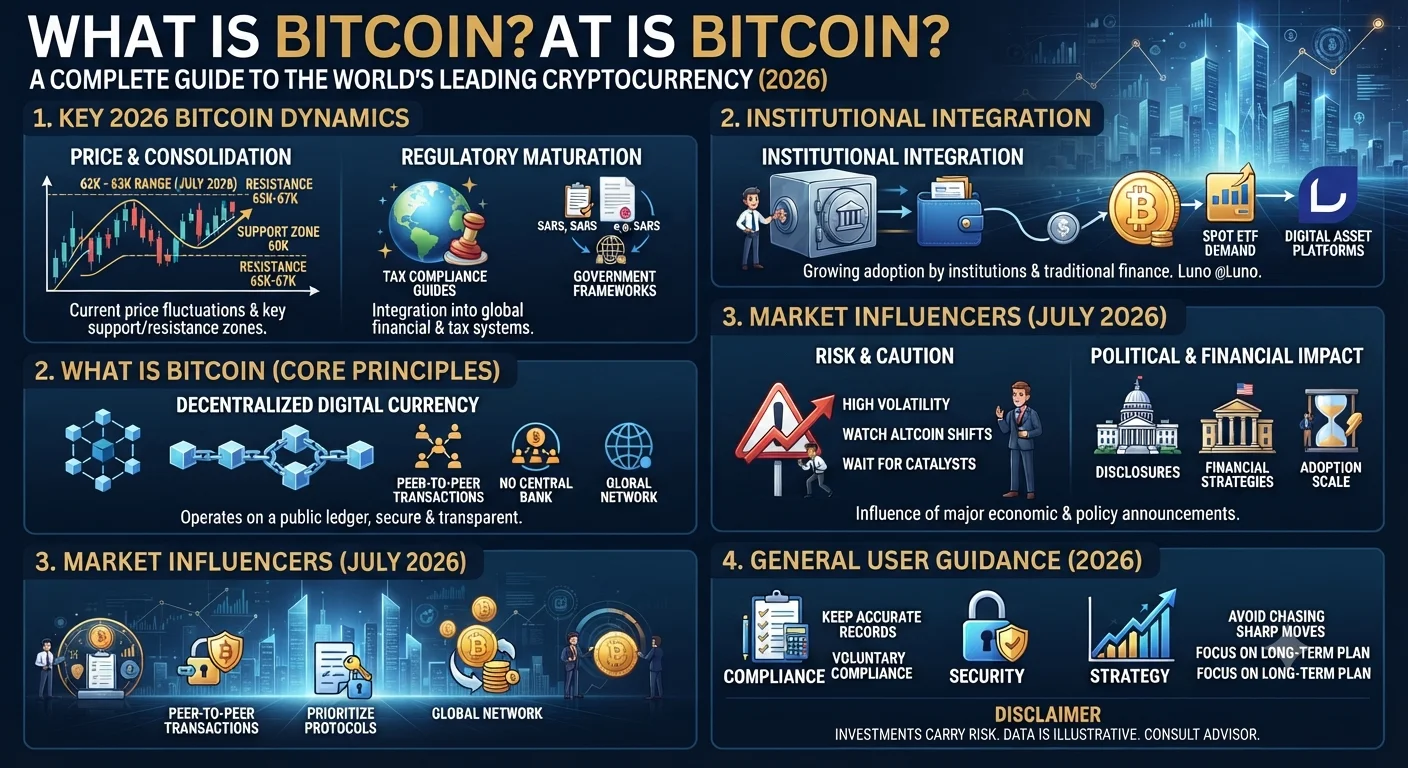
Bitcoin is the world's first decentralized digital currency, created in 2009 by an anonymous individual or group operating under the pseudonym Satoshi Nakamoto. It operates without a central bank or single administrator, using a distributed network of computers and a technology called blockchain to record and verify all transactions. Bitcoin has a fixed maximum supply of 21 million coins, which cannot be altered. This scarcity, combined with growing global adoption, is the foundational argument for its value as a store of wealth.
Introduction
- Quick Answer: What Is Bitcoin?
- Introduction
- Defining Bitcoin: The World's First Decentralized Currency
- How Bitcoin's Blockchain Technology Works
- The Transaction Verification Process
- Bitcoin Mining: How New Coins Are Created
- The Halving: Bitcoin's Disinflationary Design
- What Determines Bitcoin's Price?
- Supply Scarcity and the Halving Effect
- Institutional Adoption and the ETF Era
- Macroeconomic Environment and Monetary Policy
- Regulatory Developments Worldwide
- Bitcoin vs Traditional Currency: Key Differences
- How to Store Bitcoin Safely in 2026
- Key Takeaways
- Frequently Asked Questions
On October 31, 2008, a document titled "Bitcoin: A Peer-to-Peer Electronic Cash System" was published to a cryptography mailing list by a person or group using the name Satoshi Nakamoto. Nine pages long and written with the precision of an academic paper, it described a system for sending value directly between two parties over the internet without requiring a financial institution as an intermediary.
On January 3, 2009, Nakamoto mined the first Bitcoin block, known as the genesis block, embedding a newspaper headline within it: "The Times 03/Jan/2009 Chancellor on brink of second bailout for banks." Whether intentional symbolism or mere timestamp, the embedded headline captured the spirit of what Bitcoin represented: an alternative to a financial system that had just revealed its fragility in catastrophic fashion during the 2008 global financial crisis.
Sixteen years later, Bitcoin is the world's largest cryptocurrency by market capitalization, held by sovereign wealth funds, publicly traded corporations, pension funds, and hundreds of millions of individual investors across the globe. It has generated extraordinary wealth for early adopters and devastating losses for others who bought at cycle peaks. It has been declared dead by mainstream commentators hundreds of times and has survived every prediction of its demise.
Understanding what Bitcoin actually is, how it works technically, what drives its price, and what its legitimate risks are is essential knowledge for anyone participating in or considering participation in the cryptocurrency market in 2026.
Defining Bitcoin: The World's First Decentralized Currency
Bitcoin is simultaneously a payment network, a unit of account, and a store of value. Each function is distinct, and Bitcoin's success in each varies considerably.
As a payment network, Bitcoin allows value to be transferred between any two parties anywhere in the world without a bank, payment processor, or government as intermediary. A person in Pakistan can send Bitcoin to a person in Argentina within minutes, with transaction fees that are typically a fraction of what traditional cross-border wire transfers charge, regardless of the amount sent.
As a unit of account, Bitcoin is divisible to eight decimal places. The smallest unit is called a satoshi (0.00000001 BTC), named after its creator. This divisibility means that even as the price per whole Bitcoin rises, small fractional amounts remain accessible for everyday transactions and micro-investments.
As a store of value, Bitcoin is increasingly compared to gold, earning the informal label "digital gold." This comparison rests on several shared characteristics: scarcity (gold is physically limited in the earth's crust; Bitcoin is algorithmically limited to 21 million coins), durability (gold does not corrode; Bitcoin exists as encrypted code that cannot degrade), portability (large amounts of Bitcoin can be transferred digitally in minutes; equivalent gold requires physical transport), and divisibility (both can be broken into small units). The argument for Bitcoin as digital gold is that in a world of expanding money supplies and periodic currency crises, a fixed-supply, censorship-resistant asset holds appeal as a hedge against monetary debasement.
What makes Bitcoin fundamentally different from all forms of currency and most digital assets that preceded it is its decentralization. No single entity controls the Bitcoin network. No government can print more of it. No corporation can freeze your wallet. No bank can reverse a transaction you have authorized. The rules that govern the network are embedded in open-source code, agreed upon by consensus among the global network of participants, and resistant to unilateral change.
How Bitcoin's Blockchain Technology Works
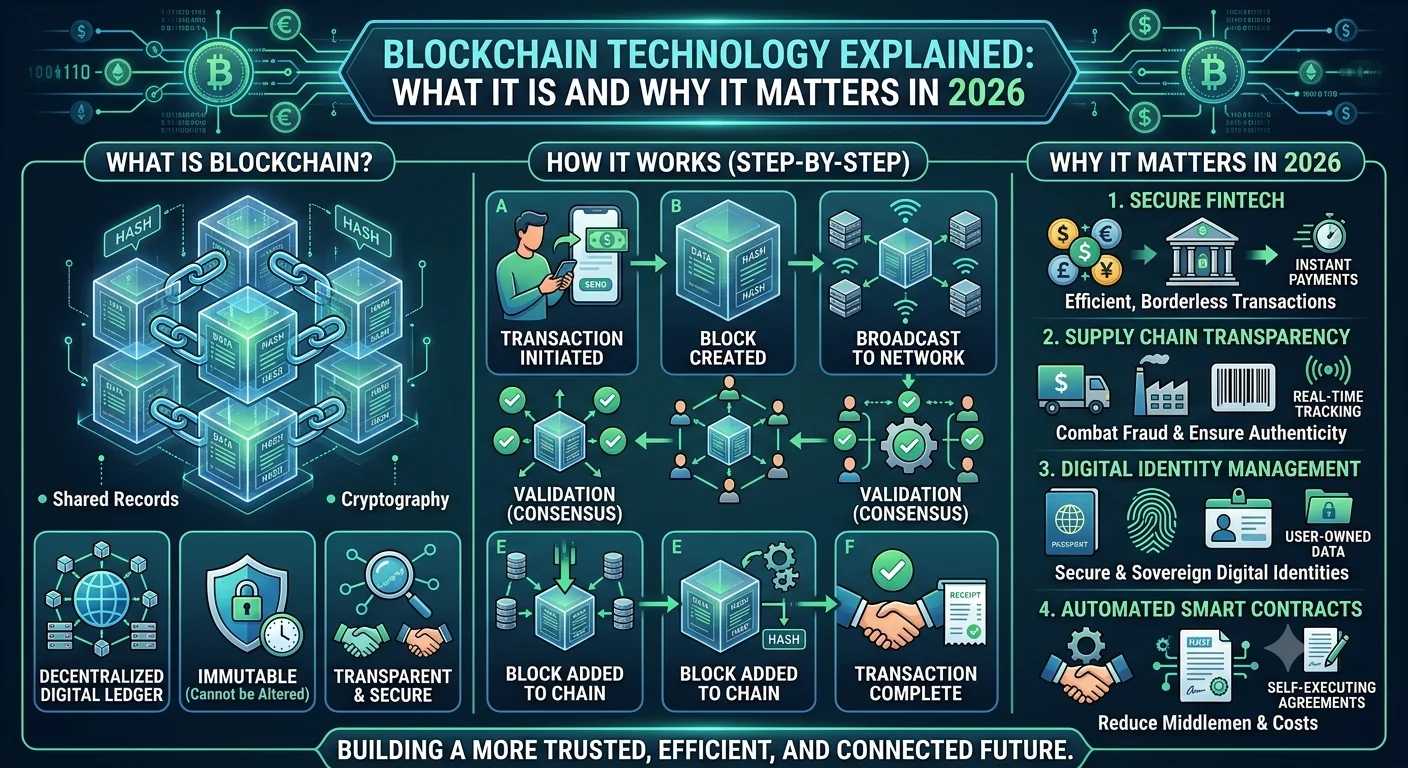
The blockchain is the technological foundation that makes Bitcoin's decentralized operation possible. Understanding it removes the mystery from Bitcoin's seemingly paradoxical claim that it can operate without any central authority while still maintaining a reliable, tamper-proof record of all transactions.
A blockchain is a distributed ledger: a database that is not stored in any single location but is replicated identically across thousands of computers (called nodes) around the world simultaneously. Every node maintains a complete copy of every Bitcoin transaction ever made, stretching back to the genesis block in January 2009.
When a user initiates a Bitcoin transaction, for example sending 0.05 BTC from their wallet to another person's wallet, the transaction is broadcast to the network and enters a pool of unconfirmed transactions called the mempool. Specialized participants called miners then compete to include pending transactions from the mempool into the next block.
Each block is a structured data package containing a batch of validated transactions, a reference to the previous block (the "hash" of the prior block), a timestamp, and a special number called a nonce. The chaining of each block to the previous one through their cryptographic hashes is what gives the blockchain its name and its integrity. To alter any historical transaction, an attacker would need to recalculate every block that followed it and outpace the honest majority of the entire global mining network simultaneously, a computational feat that is currently considered practically impossible for any actor operating within reasonable physical and economic constraints.
The Transaction Verification Process
Bitcoin transactions are verified through a process that involves several steps. When you send Bitcoin, your transaction is signed with your private key, a unique cryptographic string that proves you authorized the transaction without revealing the key itself. This digital signature system, based on elliptic curve cryptography, is what prevents anyone other than you from spending the Bitcoin in your wallet even though the entire transaction history is publicly visible on the blockchain.
Once broadcast, your transaction is verified by nodes that check whether you have sufficient funds (by reviewing the blockchain history), whether the signature is valid, and whether the transaction format meets protocol rules. Valid transactions are then included in blocks by miners. Once a transaction is included in a block and that block is added to the chain, it receives one confirmation. Each additional block added after that provides another confirmation. With six confirmations, a Bitcoin transaction is considered irreversible by most participants in the network.
Bitcoin Mining: How New Coins Are Created
Bitcoin mining is the process by which new Bitcoin transactions are verified and added to the blockchain, and by which new Bitcoin coins are created and introduced into circulation. It is both the security mechanism and the monetary issuance mechanism of the Bitcoin network.
Miners are specialized participants who dedicate powerful computing hardware to the task of solving the cryptographic puzzle required to add each new block to the blockchain. This puzzle, known as the Proof of Work algorithm, requires miners to find a nonce value that, when combined with the block's data and hashed using the SHA-256 algorithm, produces an output that meets a specific target of difficulty.
The difficulty of this target adjusts automatically every 2,016 blocks (approximately every two weeks) to maintain an average block time of approximately 10 minutes, regardless of how much or how little total mining power is directed at the network. As more miners join the network and add computational power, the puzzle becomes harder. If miners leave, the puzzle becomes easier. This self-adjusting difficulty mechanism is one of Bitcoin's most elegant engineering features.
The miner who successfully finds the correct nonce first broadcasts the new block to the network and, if accepted by the consensus rules, receives the block reward: a fixed amount of newly created Bitcoin plus the sum of all transaction fees from the transactions included in that block. The block reward is the only mechanism by which new Bitcoin enters circulation.
The Halving: Bitcoin's Disinflationary Design
The block reward is not fixed permanently. It is programmed to halve approximately every four years, or every 210,000 blocks, in an event the Bitcoin community calls "the halving" or "halvening."
When Bitcoin launched in 2009, the block reward was 50 BTC per block. The first halving in November 2012 reduced it to 25 BTC. The second halving in July 2016 reduced it to 12.5 BTC. The third halving in May 2020 reduced it to 6.25 BTC. The fourth halving in April 2024 reduced it to 3.125 BTC per block.
This programmatic reduction in new supply issuance continues until approximately the year 2140, when the final fraction of Bitcoin will be mined and the total supply reaches its ceiling of 21 million coins. After that point, miners will be compensated exclusively through transaction fees.
The halving mechanism is significant for Bitcoin's price history because it reduces the rate at which new supply enters the market while demand, which has historically continued growing, remains unchanged or increases. Basic supply and demand analysis suggests that, all else being equal, reducing new supply while maintaining or growing demand should exert upward price pressure. Bitcoin's price history shows significant bull markets in the years following each halving, though correlation between the halving and subsequent price appreciation does not guarantee this pattern will continue in all future cycles.
What Determines Bitcoin's Price?
Bitcoin's price is determined entirely by market supply and demand across a global network of cryptocurrency exchanges. Unlike traditional currencies, there is no central bank that manages Bitcoin's value or sets an official exchange rate. The price at any moment is simply what buyers are willing to pay and sellers are willing to accept on the open market.
Several categories of factors consistently influence Bitcoin's supply and demand dynamics:
Supply Scarcity and the Halving Effect
The most fundamental supply-side driver is Bitcoin's fixed maximum supply of 21 million coins, of which approximately 19.7 million had been mined as of 2026. The remaining supply will be released over a century of future mining, at a continuously decreasing rate due to the halving mechanism. This predictable, algorithmically enforced scarcity contrasts sharply with fiat currencies, whose supply can be expanded by government decision, and is central to the long-term bullish argument for Bitcoin as a store of value.
Recommended Articles
 CRYPTOCURRENCY BLOCKCHAIN
Research by economists including Saifedean Ammous, whose book "The Bitcoin Standard" provides the most detailed academic treatment of Bitcoin's monetary properties, argues that Bitcoin's stock-to-flow ratio (the ratio of existing supply to new annual production) approaches that of gold over time and will eventually exceed it, suggesting comparable or superior scarcity characteristics as a monetary asset.
Institutional Adoption and the ETF Era
The approval of spot Bitcoin Exchange-Traded Funds (ETFs) by the US Securities and Exchange Commission in January 2024 marked a watershed moment in Bitcoin's mainstream financial integration. For the first time, institutional investors including pension funds, insurance companies, and registered investment advisors could gain exposure to Bitcoin through a regulated, familiar investment vehicle without the operational complexity of direct custody.
The inflows into spot Bitcoin ETFs from major asset managers including BlackRock, Fidelity, and Invesco following their approval provided significant demand support and brought a new class of longer-term, less-speculative investors into the Bitcoin market. This institutionalization is broadly considered a structural shift in Bitcoin's investor base that reduces the volatility driven by purely speculative retail activity, though Bitcoin remains substantially more volatile than traditional asset classes.
Macroeconomic Environment and Monetary Policy
Bitcoin's price has shown meaningful sensitivity to the broader macroeconomic environment, particularly to monetary policy decisions by major central banks. Periods of aggressive monetary expansion, low interest rates, and high inflation have historically corresponded with strong Bitcoin performance, consistent with the narrative of Bitcoin as an inflation hedge and hard money alternative.
Conversely, periods of monetary tightening, rising interest rates, and dollar strengthening have generally corresponded with Bitcoin price weakness, as higher risk-free returns from bonds reduce the relative attractiveness of non-yielding speculative assets. The 2022 Bitcoin bear market, in which prices fell from approximately $69,000 to below $16,000, occurred in direct correlation with the Federal Reserve's most aggressive interest rate hiking cycle in four decades.
Regulatory Developments Worldwide
Government and regulatory decisions represent one of the most significant and unpredictable forces affecting Bitcoin's price. Positive regulatory developments, such as ETF approvals, legal tender status adoptions, or supportive regulatory frameworks, have historically been associated with price appreciation. Negative developments, including exchange bans, tax crackdowns, or enforcement actions against major market participants, have triggered significant price declines.
The regulatory landscape for Bitcoin in 2026 is substantially more developed than in earlier years, with most major economies having established or actively developing frameworks for cryptocurrency regulation. The overall trajectory in most jurisdictions has been toward regulated integration rather than outright prohibition, though significant variation remains between countries.
Bitcoin vs Traditional Currency: Key Differences
| Feature | Bitcoin | Traditional (Fiat) Currency |
|---|---|---|
| Supply Control | Fixed at 21 million, algorithmically enforced | Controlled by central banks, can be expanded |
| Issuance Authority | Decentralized, consensus-based | Government and central bank |
| Transaction Settlement | 10 minutes (average) to 1 hour (with confirmations) | Seconds (domestic) to days (international wire) |
| Reversibility | Irreversible after sufficient confirmations | Reversible (chargebacks, disputes possible) |
| Privacy | Pseudonymous (public addresses, not names) | Varies (bank records held by institutions) |
| Geographic Restrictions | None (accessible globally with internet) | Subject to capital controls and banking access |
| Inflation Protection | Built-in scarcity and predictable supply | Subject to inflationary monetary policy |
| Volatility | Very high | Generally low (in stable economies) |
| Government Backing | None | Full faith and credit of issuing government |
How to Store Bitcoin Safely in 2026
Ownership of Bitcoin is fundamentally ownership of a private key: a unique cryptographic string that authorizes the transfer of Bitcoin from a specific wallet address. Whoever controls the private key controls the Bitcoin. This means that custody, the safekeeping of private keys, is the most critical security concern for any Bitcoin holder.
Custodial storage means holding your Bitcoin on an exchange or with a third-party service that controls the private keys on your behalf. This is the most common approach for new users and offers convenience, but it introduces counterparty risk. If the exchange is hacked, becomes insolvent, or freezes withdrawals, your access to your Bitcoin depends entirely on that third party's operational integrity. The collapse of FTX in November 2022, which caused billions of dollars in customer losses, remains the most prominent example of custodial risk materializing catastrophically.
Non-custodial storage means controlling your own private keys. The most secure form of non-custodial storage uses a hardware wallet, a dedicated physical device that stores private keys offline and signs transactions without exposing the key to an internet-connected computer. Leading hardware wallet providers include Ledger and Trezor. For significant Bitcoin holdings, hardware wallet storage represents the industry best practice.
The phrase "not your keys, not your coins" has become a widely repeated principle in the Bitcoin community, reflecting the fundamental truth that custodial storage means your Bitcoin ownership is conditional on the custodian's reliability rather than absolute.
Key Takeaways
- Bitcoin is the world's first decentralized digital currency, created in 2009 by the pseudonymous Satoshi Nakamoto, operating on a distributed blockchain network that requires no central authority.
- The blockchain is a distributed, tamper-resistant ledger replicated across thousands of nodes globally, making transaction history effectively immutable once blocks receive sufficient confirmations.
- Mining uses Proof of Work to secure the network and introduce new Bitcoin into circulation through block rewards, with the supply rate halving approximately every four years until the 21 million coin maximum is reached.
- Bitcoin's price is influenced by its programmatic scarcity, institutional adoption (including spot ETF inflows), macroeconomic conditions and central bank policy, and regulatory developments worldwide.
- Compared to traditional currencies, Bitcoin offers fixed supply and censorship resistance but lacks government backing and exhibits significantly higher volatility.
- Securing Bitcoin through non-custodial hardware wallet storage is the safest approach for significant holdings, as custodial storage introduces third-party risk that has produced catastrophic losses in historical exchange failures.
Frequently Asked Questions
Is Bitcoin legal to buy and own? In the vast majority of countries, buying, owning, and selling Bitcoin is legal. The legal status of Bitcoin varies by country and by what activity is being conducted. In the United States, Bitcoin is treated as property for tax purposes by the IRS. In El Salvador and the Central African Republic, Bitcoin has been declared legal tender. In a small number of countries, cryptocurrency transactions face significant restrictions. Always verify the specific regulatory status in your country of residence before purchasing.
How do I buy Bitcoin in 2026? Bitcoin can be purchased through regulated cryptocurrency exchanges, through spot Bitcoin ETFs via a standard brokerage account (in jurisdictions where these are approved), through peer-to-peer platforms, or through Bitcoin ATMs. For most individuals, using a regulated exchange with strong security practices and clear regulatory compliance in their jurisdiction is the most straightforward approach. Always use a platform that requires identity verification (KYC), as unverified platforms carry higher fraud and regulatory risk.
What percentage of my portfolio should be Bitcoin? Portfolio allocation to Bitcoin is a personal decision that depends on your risk tolerance, investment horizon, and overall financial situation. Given Bitcoin's extreme volatility, most financial educators who address it suggest that a relatively small allocation of 1 to 5 percent of a diversified portfolio is appropriate for most retail investors, limiting the maximum potential portfolio damage from a severe Bitcoin drawdown while still providing meaningful exposure if the bullish thesis is correct. Some institutional investors with longer horizons and higher risk tolerance hold larger allocations.
What happened to all the lost Bitcoin? An estimated 3 to 4 million Bitcoin are permanently inaccessible, lost to forgotten passwords, destroyed hard drives, or deaths of holders who did not share their private key recovery phrases. Because Bitcoin transactions are irreversible and private keys cannot be recovered without the original key material, these coins are effectively removed from circulation permanently. This reduces the practical circulating supply below the theoretical 21 million maximum.
Can Bitcoin be hacked? The Bitcoin blockchain itself has never been successfully hacked. The network's Proof of Work consensus mechanism makes altering the blockchain computationally prohibitive. However, the surrounding infrastructure is vulnerable: exchanges have been hacked, individual wallets have been compromised through phishing attacks and malware, and users have been deceived into sending Bitcoin to fraudulent addresses through social engineering. The technology is secure; the human layer around it is where most losses occur.
Will Bitcoin reach $1 million? Price predictions for Bitcoin range from zero (if the technology or regulatory environment fails) to numbers well above current levels based on adoption trajectory and fixed supply arguments. Any specific price prediction, including a $1 million target, involves assumptions about future adoption rates, macroeconomic conditions, regulatory environments, and competitive dynamics that are inherently unknowable with precision. Responsible engagement with Bitcoin investment involves understanding the genuine uncertainty of future prices rather than anchoring to specific targets.
RISK DISCLAIMER: Bitcoin and cryptocurrency investments are highly speculative and volatile. You could lose all of the money you invest. This article is for educational purposes only and does not constitute financial advice. Past performance of Bitcoin is not indicative of future results.