Quick Answer: What Is Blockchain Technology?
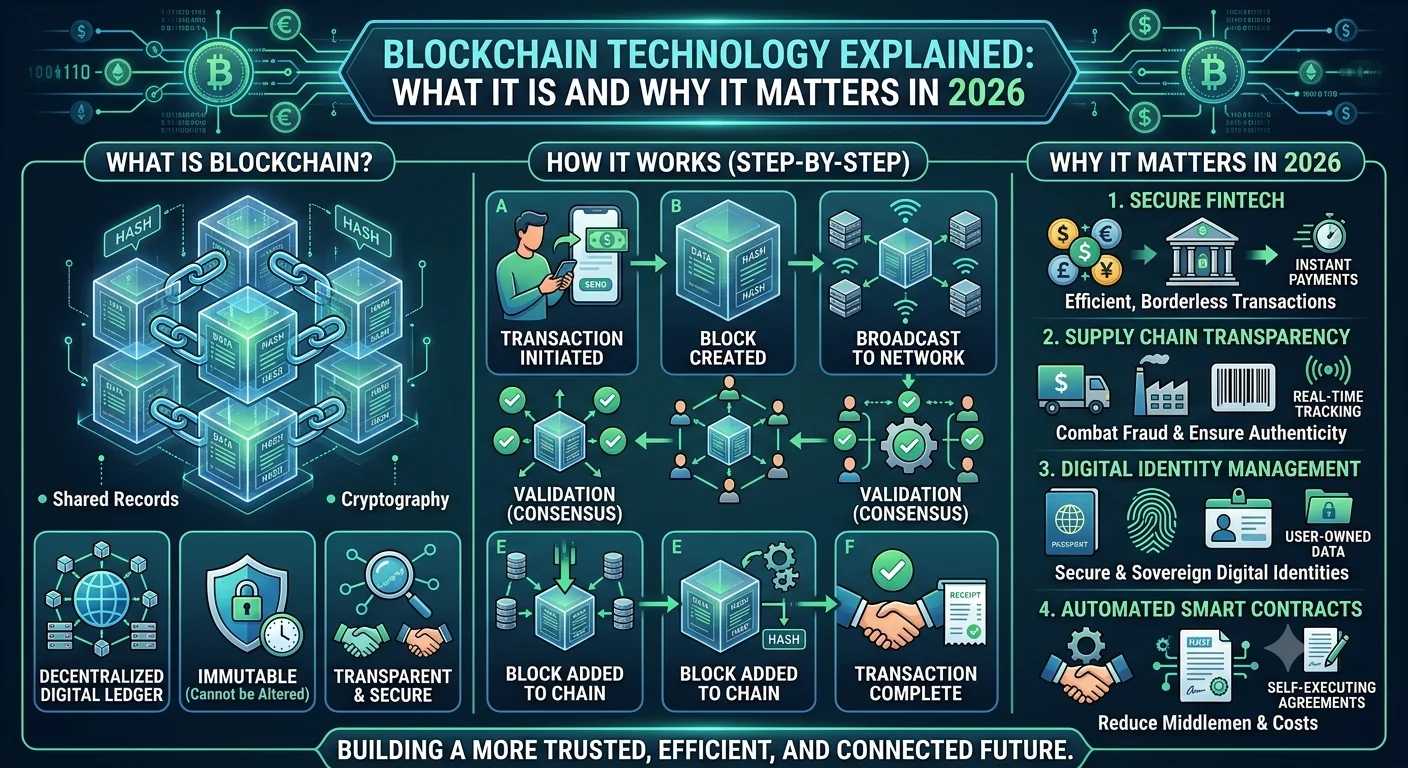
Blockchain technology is a method of storing and verifying data across a distributed network of computers so that records are transparent, tamper-resistant, and do not require a central authority to maintain. Each batch of verified transactions is grouped into a "block," which is cryptographically linked to the previous block, forming an unbroken "chain" of historical records. Once data is recorded on a blockchain, altering it requires the cooperation of the majority of the network, making fraud extraordinarily difficult in sufficiently decentralized systems.
Introduction
- Quick Answer: What Is Blockchain Technology?
- Introduction
- Defining Blockchain: A Distributed, Immutable Ledger
- How Blockchain Works: Blocks, Chains, and Nodes
- Nodes: The Distributed Participants
- Blocks: The Data Containers
- The Chain: Cryptographic Linkage
- Consensus Mechanisms: Proof of Work vs Proof of Stake
- Proof of Work
- Proof of Stake
- Real-World Applications of Blockchain in 2026
- DeFi: Decentralized Finance
- Smart Contracts and Automated Agreements
- Central Bank Digital Currencies (CBDCs)
- Blockchain in Traditional Finance
- Key Takeaways
- Frequently Asked Questions
Most technologies that change the world do so by making existing processes faster, cheaper, or more convenient. Blockchain technology does something structurally different: it removes the need for trusted intermediaries in systems that have historically required them.
Consider what makes a financial transaction trustworthy today. When you transfer money from your bank account to another person, you trust your bank to accurately record that the funds left your account, to securely transmit the instruction to the recipient's bank, and to ensure the recipient's bank correctly credits their account. Three institutions, your bank, the recipient's bank, and potentially a clearinghouse between them, are all required to certify a simple transfer of value.
Blockchain proposes an alternative: a shared ledger that all participants can read, that records transactions with cryptographic finality, and that does not require any single institution to act as the trusted intermediary. The record-keeping function is distributed across thousands of independent participants who each verify and maintain an identical copy of the complete transaction history.
This concept, simple in principle and complex in implementation, underpins not only Bitcoin and thousands of cryptocurrencies but also an expanding range of applications in finance, supply chain management, healthcare data, digital identity, and governance that are reshaping multiple industries in 2026.
Defining Blockchain: A Distributed, Immutable Ledger
To understand what a blockchain is, it helps to understand what it replaces. Traditional databases are centralized: a single server or cluster of servers maintained by one organization stores the authoritative version of the data. Every query and update goes through that central point. The organization controlling the database has complete authority over its contents and can alter, delete, or restrict access to records.
A blockchain is a distributed ledger: rather than one organization maintaining one database, an identical copy of the complete database is maintained simultaneously by every participating node in the network. There is no single authoritative server. The "truth" of the database is defined by consensus among the participants, not by any single party's records.
Immutability is the property that makes this distribution meaningful for trust. Each block in the chain contains a cryptographic hash of the previous block. A hash is a fixed-length string generated by running data through a mathematical function (Bitcoin uses SHA-256). Any change to the data in a historical block changes its hash, which invalidates the hash reference in the next block, which invalidates the next block's hash reference, cascading through every subsequent block in the chain.
This cascade effect means that altering a historical record does not just require changing one record. It requires recalculating every block that followed it and then outperforming the ongoing work of the entire honest network simultaneously. In networks with substantial mining or staking participation, this is computationally and economically prohibitive, which is what gives blockchain its characteristic tamper-resistance.
How Blockchain Works: Blocks, Chains, and Nodes
Understanding the mechanics of blockchain requires familiarity with three core components: nodes, blocks, and the chain structure that links them.
Nodes: The Distributed Participants
A node is any computer that participates in the blockchain network by maintaining a copy of the ledger and following the network's consensus rules. Nodes can serve different functions depending on the specific blockchain protocol.
Full nodes download and independently verify every block and every transaction in the entire history of the blockchain from the genesis block onward. They are the most important nodes for network security because they independently check that every rule is being followed without trusting any other participant. The Bitcoin network has thousands of full nodes distributed across dozens of countries, making it highly resistant to geographic or political attack.
Mining nodes (in proof-of-work blockchains) or validator nodes (in proof-of-stake blockchains) are full nodes that additionally participate in the block production process, competing to add new blocks to the chain and earn the associated rewards.
Light nodes (also called SPV nodes or lightweight clients) download only block headers rather than full block data, relying on full nodes to verify transaction validity. Mobile cryptocurrency wallets typically operate as light clients.
Blocks: The Data Containers
Each block in the chain is a structured data container that holds several elements. The block header contains the hash of the previous block (linking it to the chain), a timestamp, a difficulty target, and a nonce (in proof-of-work systems). The transaction data contains a list of all the transactions included in this block, verified and ordered by the producing node. A Merkle root is a single hash that summarizes all the transactions in the block using a tree-structured hashing scheme that allows efficient verification of individual transactions.
The size of each block is typically limited by protocol rules. Bitcoin limits block size to approximately 1 megabyte (with the SegWit upgrade enabling an effective capacity of slightly more). This limit constrains how many transactions can be processed per block, which at Bitcoin's 10-minute average block time produces a throughput of approximately 7 transactions per second globally. This throughput limitation is one of the primary technical challenges that blockchain scalability research and alternative protocols have sought to address.
The Chain: Cryptographic Linkage
The defining feature of a blockchain is how blocks reference each other. The header of each new block contains the cryptographic hash of the immediately preceding block. This means each block is mathematically linked to everything that came before it.
When a new block is produced, every node in the network receives it, verifies that all transactions within it are valid, confirms that the block's proof of work (or proof of stake) meets the required threshold, and checks that the hash of the previous block matches its own record of the chain. If all checks pass, the new block is added to the node's copy of the chain.
In cases where two valid blocks are produced simultaneously (a situation called a fork), the network follows a protocol-defined rule to determine which chain to build on, typically the chain representing the most accumulated computational work. The shorter chain is abandoned, and its transactions return to the mempool for inclusion in future blocks. This self-resolving mechanism maintains a single canonical chain without any central coordinator.
Consensus Mechanisms: Proof of Work vs Proof of Stake
The consensus mechanism is the protocol by which the distributed network of nodes agrees on the correct state of the blockchain without any central authority. It is the engine of blockchain security and the most heavily studied and debated aspect of blockchain design.
Proof of Work
Proof of Work (PoW), used by Bitcoin and a smaller number of other blockchain networks, requires block producers (miners) to expend real computational energy to solve a mathematical puzzle before they can add a new block. The puzzle, finding a nonce that produces a hash output below a specified target, has no shortcut: the only way to find the solution is to try billions or trillions of random nonce values until one works.
This energy expenditure serves as the security mechanism. To rewrite historical blocks on a PoW blockchain, an attacker would need to redo not only the computational work for the blocks they want to alter but also all the work accumulated on the chain since those blocks, continuously and faster than the honest network is adding new blocks. At Bitcoin's current hash rate, this is computationally and economically unfeasible for any known actor.
The environmental criticism of Proof of Work centers on its energy consumption. The Bitcoin network consumes energy on the scale of mid-sized countries. Proponents argue this energy expenditure is the price of Bitcoin's unparalleled security and censorship resistance, and that an increasing proportion of Bitcoin mining uses renewable energy sources. Critics argue the environmental cost is unjustifiable for a payments network.
Proof of Stake
Proof of Stake (PoS), used by Ethereum (following its "Merge" transition in September 2022), Cardano, Solana, and the majority of newer blockchain networks, replaces computational energy expenditure with economic stake as the security mechanism.
In a PoS system, validators lock up (stake) a specified amount of the network's native cryptocurrency as collateral to participate in block production. The network's consensus algorithm selects validators to propose new blocks based on the amount staked and other factors. Validators who behave honestly earn staking rewards. Validators who attempt to approve invalid transactions or engage in other malicious behavior risk having a portion of their staked collateral permanently destroyed, a penalty called "slashing."
Recommended Articles
 CRYPTOCURRENCY BLOCKCHAIN
The advantages of PoS include dramatically lower energy consumption (Ethereum's energy use fell approximately 99.95 percent following its Merge to PoS), faster transaction finality in many implementations, and the ability to scale to higher transaction throughput. The trade-offs and security properties of PoS differ from PoW in ways that remain actively debated among blockchain researchers and practitioners.
Real-World Applications of Blockchain in 2026
DeFi: Decentralized Finance
Decentralized Finance (DeFi) refers to financial applications built on blockchain networks, primarily Ethereum, that replicate and extend traditional financial services without requiring centralized intermediaries. DeFi applications provide lending, borrowing, trading, yield generation, and insurance through smart contracts that execute automatically when specified conditions are met.
The total value locked (TVL) in DeFi protocols, which measures the total capital held within DeFi smart contracts, grew from near zero in 2019 to tens of billions of dollars by the mid-2020s, reflecting genuine adoption of these systems by participants seeking higher yields, greater capital efficiency, and access to financial services not available through traditional channels.
Key DeFi categories include decentralized exchanges (DEXs) like Uniswap and Curve, which allow direct token swaps without a centralized order book, and lending protocols like Aave and Compound, which allow users to deposit crypto assets as collateral to borrow other assets, with interest rates determined algorithmically by supply and demand.
The risks of DeFi are substantial and should not be underestimated. Smart contract vulnerabilities have led to billions of dollars in losses through hacking and exploitation. The decentralized and pseudonymous nature of DeFi makes recovery from losses extremely difficult. Regulatory uncertainty creates compliance risk for participants in many jurisdictions.
Smart Contracts and Automated Agreements
A smart contract is a self-executing program stored on a blockchain that automatically performs specific actions when predetermined conditions are met, without requiring human intermediaries to enforce the agreement.
Ethereum, designed from its inception as a programmable blockchain, is the most widely used platform for smart contract deployment. The concept was first formally described by cryptographer and legal scholar Nick Szabo in 1994, though the technical infrastructure to implement it did not exist until Ethereum launched in 2015.
Real-world smart contract applications extend well beyond cryptocurrency. Insurance companies are exploring parametric insurance contracts that automatically pay claims when verifiable trigger conditions are met (such as a flight delay exceeding a specified threshold) without requiring a manual claims process. Real estate platforms are using smart contracts to automate the transfer of property ownership upon payment confirmation. Supply chain networks use them to automatically release payment to suppliers when verified delivery confirmation is recorded on chain.
Central Bank Digital Currencies (CBDCs)
Central Bank Digital Currencies are digital forms of national fiat currency issued and backed by central banks. Unlike Bitcoin and other decentralized cryptocurrencies, CBDCs are centralized instruments controlled by the issuing government, using blockchain or distributed ledger technology for record-keeping rather than as a decentralization mechanism.
As of 2026, the majority of the world's major central banks are actively researching or piloting CBDC programs. China's digital yuan (e-CNY) has been the most advanced large-economy CBDC deployment, with pilot programs covering millions of users across multiple cities. The European Central Bank is advancing its digital euro project. The Federal Reserve has been studying the design and implications of a potential digital dollar.
CBDCs represent a fundamentally different proposition from decentralized cryptocurrencies: they offer the transaction efficiency and programmability of digital currencies while maintaining full government control over monetary policy, identity verification, and transaction monitoring. The privacy implications of government-issued programmable money are among the most significant policy debates surrounding their development.
Blockchain in Traditional Finance
Major financial institutions including JPMorgan Chase, Goldman Sachs, and HSBC have implemented blockchain-based systems for various internal processes including interbank settlements, trade finance documentation, and securities clearing. JPMorgan's Onyx blockchain platform processes billions of dollars in transactions daily for institutional clients seeking faster settlement and reduced counterparty risk.
The SWIFT international payment network has conducted extensive trials integrating blockchain-based settlement to reduce the multi-day settlement times that characterize traditional cross-border wire transfers. These institutional applications prioritize efficiency, security, and regulatory compliance within existing financial frameworks rather than the permissionless decentralization that characterizes public blockchains like Bitcoin and Ethereum.
Key Takeaways
- Blockchain is a distributed ledger technology that maintains identical copies of a transaction record across thousands of independent nodes, creating a tamper-resistant history without requiring a central authority.
- Cryptographic hashing links each block to its predecessor, meaning altering historical data requires recalculating every subsequent block faster than the honest network can add new ones, which is computationally prohibitive on sufficiently decentralized networks.
- Proof of Work and Proof of Stake are the two primary consensus mechanisms, with PoW providing the strongest proven security properties and PoS offering dramatically lower energy consumption and faster finality.
- DeFi applications built on programmable blockchains like Ethereum are replicating traditional financial services (lending, borrowing, trading) without centralized intermediaries, though significant smart contract and regulatory risks exist.
- Smart contracts automate agreement execution without human intermediaries, with applications extending to insurance, real estate, supply chain, and many other industries beyond pure cryptocurrency transactions.
- Central Bank Digital Currencies represent governments' response to digital payment innovation, using blockchain concepts within a fully centralized, government-controlled framework that differs fundamentally from decentralized cryptocurrencies.
Frequently Asked Questions
Is blockchain the same as Bitcoin? No. Bitcoin is the first and most prominent application built on blockchain technology, but blockchain is the underlying infrastructure, not the application itself. Just as the internet is the infrastructure that enables email, web browsing, and streaming services, blockchain is the infrastructure that enables Bitcoin, Ethereum, DeFi applications, NFTs, and many other applications. Many blockchains have no connection to Bitcoin whatsoever.
Is blockchain technology secure? The security of a blockchain depends on its specific design, level of decentralization, and consensus mechanism. Bitcoin's blockchain has operated continuously since 2009 without a successful attack on the protocol itself, demonstrating exceptional security for its specific threat model. However, the applications built on top of blockchains, smart contracts, exchanges, and wallets, have been successfully attacked, producing substantial losses. Security must be evaluated at both the protocol level and the application level separately.
What is the difference between a public and a private blockchain? A public blockchain (like Bitcoin or Ethereum) is open for anyone to participate in as a user, node operator, or validator without permission from any authority. All transactions are publicly visible. A private or permissioned blockchain restricts participation to approved parties and is typically deployed within or between specific organizations. Private blockchains sacrifice decentralization for privacy and efficiency, making them more similar to traditional distributed databases. Many enterprise blockchain deployments use private or consortium (semi-private) blockchain architectures.
Can blockchain technology be used without cryptocurrency? Yes. While most public blockchains use native cryptocurrency tokens to incentivize participation and pay for network resources, the underlying distributed ledger concept can be deployed in permissioned settings without a publicly traded token. Enterprise blockchain applications for supply chain tracking, document verification, and interbank settlement often operate without any associated cryptocurrency that the general public would purchase.
What are the environmental implications of blockchain? The environmental impact of blockchain depends entirely on the consensus mechanism used. Bitcoin's Proof of Work is energy-intensive, consuming energy comparable to mid-sized countries, though the proportion sourced from renewables has been increasing. Proof of Stake blockchains like Ethereum post-Merge consume orders of magnitude less energy and have a minimal environmental footprint compared to PoW systems. Not all blockchains are environmentally equivalent, and the distinction between PoW and PoS systems is the critical variable in environmental impact assessments.
How does blockchain relate to NFTs? Non-Fungible Tokens (NFTs) are a specific application of blockchain technology. They are unique digital tokens recorded on a blockchain (most commonly Ethereum) that represent ownership of a specific digital or physical asset. Unlike cryptocurrencies (which are fungible, meaning each unit is identical and interchangeable), each NFT is unique. The blockchain record provides a transparent, verifiable ownership history. The value of any specific NFT depends on demand for the underlying asset, which has proven extremely variable and speculative.
RISK DISCLAIMER: Blockchain-based applications, cryptocurrencies, and DeFi protocols involve significant technological, regulatory, and financial risks. This article is for educational purposes only and does not constitute financial or technical advice.