Quick Answer: What Is Trading Psychology?
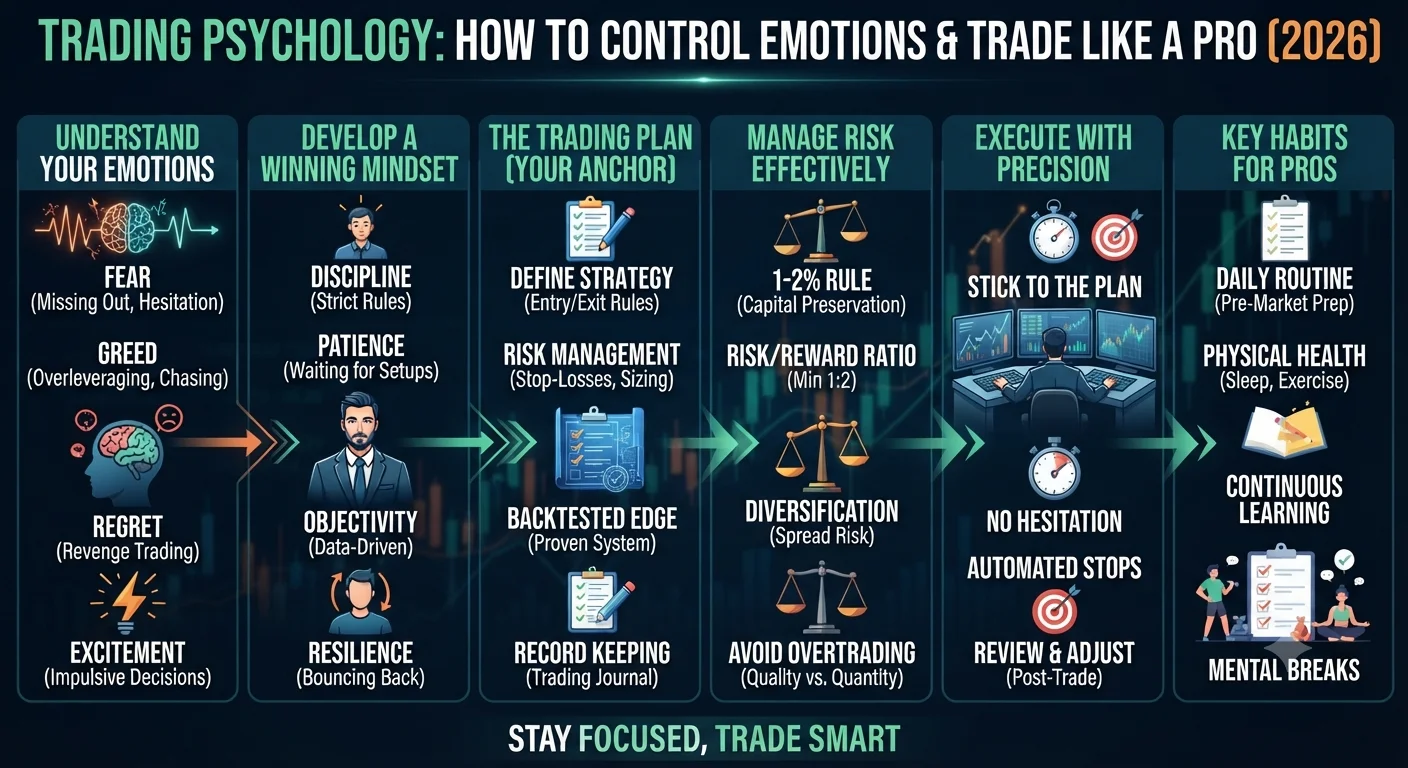
Trading psychology refers to the mental and emotional factors that influence a trader's decision-making. It encompasses the emotions, biases, and behavioral patterns that cause traders to deviate from rational, rules-based decision-making. The two most destructive emotional forces in trading are fear (which causes premature exits and missed opportunities) and greed (which causes oversized positions and holding trades too long). Mastering trading psychology means building systems and habits that reduce the influence of these emotions on your trading decisions.
Introduction
- Quick Answer: What Is Trading Psychology?
- Introduction
- Why Psychology Is the Most Important Factor in Trading Success
- The 6 Emotions and Biases That Destroy Trading Accounts
- 1. Fear of Missing Out (FOMO)
- 2. Greed: Oversizing and Moving Profit Targets
- 3. Loss Aversion: Holding Losers Too Long
- 4. Revenge Trading: The Silent Account Killer
- 5. Overconfidence After Winning Streaks
- 6. Analysis Paralysis: When Preparation Becomes Avoidance
- Evidence-Based Techniques to Master Your Trading Mind
- Keep a Detailed Trading Journal
- Develop a Pre-Market and Pre-Trade Routine
- Build a Rule-Based Trading System
- Practice Mindfulness and Detachment From Outcomes
- Key Takeaways
- Frequently Asked Questions
A trader who wins 55 percent of their trades using a system with a 1:2 risk-to-reward ratio should be consistently profitable. The mathematics are unambiguous. Yet many traders who possess exactly this kind of edge still lose money year after year.
The explanation is not in the strategy. It is in the execution. Between knowing what to do and actually doing it consistently, there is a gap that only psychology can bridge. Traders move their stop-losses when price approaches them. They close winners early because the profit feels good to lock in. They revenge trade after a loss because the emotional need to recover the money overwhelms the rational awareness that this particular trade setup does not meet their criteria.
These are not character flaws unique to certain people. They are predictable, documented behavioral patterns rooted in how the human brain processes risk, reward, and loss. The field of behavioral finance, pioneered by psychologists Daniel Kahneman, Amos Tversky, and Richard Thaler, has established through decades of rigorous research that these patterns affect virtually every human who participates in financial markets, including many professionals.
The path to overcoming them is not to pretend emotions do not exist or to suppress them through willpower alone. It is to build a trading environment structured in a way that reduces the opportunities for emotion to override reason at critical moments.
Why Psychology Is the Most Important Factor in Trading Success
Dr. Van K. Tharp, a performance coach who has worked with hundreds of professional traders and authored "Trade Your Way to Financial Freedom," estimates that trading strategy accounts for only about 10 percent of long-term trading results. Risk management accounts for approximately 30 percent. The remaining 60 percent is psychology: the mental discipline to execute the strategy and the risk management rules consistently, even when doing so feels uncomfortable.
This allocation may seem extreme until you consider what actually happens when markets move against a trader's position. The analytical skill that identified the trade setup does not disappear. The risk management rules the trader wrote in their plan do not change. What changes is the emotional state. Anxiety, frustration, hope, and fear create powerful motivations to deviate from the plan, and those deviations are what convert manageable losses into account-destroying disasters.
Mark Douglas, whose book "Trading in the Zone" is considered essential reading in professional trading circles, articulated this dynamic precisely. The market itself does not create trading losses. The decisions traders make in response to market movements create losses. And those decisions, in the critical moments that matter most, are driven more by emotional state than by analytical judgment.
The 6 Emotions and Biases That Destroy Trading Accounts
1. Fear of Missing Out (FOMO)
FOMO is the anxiety triggered by watching a market move strongly in a direction you did not participate in. The internal experience is a combination of regret about what you missed and an urgent impulse to enter the market immediately, even without a valid setup, to avoid missing further gains.
The typical FOMO trade is entered at the worst possible point: late in a strong move, after the entry signals have already appeared and faded, when the risk-to-reward ratio is unfavorable and the probability of the move continuing is lower than at the beginning. Markets frequently reverse sharply after FOMO-driven buying exhausts itself, creating what traders call "bag holders," late entrants who bought the top and are now holding a losing position.
FOMO is amplified significantly by social media in 2026. Constant exposure to other traders posting their biggest wins, influencers calling trades in real time, and community discussion of missed opportunities creates a pressure environment that did not exist in previous generations of traders. Managing FOMO requires both psychological discipline and deliberate curation of the information environment you expose yourself to during trading sessions.
2. Greed: Oversizing and Moving Profit Targets
Greed in trading manifests in two primary ways. The first is taking positions that are too large for the account, driven by the desire to make more money faster than a properly sized trade would allow. The second is moving take-profit targets further away once a trade is in profit, based on the belief that "this time the move will really run."
Both behaviors occasionally produce spectacular short-term results, which is precisely what makes them dangerous. A trader who violates their position sizing rules and wins big learns the wrong lesson: that their rules were too conservative. This reinforcement encourages the same behavior with increasingly large positions until the first time it fails catastrophically.
The cure for position-sizing greed is mechanically applying the 1 or 2 percent risk rule to every trade without exception and understanding, at a deep level, that long-term trading success is produced by consistent edge applied over hundreds of trades, not by any single large win.
3. Loss Aversion: Holding Losers Too Long
Kahneman and Tversky's Prospect Theory demonstrated that the psychological pain of a loss is approximately twice as intense as the pleasure of an equivalent gain. This creates a powerful and irrational tendency to hold losing positions longer than the trading plan dictates, in the hope that price will return to the entry level and "save" the trade, avoiding the psychological pain of confirming the loss.
In practice, holding a losing trade past its stop-loss level transforms a defined, manageable loss into an open-ended exposure. Markets do not "owe" any trader a return to their entry level. A trade that is held without a stop-loss in a trending market can continue losing for far longer and far further than any rational pre-trade analysis would suggest possible.
The discipline of accepting and closing stop-loss levels without hesitation is one of the most difficult skills in trading and one of the most important. Framing the stop-loss as "the cost of testing this trade idea" rather than as a failure is a useful cognitive reframe that reduces the emotional resistance to closing losing positions promptly.
4. Revenge Trading: The Silent Account Killer
Revenge trading is the practice of immediately placing a new trade after a loss, driven not by a valid setup signal but by the emotional need to recover the lost money as quickly as possible. It is called revenge trading because the emotional motivation is essentially to "get back at the market" for taking your money.
The problem is compounding. Revenge trades are almost always made in a heightened emotional state, without proper setup criteria, with oversized positions to recover the loss faster, and with impaired analytical judgment. They fail at a rate significantly higher than normal trades, and their failure triggers additional emotional escalation, which leads to more revenge trades. This cycle is the mechanism behind the pattern of traders having a single bad day that destroys weeks or months of accumulated gains.
The most effective structural protection against revenge trading is the predefined daily loss limit discussed in the risk management framework. When you hit your daily maximum loss, trading is over for the day. This is not a suggestion. It is a rule that is agreed to calmly before the session begins and followed regardless of how strongly the emotional impulse to "win it back" pushes in the opposite direction.
5. Overconfidence After Winning Streaks
Winning streaks create a cognitive trap as dangerous as losing streaks. A sequence of profitable trades generates a feeling of mastery and certainty that distorts the trader's objective assessment of their edge. They begin to believe their analysis is more accurate than it is, that the current market environment will continue indefinitely, and that their position sizing rules are unnecessarily conservative given their "proven" ability to pick winners.
This overconfidence typically produces three behaviors: increasing position sizes beyond the risk management framework, entering more trades than the strategy dictates, and lowering the quality threshold for setups because "everything is working right now." When the inevitable mean reversion of results arrives, the trader is overexposed precisely at the wrong moment.
Research by behavioral economists Brad Barber and Terrance Odean, published in the Quarterly Journal of Economics, found that overconfident traders trade more frequently and earn less than traders who maintain disciplined, lower-frequency approaches. Their 2000 study found that the most active traders in their dataset earned returns approximately 6.5 percentage points below the market average annually, largely attributable to overconfident trading behavior.
6. Analysis Paralysis: When Preparation Becomes Avoidance
Analysis paralysis occurs when a trader seeks so much confirmation and so many indicators that they can never find a setup that qualifies. It is the opposite end of the overconfidence spectrum and equally destructive, though it manifests as inaction rather than excessive action.
Recommended Articles
 TRADING PSYCHOLOGY MINDSET
The psychological root of analysis paralysis is often fear of being wrong. If you never enter a trade, you can never have a losing trade. The unconscious motivation is to delay the moment of commitment indefinitely while appearing to be engaged in the responsible work of analysis.
Analysis paralysis is addressed by clearly defining the entry criteria for your strategy in advance. A setup either meets all the criteria or it does not. This binary framework removes the subjective interpretation that enables indefinite delay and forces a decision: this trade qualifies by every criterion I defined, so I enter it; or it does not qualify, so I wait for the next one.
Evidence-Based Techniques to Master Your Trading Mind
Keep a Detailed Trading Journal
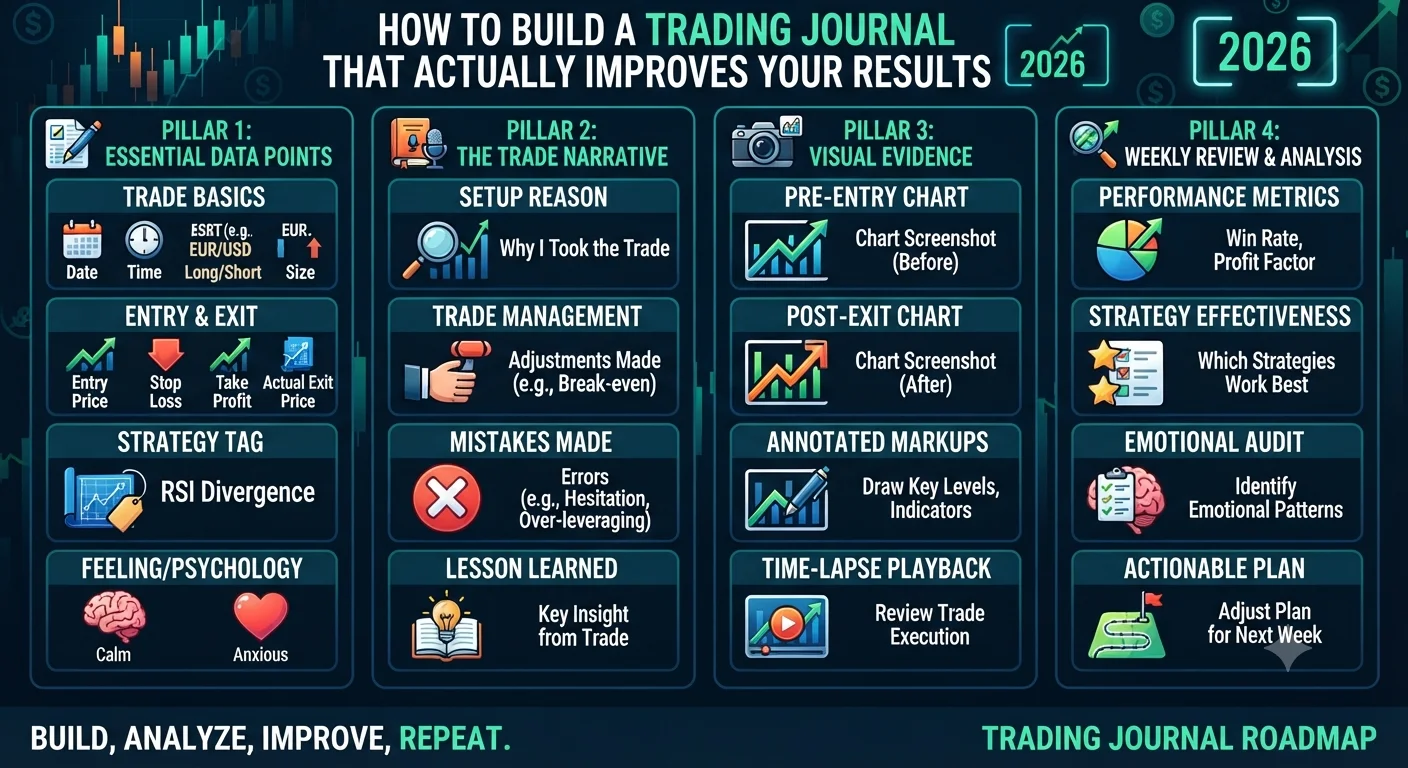
The trading journal is the single most powerful tool for developing psychological self-awareness as a trader. Beyond recording entry and exit prices, a proper trading journal captures your emotional state at the time of each trade decision: what you were thinking, what you were feeling, whether you followed your plan or deviated from it, and if you deviated, why.
Reviewing this journal weekly reveals patterns that are invisible in the moment. You may discover that your worst trades consistently occur on Monday mornings or Friday afternoons. You may notice that you deviate from your plan most often after two consecutive losses. You may identify that your winners in one setup tend to be cut short while your losers in the same setup are held too long. Each of these patterns is actionable information that allows you to make specific adjustments to your process.
The journal creates accountability to yourself that is impossible to manufacture through willpower alone. Knowing that you will have to write down and revisit every deviation from your plan creates a powerful motivational structure for sticking to it.
Develop a Pre-Market and Pre-Trade Routine
Professional athletes do not walk onto the field without a warm-up routine. Professional traders should not open their trading platform without one either. A structured pre-market routine establishes the mental state of calm, focused attention that produces your best trading decisions.
A practical pre-market routine might include reviewing the economic calendar for high-impact events of the day, identifying key support and resistance levels on your primary pairs, noting the overall market trend on the daily and four-hour charts, reviewing your recent performance in your trading journal, and setting your daily maximum loss limit in writing before the session begins.
A pre-trade routine applies the same principle to each individual trade: before entering, verify that every criterion in your trading plan is met, calculate the correct position size, confirm the stop-loss level and take-profit target, and ask whether you would be comfortable explaining this trade to another disciplined trader. If the answer to any part of this routine is no, the trade does not meet your standards and should not be taken.
Build a Rule-Based Trading System
The most effective way to reduce emotional interference in trading decisions is to convert as many of those decisions as possible into rules that are followed mechanically rather than made subjectively in the moment.
A rule-based system defines in advance and in writing: which instruments you trade, which time frames you analyze, exactly what conditions must be present for a valid entry signal, where the stop-loss is placed (referenced to market structure, not arbitrary pip distances), what your take-profit target is or what trailing stop mechanism you use to manage winning trades, and what conditions would cause you to avoid trading entirely (extreme news periods, low-liquidity sessions, highly correlated positions already open).
The more clearly defined these rules, the less room remains for emotional judgment calls that are vulnerable to the biases described above. A trader who asks "does this price action meet all seven of my specific entry criteria?" is in a fundamentally different and more protected mental position than a trader who asks "does this look like a good trade to me?"
Practice Mindfulness and Detachment From Outcomes
Mindfulness practice, the cultivation of present-moment awareness without judgment, has been adopted by a growing number of professional traders and performance coaches as a genuine tool for improving trading discipline. It is not mysticism. It is the practical ability to observe your own thoughts and emotions as they arise without immediately acting on them.
When you feel the impulse to move a stop-loss, mindfulness practice creates a brief pause between the impulse and the action. In that pause, you can recognize the emotion driving the impulse (fear of losing) and make a conscious decision about whether to follow your pre-defined plan or override it. Over time, consistently choosing the plan over the impulse builds the habit of disciplined execution that defines professional trading.
The goal of all psychological work in trading is to reach what Mark Douglas calls "the zone": a state of consistent, emotion-neutral execution in which you execute your strategy with the same detachment whether you are on a winning streak or a losing streak, because you understand that individual trade outcomes are statistical events that do not define either your skill or your future performance.
Key Takeaways
- Trading psychology accounts for an estimated 60 percent of long-term trading results, making it the most important factor in determining whether a trader with a valid strategy ultimately succeeds or fails.
- The six primary psychological traps in trading are FOMO, greed, loss aversion, revenge trading, overconfidence, and analysis paralysis, all of which are well-documented in behavioral finance research.
- A detailed trading journal that records both trade data and emotional state at the time of each decision is the most powerful available tool for identifying and correcting behavioral patterns.
- Rule-based trading systems that define entry, exit, and position sizing criteria in advance reduce the number of in-the-moment judgment calls that are vulnerable to emotional interference.
- Pre-market and pre-trade routines establish the mental conditions that support disciplined decision-making before the emotional pressures of live trading begin.
- The goal is not the elimination of emotion but the development of sufficient self-awareness to recognize emotional influences and consistently choose rules-based responses over emotional ones.
Frequently Asked Questions
Can trading psychology be learned or is it innate? Trading psychology is a learnable skill set, not a fixed personality trait. While individuals vary in their baseline emotional reactivity and tolerance for uncertainty, the specific habits, routines, and structural protections that support disciplined trading can be developed by anyone through deliberate practice and honest self-reflection. Many professional traders have reported that psychological discipline was the hardest skill to develop and the last to fully mature, often taking years of real-market experience.
How do I stop revenge trading immediately after a loss? The most effective immediate intervention is to physically step away from the trading platform after hitting a loss that triggers the urge to revenge trade. Close the platform, leave the room, and engage in any activity that changes your physical and mental state: walking, exercise, or any task that fully occupies your attention. The physiological arousal that drives revenge trading typically dissipates within 15 to 30 minutes. Return to the platform only after the emotional urgency has subsided and only if you can confirm that the next trade meets every criterion of your plan independently of the recent loss.
Is it normal to feel fear and anxiety while trading? Yes. Uncertainty about future outcomes is inherently uncomfortable for the human brain, and financial risk amplifies that discomfort significantly. Experienced and successful traders are not free from fear or anxiety. They have developed the discipline to recognize these feelings as normal responses to uncertainty rather than as signals that require immediate action. The presence of a feeling does not obligate you to act on it.
How long does it take to develop good trading psychology? There is no fixed timeline, but most serious students of trading psychology report that it takes between one and three years of active, self-aware practice before consistent emotional discipline becomes a genuine habit rather than an ongoing struggle. The process is accelerated by consistent journaling, regular review of past decisions and their outcomes, and ideally some form of mentorship or community accountability with other disciplined traders.
Does paper trading (demo trading) help with trading psychology? Demo trading helps you learn platform mechanics and test strategies without financial risk, but it has significant limitations as a tool for developing trading psychology. Because no real money is at risk, the emotional dynamics that challenge real-money traders are largely absent. Many traders who perform excellently on demo accounts find that their discipline deteriorates when they switch to live trading, because the psychological pressure is fundamentally different. The transition to live trading with very small position sizes, gradually increased as discipline is demonstrated, is a better bridge between demo confidence and real-money consistency.
What is the best book on trading psychology? Mark Douglas's "Trading in the Zone" is the most widely recommended book specifically focused on the psychology of consistent trading execution. Van K. Tharp's "Trade Your Way to Financial Freedom" provides an excellent broader framework that integrates psychology, risk management, and strategy development. For foundational understanding of the behavioral biases that affect all financial decision-making, Daniel Kahneman's "Thinking, Fast and Slow" is the essential reference, presenting the Nobel Prize-winning research in a highly accessible format.
RISK DISCLAIMER: This article addresses psychological aspects of trading for educational purposes. It does not constitute financial or psychological advice. Trading involves substantial risk of financial loss. If trading is causing significant emotional distress, please consider consulting a mental health professional as well as a qualified financial advisor.