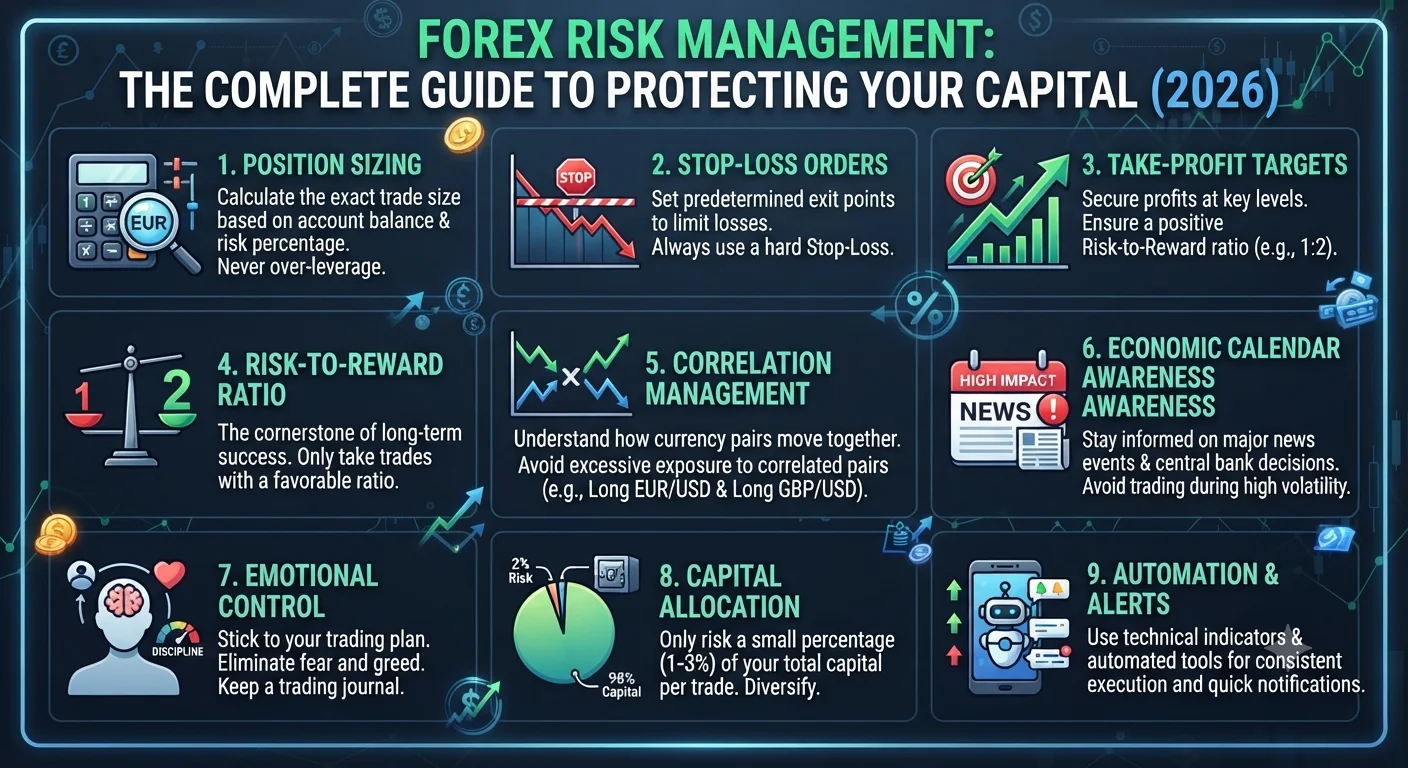
Quick Answer: What Is Forex Risk Management?
Forex risk management is the set of rules and practices a trader uses to limit the financial damage any single trade or sequence of trades can cause to their account. It includes setting a maximum loss per trade, using stop-loss orders on every position, sizing positions in proportion to account size, and knowing when to stop trading entirely. Risk management does not eliminate losses. It ensures that losses remain survivable and that no single event can remove a trader from the market permanently.
Introduction
- Quick Answer: What Is Forex Risk Management?
- Introduction
- Why Most Traders Fail Without Risk Management
- The 1 Percent Rule: Never Risk More Than 1 Percent Per Trade
- How to Set a Stop-Loss Order Correctly
- Placing Stop-Losses Using Market Structure
- Fixed Stop-Loss vs ATR-Based Stop-Loss
- Understanding Risk-to-Reward Ratios in Forex
- Position Sizing: How Many Lots Should You Trade?
- Diversification in Forex: Avoiding Correlated Pairs
- Drawdown Management: When to Stop Trading
- Key Takeaways
- Frequently Asked Questions
Two traders can use the exact same strategy, enter the exact same trades, and produce completely different financial outcomes over 12 months. One builds their account steadily. The other loses everything within weeks. The difference, in almost every case, is not the strategy. It is risk management.
This is not a theoretical observation. It is the consistent finding of every serious analysis of retail trading performance. Data published by European regulators under MiFID II disclosure requirements repeatedly shows that between 60 and 80 percent of retail CFD and forex accounts lose money. Academic studies of retail trader behavior, including research published in the Journal of Finance and the Review of Financial Studies, attribute this loss rate overwhelmingly to position sizing errors, absent or improperly placed stop-losses, and emotional responses to losing streaks that cause traders to deviate from whatever plan they started with.
The traders who survive and eventually thrive are not necessarily smarter or better at predicting market direction. They are better at protecting themselves when they are wrong. In a market where even the best professional traders are wrong 40 to 50 percent of the time, the ability to lose small and win big is what determines long-term profitability.
This guide covers every essential component of a complete forex risk management framework in practical, implementable terms.
Why Most Traders Fail Without Risk Management
Before examining the specific tools of risk management, it is worth understanding precisely how accounts are destroyed in their absence.
The most common failure pattern follows a predictable sequence. A new trader opens an account, places a few trades without defined risk parameters, experiences some early success, and interprets that success as validation of their skill rather than the product of favorable market conditions. Confidence increases. Position sizes grow. When the inevitable losing streak arrives, the trader, now accustomed to winning and unwilling to accept that their edge may be temporarily absent, begins taking larger positions to recover losses quickly. This is revenge trading. It almost always accelerates the decline rather than reversing it.
The psychological research supporting this pattern is robust. Nobel laureate Daniel Kahneman and Amos Tversky's Prospect Theory, developed in the 1970s and published in Econometrica, demonstrated that humans experience the pain of a loss approximately twice as intensely as the pleasure of an equivalent gain. This asymmetry drives irrational trading decisions: holding losing positions longer than planned because closing them makes the loss feel real, and cutting winning positions prematurely to secure the psychological comfort of a confirmed profit. Both behaviors systematically produce negative expected value over time.
A rules-based risk management framework removes these psychological traps by defining, in advance and in writing, exactly how much you will risk on each trade, where your stop-loss will be placed, and at what point you will stop trading for the day or week. When these decisions are made calmly before the market opens rather than in the heat of an adverse price move, they reflect rational judgment rather than fear-driven panic.
The 1 Percent Rule: Never Risk More Than 1 Percent Per Trade
The 1 percent rule is the foundational position sizing principle used by professional traders and recommended by risk management educators across virtually every market. It states that no single trade should put more than 1 percent of your total trading capital at risk.
For an account with $5,000 in capital, 1 percent risk means the maximum you should be willing to lose on any single trade is $50. For a $10,000 account, the maximum per-trade risk is $100. For a $50,000 account, it is $500.
The power of this rule becomes clear when you examine what it takes to destroy an account versus what it takes to recover from drawdowns under different risk regimes.
Under a 1 percent risk rule, a trader would need to lose 50 consecutive trades to reduce a $10,000 account to approximately $6,050. Even a modestly profitable strategy should not produce 50 consecutive losses, and even if it did, the trader still has sufficient capital to continue trading. Recovery from a 40 percent drawdown requires gains of approximately 67 percent, which is difficult but achievable over time.
Under a 10 percent risk rule, ten consecutive losing trades reduce the same $10,000 account to approximately $3,487. A drawdown of 65 percent requires a 186 percent gain just to return to breakeven, which is an almost impossibly high bar for most strategies to clear.
Some traders, particularly those who are more experienced and are working with proven systems, use a 2 percent risk rule. Beginners are generally better served by the stricter 1 percent limit because it provides substantially more cushion to weather the inevitable learning curve that accompanies the development of trading skill.
Applying the 1 percent rule in practice requires calculating position size mathematically for every trade rather than simply choosing a lot size arbitrarily. The formula works as follows:
Position Size = (Account Balance x Risk Percentage) / (Stop-Loss in Pips x Pip Value)
If your account balance is $5,000, your risk per trade is 1 percent ($50), your stop-loss is 20 pips, and your pip value on a mini lot of EUR/USD is $1 per pip, then your position size is $50 / (20 x $1) = 2.5 mini lots. This calculation ensures that if the stop-loss is hit, you lose exactly $50, regardless of lot size or pip value variations between different currency pairs.
How to Set a Stop-Loss Order Correctly
A stop-loss order is an instruction to your broker to automatically close your position at a specified price if the market moves against you. Every single trade you place should have a stop-loss order attached at the moment of entry. This is non-negotiable in a professional risk management framework.
The critical mistake most beginners make is placing stop-losses at arbitrary distances from their entry, such as always using a 20-pip stop regardless of market conditions. This approach ignores the actual structure of the market and inevitably produces stop-losses that are placed at technically meaningless levels, where they are frequently triggered by normal market noise before the anticipated move actually occurs.
Placing Stop-Losses Using Market Structure
The most reliable approach to stop-loss placement uses the market's own structure to define where a trade thesis is invalidated. Ask yourself: if I am buying EUR/USD expecting it to rise, at what price level would the market be telling me my analysis is wrong?
For a trade entered based on a bounce from a support level, the stop-loss belongs below that support level. If price breaks below the support that your entire trade thesis is based on, the trade is wrong, and you want to be out of it. Placing the stop-loss just below the support level (allowing a few pips of buffer for spread and normal volatility) closes the position exactly when the market confirms your analysis was incorrect.
For a breakout trade entered above a resistance level, the stop-loss belongs below the broken resistance level. A valid breakout should hold above that level. If price falls back below it, the breakout has likely failed.
For a trend-following trade, the stop-loss is placed below the most recent higher low in an uptrend or above the most recent lower high in a downtrend. Breaking these structural points signals a potential trend reversal.
Fixed Stop-Loss vs ATR-Based Stop-Loss
The Average True Range (ATR) indicator, developed by technical analyst J. Welles Wilder and first published in his 1978 book "New Concepts in Technical Trading Systems," measures the average range of price movement over a specified period. It is one of the most useful tools for placing stop-losses that account for current market volatility.
A fixed pip stop-loss does not adapt to changing market conditions. A 20-pip stop in a calm, low-volatility market may be perfectly adequate, while the same 20-pip stop in a high-volatility market is so tight that normal price fluctuations will trigger it repeatedly before any directional move develops.
An ATR-based stop places the stop-loss at a distance of one to two times the current ATR value from the entry price. If EUR/USD has a 14-period ATR of 60 pips on the four-hour chart, a stop placed at 1.5 x ATR (90 pips) below the entry accommodates typical intraday volatility without being so distant that it risks an unreasonable capital loss.
The trade-off is that wider stops require smaller position sizes to maintain the same fixed dollar risk per trade. This is the correct adjustment to make: always let the market structure and volatility determine your stop placement, then adjust your position size accordingly rather than forcing a position size and then finding a stop to match it.
Understanding Risk-to-Reward Ratios in Forex
The risk-to-reward ratio (RRR) compares the potential profit of a trade to its defined maximum loss. A trade with a 20-pip stop-loss and a 60-pip take-profit target has a risk-to-reward ratio of 1:3, meaning for every dollar risked, three dollars of profit are targeted if the trade succeeds.
The risk-to-reward ratio is the mathematical foundation of long-term trading profitability, and understanding its implications is one of the most clarifying insights available to a developing trader.
Consider a trader with a strategy that wins only 40 percent of trades, which sounds like a losing strategy. If every winning trade targets a 1:3 risk-to-reward ratio, however, the math produces a profitable outcome:
Over 100 trades: 40 wins at 3 units of profit each = 120 units gained. 60 losses at 1 unit each = 60 units lost. Net result: 60 units of profit before costs.
Now consider a trader who wins 60 percent of trades but consistently cuts winners short and lets losers run, resulting in an average risk-to-reward ratio of 0.5:1 (risking 2 to make 1):
Over 100 trades: 60 wins at 0.5 units each = 30 units gained. 40 losses at 1 unit each = 40 units lost. Net result: 10 units lost despite a 60 percent win rate.
This comparison illustrates why experienced traders consistently prioritize finding setups with favorable risk-to-reward ratios over simply trying to maximize win rate. A minimum RRR of 1:2 is typically recommended for beginners, meaning every trade targets at least twice the profit of the potential loss. This allows a strategy to be profitable even with a win rate below 50 percent, which significantly reduces the psychological pressure of accepting frequent small losses as a normal part of the process.
Position Sizing: How Many Lots Should You Trade?
Position sizing is the process of calculating the correct lot size for each trade based on your account balance, your risk per trade percentage, your stop-loss distance, and the pip value of the instrument being traded.
The formula introduced earlier in the 1 percent rule section applies consistently. What changes between trades is the pip value of different currency pairs and the stop-loss distance required by each specific trade setup.
Pip values differ between currency pairs. For USD-denominated pairs (EUR/USD, GBP/USD, AUD/USD), the pip value for a standard lot is approximately $10. For pairs where USD is the base currency (USD/JPY, USD/CAD), the pip value varies based on the current exchange rate. For cross pairs not involving USD (EUR/GBP, EUR/JPY), pip values must be calculated in reference to the USD equivalent.
Most trading platforms include position size calculators that automate this arithmetic. MetaTrader 4 and MT5 both display pip values for each instrument. Standalone position size calculators are freely available online from forex education sites and can be bookmarked as part of your pre-trade checklist.
The discipline to calculate position size correctly for every single trade before entering, rather than estimating or defaulting to a standard lot size regardless of the stop-loss distance, is one of the most important habits a developing trader can build. It takes 60 seconds and is one of the most direct protections available against devastating individual trade losses.
Diversification in Forex: Avoiding Correlated Pairs
Currency pairs do not move independently of each other. Many pairs are highly correlated, meaning they tend to move in the same direction simultaneously. If you hold multiple positions in highly correlated pairs, you are effectively taking the same trade multiple times while believing you are diversified.
The most prominent correlations in major currency pairs are well established. EUR/USD and GBP/USD typically show a high positive correlation, often exceeding 0.85 on a rolling 20-day basis, because both currencies share European economic dynamics and similar sensitivity to USD movements. EUR/USD and USD/CHF typically show a strong negative correlation because the Swiss franc tracks the euro closely, so USD strength pushes EUR/USD down and USD/CHF up simultaneously.
If you are simultaneously long EUR/USD and long GBP/USD, a broad USD strengthening move will likely trigger stop-losses on both positions at the same time, doubling your loss on what felt like two separate positions.
The practical implication is to monitor correlation when planning multiple simultaneous positions. If you are trading in the direction of USD strength, one position in that direction is sufficient. Adding five more positions across different dollar pairs simply multiplies exposure to the same fundamental driver without genuine diversification. Genuine diversification in forex involves taking positions in pairs driven by different fundamental factors or in instruments across different asset classes.
Drawdown Management: When to Stop Trading
A drawdown is the peak-to-trough decline in your account value expressed as a percentage. Every trader experiences drawdowns, including professional fund managers. The question is not whether drawdowns will occur but how large you allow them to get before taking a structured break to review and reassess.
Most professional trading risk management frameworks include a maximum daily loss limit and a maximum overall drawdown limit. Common parameters used by proprietary trading firms include a maximum daily loss of 3 to 5 percent of account value and a maximum overall drawdown of 10 to 15 percent before trading must be paused and the system reviewed.
For retail traders, defining these limits in advance serves the same protective function. A trader who loses 3 percent in a single day and stops trading for that day preserves capital and prevents the emotional cascade of revenge trading that frequently converts a bad day into a catastrophic one.
When you reach your predefined daily or weekly loss limit, close all positions, step away from the screens, and review your recent trades analytically rather than emotionally. Were the losses the result of a changed market environment where your strategy's edge temporarily disappeared? Were they the result of poor execution or deviation from your rules? Or were they simply the statistical result of a normal losing streak within an otherwise sound approach? This analysis, conducted calmly and without screen time, is far more productive than attempting to force recovery trades under psychological pressure.
Key Takeaways
- Risk management, not strategy, is the primary determinant of whether a forex trader survives long enough to develop genuine skill and profitability.
- The 1 percent rule limits maximum loss per trade to 1 percent of total account capital, which allows a trader to sustain 50 consecutive losses before losing half their account, providing sufficient runway to recover and improve.
- Stop-losses should be placed at market structure levels that invalidate the trade thesis, not at arbitrary pip distances from entry.
- ATR-based stop-losses adapt to current market volatility and are more reliable than fixed pip stops in changing market conditions.
- Risk-to-reward ratios of at least 1:2 allow a strategy to remain profitable with a win rate below 50 percent, which is mathematically critical for long-term sustainability.
- Correlated currency pairs multiply risk when traded simultaneously in the same direction, eliminating the illusion of diversification.
- Predefined maximum daily and overall drawdown limits prevent emotional responses from compounding manageable losing streaks into account-destroying events.
Frequently Asked Questions
What is the most common risk management mistake forex traders make? The most common mistake is sizing positions based on gut feel or a standard default lot size rather than calculating the correct position size mathematically for each trade. This leads to inconsistent risk per trade, where some trades risk 0.5 percent and others inadvertently risk 5 percent or more, making it impossible to evaluate strategy performance objectively or maintain consistent capital protection.
Should I always use a stop-loss in forex? Yes, without exception. Trading without a stop-loss is the equivalent of driving without a seatbelt: most of the time nothing catastrophic happens, but when it does, the consequences are severe. Extreme market events, including flash crashes, unexpected central bank interventions, and major geopolitical shocks, have produced price gaps of hundreds of pips in minutes. A stop-loss does not guarantee execution at the specified price during such events (gapping can cause execution at worse prices), but it provides substantially more protection than having no stop at all.
What is a good risk-to-reward ratio for forex trading? A minimum ratio of 1:2 is recommended for most strategies, meaning you target at least twice your risk in profit on every trade. Many professional traders target 1:3 or higher on their primary setups. However, the appropriate ratio depends on your strategy's win rate. Higher win-rate strategies can be profitable with lower RRRs, while lower win-rate strategies require higher RRRs to compensate. The math of expectancy, calculated as (Win Rate x Average Win) minus (Loss Rate x Average Loss), should be positive for any sustainable strategy.
How do I manage risk when trading with a small account? Small accounts (under $1,000) present position sizing challenges because the mathematically correct position sizes for proper risk management may fall below the minimum available lot size on some platforms. The solution is to trade exclusively micro lots on platforms that offer them, trade pairs with lower pip values, or build the account to a size that allows proper position sizing before attempting to trade instruments with higher minimum lot requirements. Trading a small account with oversized positions to "make it matter" is one of the fastest paths to losing it entirely.
What is the difference between risk management and money management? The terms are often used interchangeably in trading contexts, but there is a distinction. Risk management refers to controlling the risk on individual trades through stop-losses, position sizing, and risk-to-reward analysis. Money management refers to the broader management of your overall capital: how you allocate funds between trading and non-trading purposes, how you handle profits and drawdowns at the account level, and decisions about when to withdraw profits or add capital. Both are necessary components of a complete approach to trading capital preservation.
Can risk management turn a losing strategy into a profitable one? No. Risk management cannot create edge where none exists. If a strategy has a negative expected value, meaning the average loss is larger than the average win adjusted for probability, even perfect risk management will result in losses over a sufficient number of trades. What risk management does is ensure that a strategy with genuine positive edge is not destroyed by position sizing errors, emotional decisions, or a single catastrophic trade before that edge has the opportunity to manifest over the long run.
RISK DISCLAIMER: Forex trading involves substantial risk of loss and is not suitable for all investors. The risk management techniques described in this article are educational in nature and do not guarantee profitable trading outcomes. This content does not constitute financial advice.