Quick Answer: What Are the Best Passive Income Ideas in 2026?
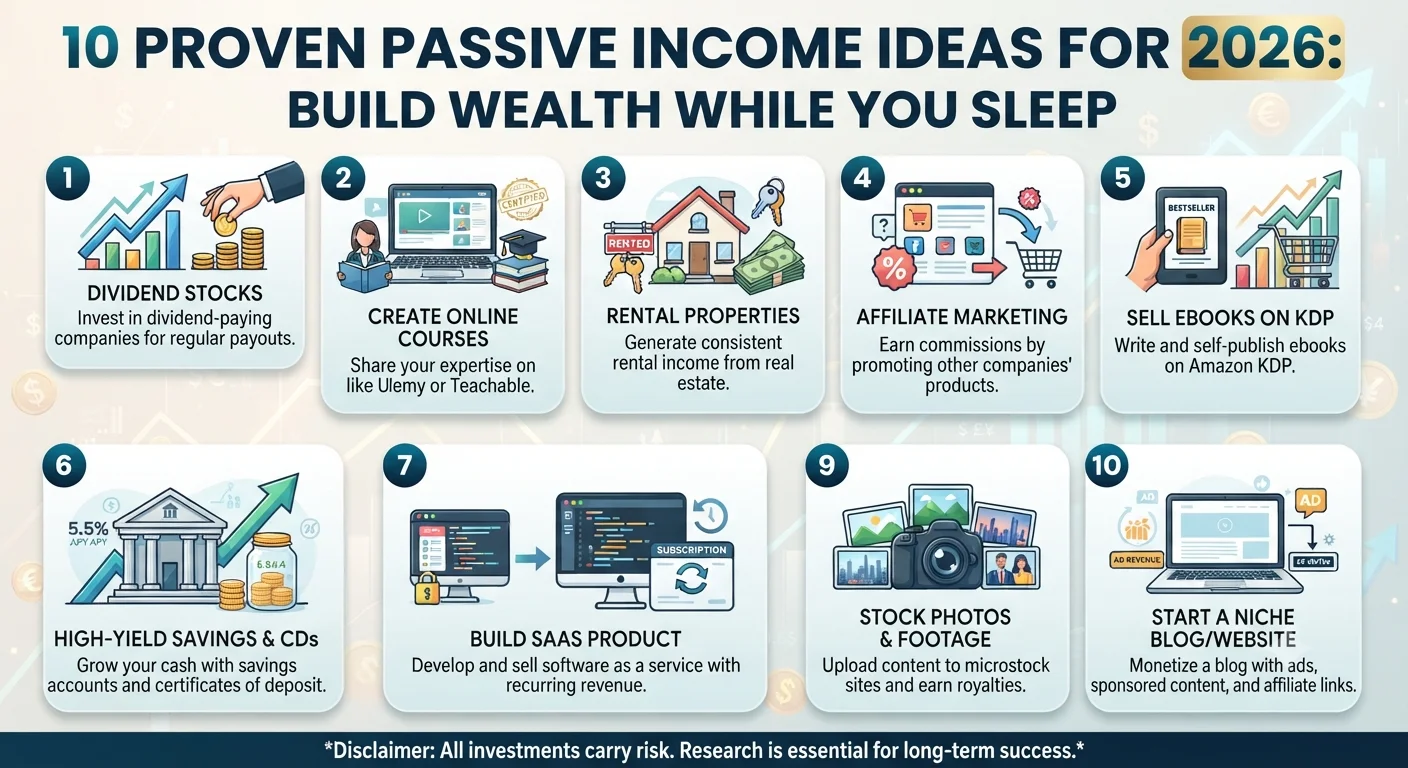
The ten best passive income ideas in 2026 are dividend stock investing, real estate investment trusts (REITs), high-yield savings accounts and certificates of deposit, peer-to-peer lending, index fund investing, creating and selling digital products, affiliate marketing in financial niches, bond and treasury investing, rental property income, and crypto staking. Each requires either upfront capital, time investment, or specific skills to establish, but all have the potential to generate income that continues with minimal ongoing effort once the system is in place.
Introduction
- Quick Answer: What Are the Best Passive Income Ideas in 2026?
- Introduction
- What Is Passive Income and How Is It Different From Active Income?
- 1. Dividend Stock Investing: Getting Paid to Own Companies
- 2. Real Estate Investment Trusts (REITs): Property Income Without Owning Property
- 3. High-Yield Savings Accounts and Certificates of Deposit
- 4. Peer-to-Peer Lending Platforms
- 5. Index Fund Investing: The Set-and-Forget Wealth Builder
- 6. Creating and Selling Digital Products
- 7. Affiliate Marketing in Financial Niches
- 8. Bond and Treasury Investing
- 9. Rental Property Income
- 10. Crypto Staking and Yield Opportunities
- Key Takeaways
- Frequently Asked Questions
The phrase "passive income" has been romanticized to the point of distortion. On social media, it conjures images of people sipping coffee on a beach while bank notifications light up their phone. The reality is more prosaic and also more achievable.
Passive income is not effort-free income. It is income that continues flowing after the initial work of creating or funding the income stream is complete. A landlord who spent years saving for a down payment and then manages a rental property for hours each month is earning passive income relative to an hourly employee but is still actively involved. A dividend investor who spent years systematically buying shares of quality companies receives quarterly payments that require no daily effort to collect. A course creator who spent three months building an online course earns royalties on sales that happen while they sleep.
The meaningful distinction is not between zero effort and some effort. It is between exchanging your time for every dollar you earn, which is the structure of traditional employment, and building systems that generate income independently of your hourly involvement, which is the foundation of long-term financial freedom.
According to research by Thomas Stanley and William Danko, published in "The Millionaire Next Door," most financially independent Americans have built their wealth through business ownership and systematic investment rather than high earned income alone. The data consistently shows that multiple income streams, at least some of which do not require direct daily labor, characterize the financial profile of people who achieve genuine, lasting financial security.
This guide covers ten of the most accessible, evidence-backed passive income strategies available in 2026, with an honest assessment of what each requires to establish and what realistic income expectations look like.
What Is Passive Income and How Is It Different From Active Income?
Active income is compensation received in direct exchange for time and labor: your salary, hourly wages, freelance project fees, and professional fees. Stop working, and active income stops.
Passive income is earnings generated by assets or systems that do not require your direct, proportional time input to produce revenue. The key word is "proportional." Building a passive income stream almost always requires initial effort or capital. The defining characteristic is that once established, income continues independently of whether you work that specific day.
The Internal Revenue Service defines passive income as income from business activities in which you do not materially participate and income from rental activities. More broadly, personal finance educators use the term to describe any income stream where the ongoing earning-to-effort ratio improves over time as the asset or system matures.
The tax treatment of passive income also differs from active income in important ways in most jurisdictions. Qualified dividends and long-term capital gains are taxed at lower rates than ordinary income in the United States. Rental income may benefit from depreciation deductions. Understanding the tax implications of each passive income stream is an important component of evaluating its true net return.
1. Dividend Stock Investing: Getting Paid to Own Companies
Dividend investing is the practice of building a portfolio of stocks in companies that distribute a portion of their profits to shareholders as regular cash payments. Shareholders receive these payments quarterly in most cases, proportional to the number of shares they own, simply by holding the shares in their brokerage account.
The appeal of dividend investing as a passive income strategy is its directness. You buy shares of established, profitable companies once, and those companies send you a portion of their earnings regularly without requiring any additional action from you. Reinvesting those dividends to buy more shares compounds the income over time in what is called a Dividend Reinvestment Plan (DRIP).
The key metrics for evaluating dividend stocks are dividend yield (annual dividend per share divided by current share price, typically ranging from 2 to 6 percent for sustainable dividend payers), the payout ratio (what percentage of earnings are paid as dividends, with ratios below 60 to 70 percent generally considered more sustainable), and dividend growth history.
The Dividend Aristocrats, companies in the S&P 500 that have increased their dividend every year for at least 25 consecutive years, represent the gold standard of dividend reliability. Companies like Johnson and Johnson, Procter and Gamble, Coca-Cola, and Realty Income have demonstrated the financial durability to sustain and grow dividends through multiple recessions, market crashes, and economic cycles.
Realistic income expectation: A portfolio of $100,000 invested in dividend stocks yielding an average of 3.5 percent generates approximately $3,500 per year in dividend income, or roughly $292 per month. Growing this to a meaningful income replacement requires building significant invested capital over time, which is why dividend investing is most powerful when started early and maintained consistently over decades.
2. Real Estate Investment Trusts (REITs): Property Income Without Owning Property
Real Estate Investment Trusts are companies that own and operate income-producing real estate properties: office buildings, apartment complexes, shopping centers, data centers, healthcare facilities, warehouses, and more. They are publicly traded on stock exchanges like any other stock, meaning you can invest in commercial real estate portfolios with the same ease and liquidity as buying a share of Apple.
The most distinctive feature of REITs is their mandatory dividend distribution requirement. Under US law, REITs must distribute at least 90 percent of their taxable income to shareholders annually. This legal requirement makes REITs one of the most reliable sources of dividend income in the equity market, with average dividend yields significantly higher than those of the broader S&P 500.
Because REITs own physical properties, their revenues tend to be inflation-linked to varying degrees, as property values and rental rates typically rise with inflation over long periods. This inflation sensitivity makes REITs a useful portfolio component during periods of elevated inflation.
Investors can access REITs in several ways: individual REIT stocks (allowing selection of specific property sectors), REIT-focused ETFs (providing instant diversification across dozens of REITs in a single purchase), or REIT mutual funds. For passive income investors, a REIT ETF covering multiple property sectors provides diversification against the risk of any single property type or company encountering difficulties.
Realistic income expectation: The average REIT ETF dividend yield in the US market has historically ranged from 3 to 5 percent. A $50,000 allocation to a REIT ETF yielding 4 percent produces approximately $2,000 per year in dividend income.
3. High-Yield Savings Accounts and Certificates of Deposit
High-yield savings accounts (HYSAs) and certificates of deposit (CDs) are among the most accessible and lowest-risk passive income vehicles available. They require no investment expertise, carry FDIC insurance up to $250,000 per depositor per institution in the United States (and equivalent protections in other countries), and produce guaranteed returns within their terms.
In the higher interest rate environment of 2026, the returns available from HYSAs and CDs are meaningfully better than the near-zero rates that characterized the 2010s. Online banks and credit unions, which operate with lower overhead than traditional branch-based banks, typically offer the most competitive rates on these products.
A certificate of deposit locks your money for a specified term (typically three months to five years) in exchange for a fixed interest rate that is guaranteed for the term. The longer the term, generally the higher the rate offered. CD laddering, the practice of distributing funds across multiple CDs with staggered maturities, provides access to competitive rates while maintaining periodic liquidity as individual CDs mature.
Realistic income expectation: This varies significantly with prevailing interest rates. In the current environment, competitive HYSAs and short-term CDs are available at rates meaningful enough to provide genuine income on parked savings. The guaranteed, insured nature of these instruments makes them most appropriate as a home for emergency funds, short-term savings, and the conservative portion of a portfolio rather than as a primary wealth-building vehicle.
4. Peer-to-Peer Lending Platforms
Peer-to-peer (P2P) lending platforms connect individual borrowers with individual lenders, bypassing traditional banking intermediaries. As a lender on a P2P platform, you earn interest income from the loans you fund, with rates typically higher than bank savings products because you are accepting credit risk that a bank would otherwise absorb.
The higher returns reflect the genuine risks involved. Borrower default is the primary risk, and unlike bank deposits, P2P loans are not government-insured. Platforms typically allow diversification across many individual loans to reduce the impact of any single default, and many offer automated portfolio construction tools that distribute your investment across dozens or hundreds of loans based on your chosen risk level.
Realistic income expectation: Returns vary significantly by platform, risk tier, and economic conditions. Higher-risk loan categories offer higher interest rates but experience more defaults. Research platforms operating in your jurisdiction thoroughly, verify their regulatory status, and understand the liquidity constraints (many P2P loans lock your capital for fixed terms) before committing funds.
5. Index Fund Investing: The Set-and-Forget Wealth Builder
Index fund investing, covered in depth in the investment strategies article, represents the most accessible and historically reliable long-term wealth-building passive income strategy. The income generated by index funds comes from two sources: dividends distributed by the underlying companies in the index and capital appreciation of the shares over time.
While not "passive income" in the traditional sense of generating monthly cash deposits, index fund investing is passive in the most meaningful way: once a regular contribution is established and automated, the portfolio grows with zero ongoing decision-making required. For long-term financial goals including retirement, this is often the most appropriate and efficient passive income vehicle available.
The S&P 500 Total Return Index, which includes reinvested dividends, has produced an average annual return of approximately 10.5 percent over the past 50 years according to data maintained by Standard and Poor's. This performance, achieved by simply owning the index at minimal cost, exceeds the results of the majority of actively managed funds over most long-term periods.
Realistic income expectation: A $200 monthly contribution to an S&P 500 index fund for 30 years, assuming an 8 percent average annual return, produces approximately $272,000 in total contributions plus accumulated growth that varies based on market performance. The compounding effect over decades converts relatively modest regular contributions into significant wealth.
6. Creating and Selling Digital Products
Digital products, which include online courses, e-books, templates, software tools, stock photography, music, and educational resources, can generate ongoing passive income because they are created once and sold repeatedly with zero incremental production cost.
The creator economy has grown substantially in the 2020s, with platforms like Udemy, Teachable, Gumroad, and Etsy making it feasible for individuals with specific knowledge or skills to package that knowledge into sellable products accessible to a global audience. A well-constructed online course on a topic with genuine demand can continue generating enrollment revenue for years after its creation with only periodic updates required.
The realistic path to meaningful passive income from digital products requires a combination of genuine expertise in the topic, quality production of the product, and effective marketing to reach a relevant audience. Most successful digital product creators invest significant active effort in content creation and audience building during an initial phase before the passive income component becomes meaningful.
Realistic income expectation: Income varies enormously based on topic, audience size, product quality, and marketing effectiveness. Successful digital product businesses generate everything from a few hundred dollars per month to multi-million dollar annual revenues. Approaching this as a long-term project with realistic growth expectations rather than a quick income solution produces better outcomes.
7. Affiliate Marketing in Financial Niches
Affiliate marketing involves earning commissions by promoting other companies' products and services through unique tracking links. When a reader or viewer uses your link to make a purchase or complete a specific action (signing up for a service, opening an account), you receive a commission from the company whose product was purchased.
Financial niches, including investment platforms, trading education, insurance products, and personal finance tools, are among the highest-commission categories in affiliate marketing. This reflects the high lifetime value of financial services customers to the companies offering those services.
The passive income potential of affiliate marketing lies in content that continues attracting organic search traffic and generating conversions long after it was created. A well-researched article that ranks highly in search results for a relevant query can generate affiliate commissions continuously for years with only periodic maintenance updates.
Building an affiliate marketing income stream requires creating genuinely valuable, trustworthy content that serves the reader's interests rather than purely promoting products for commission. Content that misleads readers or promotes poor-quality products violates both platform terms of service and Google's content quality guidelines, and damages the long-term credibility that makes the income stream sustainable.
Realistic income expectation: Affiliate marketing income varies from zero (for new publishers with no traffic) to tens of thousands of dollars monthly for established publishers with significant organic search presence. Building to meaningful affiliate income typically takes 12 to 36 months of consistent content creation and audience development.
8. Bond and Treasury Investing
Bonds provide passive income through regular interest payments (called coupon payments) made to the bondholder throughout the life of the bond, plus the return of the principal amount at maturity. As discussed in the investment strategies guide, different bond types offer different yields, credit risk levels, and tax treatments.
US Treasury bonds, notes, and bills are backed by the full faith and credit of the US government and are considered the lowest-risk dollar-denominated fixed income instruments available. In 2026, the yield environment for Treasury securities provides meaningful income that was essentially unavailable during the near-zero rate environment of 2012 to 2021.
I-Bonds (Series I Savings Bonds), which adjust their interest rate semi-annually based on inflation, are particularly relevant in periods of elevated inflation because they provide a guaranteed real (inflation-adjusted) return on invested capital, protecting the purchasing power of your savings.
Realistic income expectation: Treasury bond yields vary with the interest rate environment and maturity of the bond. Longer-maturity bonds generally offer higher yields to compensate for locking up capital for a longer period. Bond income is predictable and guaranteed for the bond's life, making bonds particularly valuable for conservative income generation or as a portfolio stabilizer.
9. Rental Property Income
Rental property is one of the most established passive income strategies in history, offering a combination of monthly rental income, long-term property appreciation, and tax advantages through depreciation that makes it financially compelling when approached correctly.
The core mechanism is straightforward: purchase a property, rent it to tenants for an amount that exceeds your mortgage payment, property taxes, insurance, and maintenance costs, and collect the monthly surplus as income while the tenants pay down your mortgage and the property potentially appreciates in value.
The challenges of rental property ownership are equally real: significant upfront capital for the down payment (typically 15 to 25 percent for investment properties in most markets), ongoing management responsibilities, tenant vacancy periods during which costs continue but income does not, and maintenance expenses that can be irregular and substantial. Many rental property investors hire property management companies to handle day-to-day operations, typically at a cost of 8 to 12 percent of monthly rent, which reduces income but increases the passive nature of the investment.
Realistic income expectation: Cash-on-cash return (annual net rental income divided by the total cash invested) for well-selected investment properties in competitively priced markets typically ranges from 5 to 10 percent annually, though this varies significantly by location, property type, financing terms, and local rental market conditions.
10. Crypto Staking and Yield Opportunities
Cryptocurrency staking is the process of locking up cryptocurrency holdings in a proof-of-stake blockchain network to support network validation, in return for rewards paid in the staked cryptocurrency. Networks including Ethereum (following its transition to proof-of-stake in 2022), Cardano, Solana, and dozens of others offer staking rewards.
The annual staking yield varies by network, market conditions, and the total amount staked on the network, generally ranging from 3 to 10 percent or higher in certain cases. However, these yields are paid in the staked cryptocurrency itself, meaning the dollar value of the rewards fluctuates with the cryptocurrency's price.
This introduces a fundamental distinction from traditional passive income instruments: staking rewards in a cryptocurrency that declines 50 percent in dollar value produce a negative real return in dollar terms even if the staking yield percentage appears attractive. Crypto staking is best understood as a supplement to holding cryptocurrency you already intend to hold for the long term, not as a stable-income vehicle comparable to dividends or bond coupons.
Realistic income expectation: Staking yields vary widely and carry the full volatility of the underlying cryptocurrency. Approach crypto staking as a long-term holder's tool rather than a reliable income source, and size any allocation appropriately relative to the speculative risk involved.
Key Takeaways
- Passive income requires either upfront capital (dividends, REITs, bonds, rental property) or upfront time and skill investment (digital products, affiliate marketing) to establish, but generates ongoing income with reduced daily effort once the system is in place.
- Dividend investing in companies with long histories of consistent and growing dividends provides reliable, tax-advantaged income that compounds significantly over time.
- REITs offer exposure to commercial real estate income with stock market liquidity, mandatory high dividend distributions, and inflation-linked revenue characteristics.
- Index fund investing is the most accessible, lowest-cost, and historically most reliable long-term wealth-building passive income strategy for most individuals, even though it does not generate regular cash income in the way dividends or rental payments do.
- Rental property offers compelling combinations of income, appreciation, and tax advantages but requires significant capital, management involvement, and tolerance for illiquidity.
- Diversifying across multiple passive income streams provides both higher total income potential and resilience against the disruption of any single stream.
Frequently Asked Questions
How much money do I need to start earning passive income? The required starting capital varies enormously by strategy. High-yield savings accounts and I-Bonds accept any amount. Stock market dividend investing can begin with as little as $100 using fractional shares. Rental property typically requires tens of thousands of dollars for a down payment. Digital products can be created with minimal financial investment if you already possess the relevant knowledge. The most accessible starting point for most people is automating a monthly investment into a dividend index fund or high-yield savings account while simultaneously building the knowledge base needed for more complex strategies.
Is passive income taxable? Yes, in virtually all jurisdictions. The specific tax treatment depends on the income type and your country's tax laws. In the United States, qualified dividends and long-term capital gains are taxed at preferential rates compared to ordinary income. Rental income is subject to ordinary income tax rates but may benefit from depreciation deductions. Interest income from bonds and savings accounts is taxed as ordinary income. Cryptocurrency staking rewards are generally treated as ordinary income when received in most jurisdictions. Consult a qualified tax professional to understand the specific implications for your situation.
How long does it take to build meaningful passive income? Building passive income that meaningfully supplements or replaces earned income requires sustained effort over years, not months. The timeline depends heavily on your starting capital, savings rate, and the strategies employed. Someone who consistently invests $500 per month in dividend stocks over 20 years builds a portfolio generating thousands of dollars in annual dividend income. Someone who creates a successful online course over six months may begin generating meaningful passive income within a year. Setting realistic multi-year expectations prevents disappointment and abandonment of strategies that simply need more time to mature.
What is the difference between passive income and residual income? The terms are often used interchangeably. Residual income, sometimes called royalty income, specifically refers to earnings that continue from a single original effort, such as book royalties, music licensing fees, or patent royalties. Passive income is broader and includes residual income but also encompasses investment income and rental income that do not originate from a creative work. In everyday usage, the distinction is not critical, and both terms describe income that continues without proportional ongoing effort.
RISK DISCLAIMER: All passive income strategies involve risk, including the possible loss of principal. Returns are not guaranteed. This article is for educational purposes only and does not constitute financial advice. Consult a qualified financial professional before implementing any income strategy.